
On the eve of his visit to Brussels, Kosovo’s Prime Minister, Ramush Haradinaj, does not hide that he is in a kind of confrontation with the European Union (EU). In an interview with Ekonomia Online, Haradinaj says that during his visit in November to the EU’s “capital,” as well as in the meetings he will have tomorrow, he is asking that Kosovo […]
Haradinaj “conditions” continuation of dialogue, seeks date for opening chapters

On the eve of his visit to Brussels, Kosovo’s Prime Minister, Ramush Haradinaj, does not hide that he is in a kind of confrontation with the European Union (EU).
In an interview with Ekonomia Online, Haradinaj says that during his visit in November to the EU’s “capital,” as well as in the meetings he will have tomorrow, he is asking that Kosovo be treated as a state and an equal party in discussions.
The head of government stresses that in Brussels, when Kosovo is discussed, much of it is linked to the dialogue with Serbia. This issue, he says, is important, but he notes that while Serbia has advanced with opening chapters for EU integration, Kosovo has been left only with the Stabilisation and Association Agreement.
“We are asking that a time frame be set for Kosovo, so that it is given the opportunity to open chapters for EU integration, as happens with Serbia. Serbia is more advanced with chapters, but we should also start with the first one,” Prime Minister Haradinaj said.
“We are only at the SAA stage. We are seeking candidate status for next year and the start of opening chapters. This request in itself also accelerates visa liberalisation because it comes first.”
“I believe that we are currently not in a favourable situation. So there is a lot of work to be done for Kosovo’s agenda to truly be confirmed,” Haradinaj acknowledges.
In this interview with EO, the head of government also speaks about his major promise that he would resolve the demarcation issue within the first three months and that Kosovars would be able to travel without visas. He says he has “revived” the demarcation issue and that it is now in the hands of MPs to vote on the agreement or not.
“Demarcation is an added criterion… For two and a half years the demarcation issue lay dormant; no one dealt with it. Now it is in its final phase and will soon reach an outcome.”
But he does not want to give a date for when Kosovars are expected to be able to travel without visas. “I am in a kind of confrontation with the EU. Kosovo was at a disadvantage in the past… I think that talking about a date could also irritate others, but we are working to ensure that the date is not far off… Good news for visa liberalisation is that there have been no emigrants leaving Kosovo, and internal consolidation and democracy are functioning; in parliament too, even though there is no momentum, it is nevertheless functioning momentum. So I think we are not far off,” he says.
Speaking about the first 100 days of his government, Haradinaj says that the only point of criticism is the large number of deputy ministers. He says the opposition is unable to keep up with the government’s pace.
Haradinaj does not support ideas that the establishment of the Association be made conditional on Serb MPs’ vote for the Kosovo army. He said that when they reached a coalition agreement with the Serb List, they did not discuss establishing the Kosovo Army or the Association of Serb Municipalities.
FULL INTERVIEW:
 EO: The first 100 days of the Haradinaj Government are approaching. Usually, after 100 days an assessment is made, and criticism begins from the opposition, the media, civil society… How would you yourself assess these three months? Are you satisfied with the work done, have you encountered unexpected challenges or problems?
Haradinaj: We have prepared a report on the first 100 days. Next week, around the middle of the week, I will respectfully submit it to the president, the speaker of parliament, MPs, citizens, and the media. This has not been an easy time or an easy period; I believe it has been very difficult, because we are still facing major challenges as a country and governance needs to have the capacity to implement. Implementation is not at a sufficient level in Kosovo, but I think that through these working days we have managed to put this government into operation, to make governance happen. There are many issues, and most of them are difficult.
EO: You were prime minister for about 100 days in 2005 as well, when you resigned to respond to and clarify the accusations from the Hague Tribunal. You have often repeated that you would return to continue the work where you left off. That 100-day period was considered very successful, even by your “opponents.” In contrast to then, the opposition is now very harsh; a lack of constructiveness is evident in parliament—for example, the opposition does not vote, not even against, on an important bill such as the budget. Why has Kosovo’s politics reached this point, why is this antagonism so pronounced?
Haradinaj: We are now almost 10 years past independence, and no one has any patience left to wait for success; I feel that pressure, because success is being demanded immediately. To tell you the truth, these 100 days have been successful and productive. So, apart from the large number of deputy ministers, which is open to criticism, but which does not harm the public if they are committed and carry out many duties because there is a lot of work in the country; then I can say this is a period of work. I call it that because a lot of work has been done in the country. It is difficult for the opposition to face a government like this; in other words, they have more difficulty understanding what is happening, because I think that in the past the dynamics were different, decision-making was not like it is today, and as a result it is very difficult for them to keep up with the government’s work.
EO: One of your major promises as the PAN candidate for prime minister was that you would resolve the demarcation issue within the first three months and that Kosovars would be able to travel without visas. The government has already sent the (old) demarcation agreement to the Assembly, but the AAK itself says it will not vote for it. Why did you send it to parliament, then? To pave the way for negotiating a new agreement? Can you promise Kosovars, or give an approximate date for when they will be able to travel freely?
Haradinaj: Kosovo has suffered some losses, as I would call them, both domestically and in the period before I took over the government; but also regionally, and globally and nationally. So some losses were caused by the past. Repairing these losses, restoring a stable situation and returning Kosovo to its domestic, regional and international standing was not an easy battle. It mainly depends on the way we govern, on the substance of what we do. The main condition is the fight against corruption; the rule of law and Kosovo must be capable. What I have done all these days is strengthen the law-and-order mechanisms, supporting this with a budget, more personnel and greater operational capacity, so that Kosovo can become and remain a state governed by the rule of law.
Demarcation is an added criterion; it is not a standard criterion, but it too requires us to make progress. I have done that; I have moved the demarcation issue forward, since it was a dormant topic in the past. For two and a half years the demarcation issue lay dormant; no one dealt with it. Now it is in its final phase and will soon reach an outcome.
The government submitted the old agreement to parliament, but it also submitted the report of the new state commission. It is now up to MPs to decide; it would be good to decide as soon as possible. In other words, not to leave this issue waiting indefinitely.
EO: Can we say that this agreement was sent to the assembly to pave the way for negotiating a new agreement?
Haradinaj: Now I hear different opinions, including from respected people. Look, we are all seeking a solution; no one is not seeking a solution, but I cannot depart from the substance. And the substance says that mistakes were made in the past. The new report says that mistakes were made in the past, so MPs must have their say, and that is what I have done.
EO: Can you promise Kosovars, or give an approximate date for when they will be able to travel freely?
Haradinaj: I am in a kind of confrontation with the EU. Kosovo was at a disadvantage in the past in these relations. But I think we have returned to the table seriously with the EU. I think talking about a date could also irritate others, but we are working to ensure that the date is not far off. I am saying that I do not think it is a long-term issue, but it is not an easy process. We have the five (European countries) that do not recognise us. As you know, there are difficulties in this regard; the EU itself is quite heterogeneous. But we are working. Good news for visa liberalisation is that there have been no emigrants leaving Kosovo. And internal consolidation and democracy are functioning, including in parliament, even though there is no momentum; nevertheless, it is functioning momentum. So I think we are not far off.
EO: The agreement for the “New Kosovo” power plant will be signed on Wednesday. Will the entire agreement and its financial cost be made public? How would you respond to criticism (e.g. from KOSID) that Kosovo is entering into contractual obligations to repay investments to a private operator? Can you guarantee that electricity prices will not rise?
Haradinaj: We are pleased to make the agreement public. Let me tell you two or three things: this is foreign money; Kosovo is not investing a single cent. Bear in mind that this is entirely a foreign investment, the first of its kind in Kosovo. It is around 1 billion 300 million, a foreign investment, and at the same time it uses the newest, most advanced technology. The maximum cleanliness coefficient is 42, while ours is 40, so it does not go any higher. We are using the most advanced technology. This completely changes the situation for Kosovo and for investors. When the company lists this contract on the London Stock Exchange’s premium market, then Kosovo’s whole image among the most credible investors—I mean the most serious ones in the world—will change. And this is a good sign for Kosovo. The rate of return on equity for one part of the investment is not 20. Mr (Visar) Ymeri did not have the latest information that day in the Assembly; it is 18.5 percent.
An increase in electricity prices is inevitable; it is a matter of market prices, not only in Kosovo but around the world. But this contract does not affect the price increase. When we produce using outdated capacity, as we do today, and cannot meet our needs, we buy electricity at over 100 euros per megawatt, whereas under the new contract the price is around 70 euros per megawatt. So it is not as has been claimed.
The energy market regulator had already anticipated an increase before the investment took place. They did not know that the agreement would be reached. In fact, I have completed a task that has been on Kosovo’s tables for years, for 15 years. We have completed a task that brings the return on equity down from 24 percent to 18.5 percent. And I have given Kosovo a completely new and different situation. And I am not the only one who is proud of this; generations have worked on it. And thank goodness we have coal, because it would not have happened without coal.
But it is very important that we have secured an investment of this kind, because investment in coal, in coal-fired energy, is no longer being made.
EO: When will the Association of Serb Municipalities be established?
Haradinaj: Kosovo has established priorities; that means we are focused on law and order. We need to give the rule of law much greater priority; we have sensitive issues such as healthcare and education. So we have not achieved enough, nor devoted enough attention to healthcare, because energy and other issues took up a lot of our time. We are working hard for producers, to give them room to operate and free them from burdens and taxes…
The establishment of the Association of Serb Municipalities in Kosovo stems from the agreement as an obligation. Kosovo has always been ready to establish such an association, since it has a constitutional basis. But you know the decision of the Constitutional Court, which rejected an association in accordance with the agreements, and now it has been left to what the country’s Constitution provides for.
EO: There have been some suggestions that the establishment of the Association be made conditional on Serb MPs’ vote for the Kosovo army. What is the Serb List’s position on transforming the KSF? Did you discuss this important issue when you formed the coalition?
Haradinaj: The Association of Municipalities and the Army do not feature in the coalition issues; they are not part of our discussions. We have not linked these issues; it is only about taking on responsibilities in government. What I am doing carefully is ensuring Kosovo’s Serbs, especially those in the north, that they are in Kosovo and that Kosovo is their country, and that they do not need to wait for Belgrade to take care of them; they can take care of themselves in Kosovo and take care of Kosovo, because it is their country. I do not know what their position will be on the vote for the army. We do not have a definitive answer, but we are truly working intensively to make Kosovo the homeland of everyone, so that the army, too, belongs to everyone, not just Albanians.
You know there are around 200 members from the communities, including Serbs. You know that there have been no interethnic incidents or any bad news from the KSF in a decade; and it has received the highest assessments from international mechanisms, such as NATO’s mission and KFOR. We expect the KSF to receive its constitutional mandate from Parliament, and we expect to become NATO members. So we see the formation of the army not only as an army for Kosovo, but also as a criterion for NATO membership.
EO: There have been warnings, including from President Thaçi, that the army could also be established through a law, if not through constitutional amendments. Why did it stall; was it not supported by the international community?
Haradinaj: I think the international community is very interested in the Kosovo army. They want it to be established with as much internal harmony as possible and beyond; because, as I said earlier, we are not only talking about creating an army, but also about gaining another criterion to accelerate the process of joining NATO.
EO: In the coming days you will go to Brussels again. Can you tell us more about the agenda and meetings? What are Kosovo’s relations with Brussels like? Is Kosovo being treated as a state by the EU?
Haradinaj: I have had a very difficult time dealing with EU institutions, because I have asked that Kosovo have the position it is entitled to; in other words, that we be a party in discussions, a party with the EU on integration. We are only at the SAA stage. We are seeking candidate status for next year and the start of opening chapters. This request in itself also accelerates visa liberalisation because it comes first. I believe that we are currently not in a favourable situation. So there is a lot of work to be done for Kosovo’s agenda to truly be confirmed.
Much of it is linked to the dialogue, which is important. But we are asking that a time frame be set for Kosovo, so that it is given the opportunity to open chapters for EU integration, as happens with Serbia. Serbia is more advanced with chapters, but we should also start with the first one.
EO: You have allocated a fund of 290 thousand euros for the families of people involved in the Kumanovo case. During the visit of your counterpart, Zoran Zaev, did you discuss this issue?
Haradinaj: I warmly welcomed the visit to Kosovo by the Prime Minister of the Republic of Macedonia, Mr Zaev. It was also the first visit by a prime minister, something that had never happened before. This is part of the history of both countries; I am very pleased with the visit, the positions and the discussions we had.
EO: You set a 10-day deadline for the residents of Hade and Shipitullë. Has your “ultimatum” worked?
Haradinaj: This is the final deadline. We have already gone through several previous stages; we have taken all the necessary steps to ensure that the residents’ relocation is carried out on terms that are respectful and dignified, and with compassion, because they are our people. But, of course, a number of individuals or certain elements cannot keep Kosovo hostage indefinitely. The deadline is final; after this deadline, there is only the legal basis that halves the compensation for residents, and the enforcement of the law. As in every other case, the law will be enforced here.
Interviewed by: Kaltrina Zymberi
Camera: Hydë Kelmendi/ Egzon Marku
Related
Policy
The Alliance convenes its Presidium, with organizational issues and political developments in focus
Policy
Foreign Ministry Signs $50,000-a-Month Contract for Lobbying in the U.S.
Policy
President Shiroka Pula receives Slovenian ambassador; bilateral cooperation and Euro-Atlantic integration in focus
Policy
Çitaku: PDK will enter a regular election cycle to elect a new leader
Policy
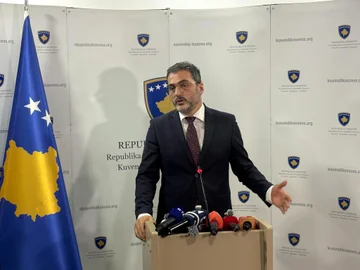
Gola on Thaçi’s sentence: We express regret
Policy
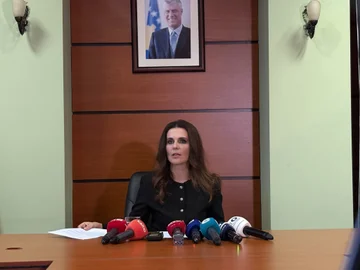
Çitaku after Thaçi’s sentence: A shameful and unacceptable decision
Policy
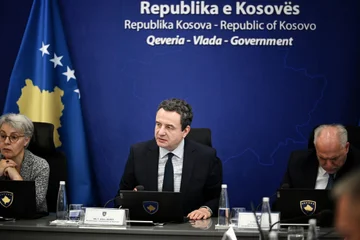
Government after Thaçi’s sentence: Our reservations about the Specialist Chambers’ ability to ensure a fair trial remain steadfast
Policy
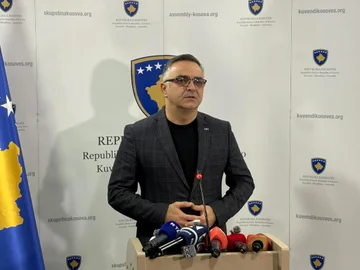
Tahiri insists that Thursday’s session be held and the president’s decree on the Law on the Specialist Chambers be returned to the Assembly
Policy
Presidium meeting fails
Policy
“The whole people should rise to their feet,” an outraged citizen after Thaçi’s sentencing
Policy
Shiroka Pula meets Japanese ambassador, discusses deepening cooperation between the two countries
Policy
Serbian nationalist song, Gërvalla at meeting with the EU: Kosovo’s independence cannot be denied





