
Kosovo Prime Minister Ramush Haradinaj told Voice of America in an interview that he would act quickly to resolve the issue of the agreement on marking the border with Montenegro, one of the longstanding challenges his government will face. A day after parliament voted to elect […]
Haradinaj pledges to correct the demarcation agreement

Kosovo Prime Minister Ramush Haradinaj told Voice of America in an interview that he would act quickly to resolve the issue of the agreement on marking the border with Montenegro, one of the longstanding challenges his government will face.
A day after parliament voted to elect him prime minister, Haradinaj said there was no alternative to talks with Serbia, but that they should be preceded by an internal dialogue in Kosovo.
• Yesterday you took over the leadership of Kosovo’s new government, which is made up of several parties. How do you expect it to function?
Haradinaj: The Government of Kosovo, which I have been entrusted to lead, is supported by several political parties, many of them, and by the communities as well. But they are all people of this land, of this country, and aware of the mission before us, which means restoring trust in institutions. We inherit a very difficult situation in the country, with corruption that is endemic at every level of society, with several challenges in law and order and new risks—now terrorism, which we must be vigilant about—and a difficult economic situation. We face many challenges both regionally and internationally in terms of Kosovo’s international prospects, but we are aware of what lies ahead for us at home.
• Your government was elected with 61 votes, while on the other hand you will face opposition from two large parties that have 58 MPs. How will you manage with such an opposition?
Haradinaj: The opposition is an asset to society, particularly to countries in transition. Such a situation of confrontation will be an asset to the government; it will help ensure that the government is continually challenged by opposing views. I call on the opposition to be uncompromising in its role as the opposition, and at the same time I call on the media and civil society to hold us accountable for our responsibilities or to keep reflecting their views. We welcome the fact that we have a strong opposition, and that is to our benefit and to Kosovo’s.
• Opposition parties say your government will not last more than six months. What is your response?
Haradinaj: Look, what matters is that, whether we work for an hour, a day, a month or six months, we serve the country. That is the main thing, not how long a government lasts, but whether it serves the citizens and the country. I believe we will serve a full term, and we will work during that full term to ensure that what is expected of us—and of me in this case—really happens in Kosovo. I know expectations are high and I am aware of that, but I will also be serious in my work.
• At the same time, opposition parties have accused you of submitting to Belgrade’s influence by forming post-election coalitions that include the Serb List. Given the number of votes in parliament, what influence can the Serb List political entity actually have?
Haradinaj: I believe you were at yesterday’s session. The elected cabinet took an oath to work in accordance with the country’s Constitution and the laws in force in Kosovo. That is the answer to these views. At the same time, we should seize every opportunity to build trust with Kosovo Serbs. Fortunately, we have built good relations with the other communities, but we must do so with Serbs as well—not only those in the south, but also those in the north. Albanians are an ancient people, among the oldest in the Balkans, indigenous, and they have always honored others and respected their national, religious, linguistic or other identities. Albanians know how to do this, and I know how to do it for Kosovo Serbs, too. We need this mutual trust, and we will work to build it.
• You now have to deal with some of the challenges left over from the previous government, such as the border issue with Montenegro, which is also holding up visa liberalization. How will you approach this problem now as prime minister, given that you strongly opposed it while in opposition?
Haradinaj: My political principles do not change depending on whether I am in opposition or in government. I defend what I believe and speak out about what I believe. The current version of the agreement is wrong. The Kosovo-Montenegro border is at Çakorr and Kulla and along the high peaks, so we will correct this. It is a great fortune that Montenegro is a neighboring country. We have welcomed Montenegro’s progress, particularly its membership in NATO, which we also aspire to join, and I do not see major difficulties with this issue. I believe we will find a quick way out of the current situation, but I will not specify now what steps we will take. We will find a quick way out of this situation and will not delay visa liberalization.
• But Montenegro has already ratified the border agreement with Kosovo. Can such an agreement be undone?
Haradinaj: An agreement is concluded when two parliaments ratify it, not just one, because it is an international agreement. As such, it can also be returned to square one if the other party does not ratify it.
• A hypothetical question: if, after every verification of the border agreement with Montenegro, it turns out to be different from what you have asserted, what will you do?
Haradinaj: Excuse me. I will verify it myself now; someone else does not have to tell us how to verify it. Some mistakes were made in the past, and things will not continue this way.
• Speaking of the work of the State Commission that drew up the border agreement with Montenegro, will you reject that agreement?
Haradinaj: The agreement, in my view, has errors. I believe we will identify these errors, and we will certainly have new expertise—other experts than those who worked on it in the past, such as (Murat) Meha and others—and they will find the truth. The agreement has errors. I did not want to specify the methodology because it is too early to announce that, but there are two options: identifying these errors and negotiating with Montenegro to reach agreement on correcting them, so that we can approve it both here in Kosovo and in Montenegro; or sending this agreement to parliament for a vote, while telling parliament that we know it has errors and should reject it. There is no other way; these situations cannot last forever. I will act and will not leave this without a resolution.
• One issue that has already begun to change in form is the dialogue on normalizing relations with Serbia. How do you view these talks?
Haradinaj: It is important, first of all, that we engage in dialogue with all our neighbors. Kosovo is open and responsible about its role and responsibilities in the region, because a peaceful and stable region is in our interest too. Stability is not only for others; it is especially for us, because we are a young state, just starting out, and we have an interest in stability, good relations and mutual trust with everyone around us. Of course, there is no alternative to dialogue, including with Serbia. Although we have a tragic history, we cannot undo the fact that we are neighbors and will remain so. For this reason, we need to bring the dialogue back to the people and have dialogue between peoples, not only between political elites. The achievements of the dialogue must come from the people so that they can be implemented. We first need an internal discussion in Kosovo about the dialogue, with civil society, the media, the opposition and everyone else, so that when our leaders, the representatives of Kosovo, represent Kosovo, we do not end up in a situation where implementation is impossible. That is what happened in the past, and we will be much more careful with our steps, including what I call our achievements in the dialogue. Of course, Kosovo aspires—and not only aspires, but also has as its goal, with no alternative—membership in the United Nations, NATO and the European Union. What concerns me is the excessive length of our path toward the European Union, a very distant prospect for EU membership that loses its meaning. I have insisted, and continue to insist today, that the Stabilisation and Association Agreement, our contract with the European Union, be implemented and that we move forward to candidate status. Kosovo cannot be left in its current state, still without recognition by the five EU countries, without visa liberalization and without a clearer prospect of what will happen and what steps Kosovo must take to join the European Union. We must seek a concrete situation in this regard.
• How long will it take Kosovo to obtain candidate status in the European Union?
Haradinaj: I do not think it will take a long time. I will not specify exactly, because mutual relations are also involved, but we will do our part. Kosovo does not go to the European Union; the EU is built here. We will work on our homework, but we also expect a response from Brussels.
• Do you mean within this term?
Haradinaj: I believe so.
• In your view, what are the greatest security risks facing Kosovo, and what will you do to address them?
Haradinaj: The entire security framework is new in Kosovo. The framework of every institution in security, law and order is new, but there is a strong desire and will to be champions of security and prove ourselves. So I do not see risks that will defeat us, but I see a lot of work ahead to overcome the shortcomings and challenges before us. The fact that we are young as institutions is an advantage, because we are not inheriting the shortcomings of past eras, but are focused. I see Kosovo as capable of ensuring its own security and being a factor for stability, helping to ensure security in the region. There are many risks, both old and new. Terrorism, or religious extremism, is now emerging, but we are aware of this and ready to face it.
• What economic reforms will you introduce to reduce unemployment in the country?
Haradinaj: I believe there are ways to create jobs. Statistics show that there are between 60,000 and 80,000 active small and medium-sized businesses in Kosovo; I am not talking about the large ones. Imagine an approach, a partnership between the government and these small and medium-sized businesses, and perhaps their willingness to expand as a result of that partnership. If each hired just one person, that would mean 60,000 jobs. There are tens of thousands of farmers in Kosovo—over 100,000 are estimated, and there are statistics on this—people who own land and engage in agriculture. A partnership with them could also result in each hiring one person, even seasonally, for a certain period. I see us starting with those already operating in the economy, who can expand, but we will also encourage those willing to start up—new entrepreneurs—with special attention to women, because it is harder for them to get started due to the circumstances. We will take a realistic approach and need to take an accurate snapshot of the situation in each sector separately, so that we can make a sound start. No one climbs the stairs starting from the third step, but starts with the first. We will make sure to be realistic and not indulge in fantasy; we will start climbing the stairs from the beginning, from what is before us, so that Kosovo can move forward and growth can begin.
• This is the second time you have become prime minister of Kosovo since 2004. In your view, what is different from that time?
Haradinaj: Back then, everything was clearly focused on independence from the United Nations, since we were under UN administration, and on transferring responsibility from them to local authorities. Now it is time to prove that we can handle the responsibilities ourselves, as a state, as an independent country, which we have rightfully become. I said it yesterday and I will say it again: with the birth of our freedom, a friendship was born too—a unique friendship, I believe, between peoples around the world, between Kosovo and America. I also want to strengthen this friendship. We are now in a completely different situation; we must prove who we are and honor ourselves before the citizens of our country and before the friends who care about us.
Related
Policy
The Alliance convenes its Presidium, with organizational issues and political developments in focus
Policy
Foreign Ministry Signs $50,000-a-Month Contract for Lobbying in the U.S.
Policy
President Shiroka Pula receives Slovenian ambassador; bilateral cooperation and Euro-Atlantic integration in focus
Policy
Çitaku: PDK will enter a regular election cycle to elect a new leader
Policy
Gola on Thaçi’s sentence: We express regret
Policy
Çitaku after Thaçi’s sentence: A shameful and unacceptable decision
Policy
Government after Thaçi’s sentence: Our reservations about the Specialist Chambers’ ability to ensure a fair trial remain steadfast
Policy
Tahiri insists that Thursday’s session be held and the president’s decree on the Law on the Specialist Chambers be returned to the Assembly
Policy
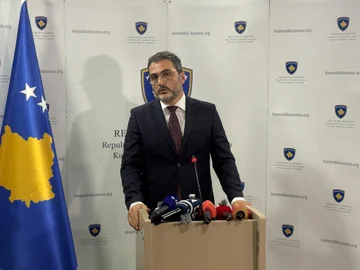
Presidium meeting fails
Policy
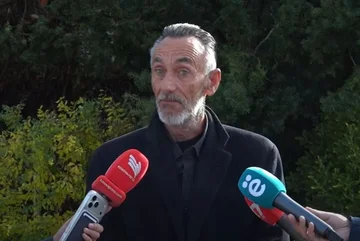
“The whole people should rise to their feet,” an outraged citizen after Thaçi’s sentencing
Policy
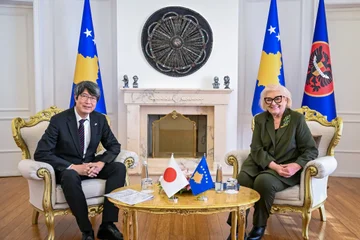
Shiroka Pula meets Japanese ambassador, discusses deepening cooperation between the two countries
Policy
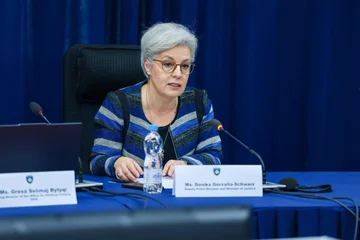
Serbian nationalist song, Gërvalla at meeting with the EU: Kosovo’s independence cannot be denied





