
Kosovo’s former president, Fatmir Sejdiu, says Kosovo’s Constitution does not allow President Hashim Thaçi to discuss topics he is not mandated to discuss during the dialogue process with Serbia. In an interview with Kallxo.com, speaking about the idea of “border correction,” Sejdiu said that opening such topics […]
Sejdiu: The President has no mandate to discuss border correction
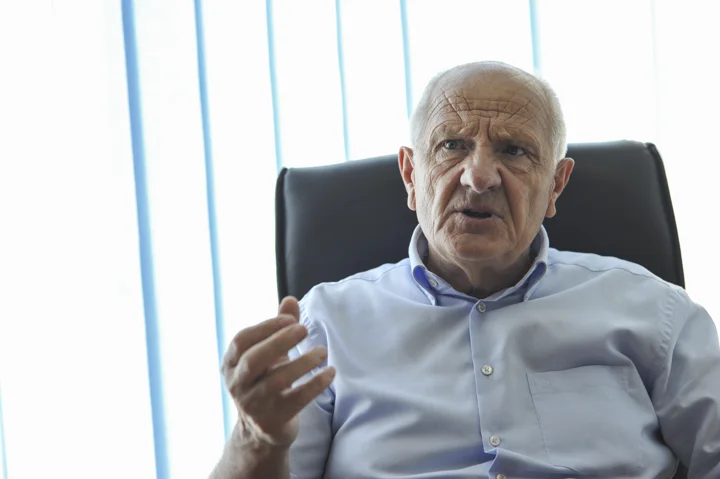
Kosovo’s former president, Fatmir Sejdiu, says Kosovo’s Constitution does not allow President Hashim Thaçi to discuss topics he is not mandated to discuss during the dialogue process with Serbia.
In an interview with Kallxo.com, speaking about the idea of “border correction,” Sejdiu said that opening such topics could provoke further reactions and open up other issues in the region.
In this interview, Sejdiu talks about how he views LDK’s opposition work, how he sees himself in LDK, and what recent developments surrounding the resignation of the prosecutor investigating inflated lists of war veterans could bring.
Kallxo.com: More than a decade after Kosovo declared independence, within a framework accepted by the overwhelming majority of the international community, Kosovo’s borders are once again being discussed. But unlike previous times, when Kosovo reacted to these ideas, there is now proactivity in Kosovo toward the idea of changing the borders. How have you viewed these developments?
Fatmir Sejdiu: I never thought, never, that there would be topics discussed with such intensity. We are in this phase, which has in fact raised many doubts and concerns among the country’s citizens. These concerns are also evident among international institutions and important countries, especially those that have been great supporters of Kosovo in its processes of freedom and independence, as well as in its construction and development during the period we have traversed so far.
It must be emphasized that all issues surrounding Kosovo’s political status were settled with Kosovo’s declaration of independence on February 17, 2008, following an internationally led and supervised process of negotiations by the UN Special Envoy.
With this Decision by its elected representatives, Kosovo was declared a sovereign and independent state that day, with its territorial integrity inviolable. On the basis of this Decision, all international recognitions of Kosovo followed. This Decision was further strengthened by the International Court of Justice’s ruling, which found that Kosovo’s declaration of independence was in accordance with international law. As such, Kosovo has been recognized by the majority of UN member states.
From that historic moment (February 17, 2008), as President of the country at the time and leader of the negotiations until the declaration of independence, I have always firmly considered (as I do today) that issues relating to political status, sovereignty and territorial integrity (which also means the country’s borders) are settled. It must be emphasized that even in the international negotiations preceding Kosovo’s internationally coordinated declaration of independence, the issue of Kosovo’s borders was never raised or discussed, because Kosovo’s existing borders were considered lawful.
Therefore, the topic opened by President Thaçi of “border correction,” as he calls it, which we have seen presented in meetings with Vučić, appears to run counter to the construct of Kosovo’s territorial integrity, confirmed by the act of declaring independence and enshrined and protected by its Constitution. Moreover, so far no institution has given a concrete answer as to what these actions “to correct the borders” actually mean.
The country’s Constitution does not allow for such possibilities as are being debated without a specific mandate. Its provisions clearly define the mandate of each institution, in this case also that of the President of the country, and, of course, that of the Assembly, which may grant specific authorizations to address various topics, as has been done in earlier phases.
Kallxo.com: There have been all kinds of reactions to this idea. How have you viewed these reactions?
Fatmir Sejdiu: There have been many reactions, mostly measured ones from the international side. Although there may have been different interpretations of some statement encouraging the parties to reach an agreement, I believe the international community’s primary interest is to preserve peace and stability in the region, avoiding the opening of issues that would threaten them.
Opening such topics would open up many other things as well. We always say that Kosovo is not the fundamental hub for overall regional developments and beyond, yet Kosovo is one of the most sensitive points in this area, because, whether we like it or not, it is an important geostrategic crossroads for both the East and the West.
Therefore, among other things, the international investment made to create a framework, a format for the stability of a sovereign country, must not be put at risk.
As for the positions and reactions of the international community, I want to reiterate that, as President of the country, I received international recognitions from the United States, Germany, the United Kingdom, France, Italy and other countries, and each of them states in its recognition that it recognizes the state of Kosovo as a sovereign state within its borders.
KALLXO.com: In recent days, a 1994 statement by President Ibrahim Rugova about an idea of exchanging territories between Kosovo and Serbia has been taken out of the archives. You were President Rugova’s associate at the time; do you remember that statement, and what was Rugova’s own position on this issue?
Fatmir Sejdiu: I do not remember a statement by President Rugova of that kind. President Rugova never took an approach of exchanging territories, because of Kosovo’s strategic interests. I know President Rugova’s position always: a principled and consistent position, formed from his earliest statements, even before he became LDK chairman and President of Kosovo, elected in May 1992. I also saw the reactions of journalists who spoke with him and who mention the denial of that statement. I do not want to comment on this, but I know President Rugova’s essential position on an independent and sovereign Kosovo, a vision that has been developed and realized. We valued his earlier formula of “an independent, neutral Kosovo, open to Albania and Serbia,” which means a modern Kosovo, free for its citizens. These principles are also embodied in the current Constitution of the Republic of Kosovo.
Kallxo.com: How should President Trump’s adviser, Mr. John Bolton’s statement be read?
Fatmir Sejdiu: I think it may be a statement that, in a way, encourages the parties to see what they will do, but it is difficult—absolutely impossible—given Serbia’s continued approach to Kosovo’s independence and the freedom of Albanians. We know Serbia’s role. It has continually dragged out various negotiation processes, including the latest one at the level of the dialogue mediated in Brussels, about which I had reservations—and still do—regarding how it was initiated, the topics raised and how they were handled, and the level at which this dialogue was conducted.
I think that regardless of interpretations of statements by various officials, which can sometimes create immediate concerns, the main countries supporting Kosovo’s independence have not changed their fundamental policies toward Kosovo and their support for it.
Kallxo.com: How should the dialogue have been conducted?
Fatmir Sejdiu: It should have been conducted at an exceptionally well-defined level, in terms of aligning it with the topics. The idea was that this would be a dialogue to ease relations between the two sovereign states, reduce tensions, and address technical issues relating to the free movement of citizens, the prevention of organized crime, recognition of diplomas and similar topics—not as happened, with the topics changing at this level and the dialogue gradually being elevated. It started as a dialogue at the technical level between officials and gradually moved up to the level of prime ministers and presidents of the countries, raising topics that Serbia actually wanted to discuss, seeking to compromise all the results of earlier processes that culminated in Kosovo’s independence.
This approach has had a negative impact on our country’s progress, because Kosovo has thus entered a situation of constant pressure, such as the issue of hesitancy about integrating the Serb minority community in the north, and it has also negatively affected the increase in recognitions of Kosovo and its membership in international organizations. And finally, something very important: it has given Russia an opportunity to become involved in the processes of Southeastern Europe. Russia now presents itself as persistently interested, with great determination, in countries where it has influence, in weakening support for Kosovo, as well as with a new tendency to advance its role in this part of Europe. We should bear in mind Russia’s concentration at the base in Niš, a city around 100 kilometers from Pristina …
Kosovo belongs to the West and lies on one of its most important geostrategic fault lines. That is why strategic investments have been made by the Western world and NATO. All this is regarded by the people of Kosovo as their protection, as well as a guarantee of lasting peace and stability in the region.
Kallxo.com: You led the Vienna negotiations on Kosovo’s status in 2006–2007. Did any party in those negotiations ever claim that the borders between Kosovo and Serbia should be discussed?
Fatmir Sejdiu: As I said earlier, the issue of the borders was never raised. Never. In fact, the issue of the borders was never raised even by the Serbian side itself, represented at the highest levels of state.
The only issue addressed in the Ahtisaari Comprehensive Proposal was the determination of the border with Macedonia (the Debelde area), which was considered a settled matter under the Treaty concluded between the former Federal Yugoslavia and the former Yugoslav Republic of Macedonia (Macedonia).
As President Ahtisaari emphasized, Kosovo is sui generis in its history and territory, something that distinguishes it from others, and this sui generis character led him to conclude that Kosovo should be independent, naturally with a period of international supervision, which took place and has been completed.
Kallxo.com: President Thaçi’s idea seems to have caught Kosovo’s opposition by surprise. I want to ask you as a former LDK chairman, a party now in opposition. Its leaders have differing positions; some are silent, while one deputy chairman, Lutfi Haziri, supports this idea.
Fatmir Sejdiu: President Thaçi’s idea has drawn different reactions, including from the party he previously led.
As for LDK, to which I belong, I believe its position should be consistent with the political stance it has maintained since its founding. Because, whether we like it or not, I do not want to debate the political projects of other entities, but the national and most progressive project of the time is LDK’s project for a free, independent and democratic state of Kosovo. This project contains the most important points that concern the national interests of Albanians as the majority, as well as the treatment of minorities in a modern state.
No one can prevent anyone from speaking, but such an important issue must be addressed by LDK as soon as possible in its highest party bodies, in order to establish clear and mature positions that should then be respected and implemented by all its officials.
LDK must bear in mind that citizens follow these things, and it is not enough for us now to say, “President Rugova said this or that.” He did say it, but what is the consistent part? There is no room for dissonance in these developments. I am not talking about harsh positions or dogmatic formulas, but I nevertheless say that a formula connecting the party’s internal spectrum through its philosophy is very necessary.
LDK’s membership, as well as the country’s citizens, are calling for this clarification of LDK’s positions.
Kallxo.com: Apart from meetings of the presidency and those with branch chairpersons, we have not seen LDK convene and discuss this with other senior forums, the General Council and the Assembly…
Fatmir Sejdiu: There is a direct attack on LDK’s identity and thinking, and for issues this major it is extremely important to convene the party’s highest forums. There is the General Council, if the Assembly cannot convene. The General Council is the highest forum between two assemblies, and it should state its position.
LDK has potential, a structure, and additional people who can help it put forward its formula for how it can help Kosovo during this period, because it is the largest party, not only the largest opposition party, and it is responsible for the steps that may come later.
Kallxo.com: Have you met with LDK chairman Mr. Isa Mustafa?
Fatmir Sejdiu: I met Mr. Mustafa three or four weeks ago, and among other things we discussed the situation we find ourselves in and the challenges ahead, which require a general mobilization and everyone in LDK to work together.
Kallxo.com: When you say “everyone,” do you include yourself?
Fatmir Sejdiu: Of course. LDK should bring together and consult all the people it has within its ranks, and we should see what we can do in our future actions for the good of Kosovo.
I am not saying that we should bypass the provisions of the statute, but policies do not stop at rules and form; a party must live with all its members and supporters. LDK should communicate at different levels so that we can see what LDK can offer Kosovo and its citizens.
Kallxo.com: In terms of domestic politics, how do you assess the opposition LDK has put up so far, especially in the Assembly?
Fatmir Sejdiu: It seems it has not quite found its footing, as much as it should. Even with its current structure, LDK can do more and has the capacity to do more work, and to act on the basis of a clear and substantive platform. Not in the way we sometimes see, with individuals and who should be seen on screen. I do not want to cite examples of such people, but I say that LDK should develop its positions and energize its policies and actions. Despite its role as the opposition, LDK is responsible because of its representative strength and its obligations to its exceptionally well-prepared electorate and to the country’s citizens.
Let us not forget that people have now begun to look at things differently: where we were yesterday, what the promises were and what was achieved, and what our position is today. This is called the political maturity of citizens.
Kallxo.com: At the last LDK Assembly, you attended and spoke about what you thought of the party but did not run for chairman. The next LDK Assembly is expected to be held next year. Have you decided on your position—will you run to lead LDK?
Fatmir Sejdiu: This is not a topic I want to deal with, but then as now, I have always been willing and ready to give my utmost to LDK, with all my knowledge, energy and experience.
Kallxo.com: Even as chairman…
Fatmir Sejdiu: I have nothing to add to what I said above about my position and involvement in LDK. But alongside this, it is important to think about planning LDK’s further development and renewal through a normal generational transition, with an emphasis on preserving its identity.
Kallxo.com: How do you view the latest developments prompted by the resignation of the special prosecutor in the veterans case? There have been accusations of political interference in the investigation and later statements by politicians, such as Prime Minister Ramush Haradinaj, about the prosecutor’s work.
Fatmir Sejdiu: People need to understand that the branches of government are separate. The principles on which a democratic state and a democratic society are built must be respected. Kosovo cannot receive a positive rating from those who genuinely want to assess its work if we have ringing phones or political interference in the judiciary, or vice versa, because the divisions are clear. A prosecutor or a judge must be independent in their work. I do not really know the full truth, but one thing everyone says is that the number of people supposedly declared to have participated in the armed war has been greatly inflated, which naturally has caused enormous damage to the state budget and to the contributions of Kosovo’s taxpayers. It is just like putting your hand in someone else’s pocket. This may be even worse, because money that people do not deserve is paid out with the signatures of state offices. Therefore, this matter must be cleaned up. Whether we like it or not, this will greatly damage our image. There are other issues connected with this kind of interference in the branches of government, so care must be taken to ensure that such phenomena are stopped once and for all. This will, in fact, be the best contribution to the functioning of the rule of law and democracy in our country. And this can be achieved if everyone exercising responsibilities in the separate branches of government fulfills their constitutional and legal duties and obligations.
Related
Policy
The Alliance convenes its Presidium, with organizational issues and political developments in focus
Policy
Foreign Ministry Signs $50,000-a-Month Contract for Lobbying in the U.S.
Policy
President Shiroka Pula receives Slovenian ambassador; bilateral cooperation and Euro-Atlantic integration in focus
Policy
Çitaku: PDK will enter a regular election cycle to elect a new leader
Policy
Gola on Thaçi’s sentence: We express regret
Policy
Çitaku after Thaçi’s sentence: A shameful and unacceptable decision
Policy
Government after Thaçi’s sentence: Our reservations about the Specialist Chambers’ ability to ensure a fair trial remain steadfast
Policy
Tahiri insists that Thursday’s session be held and the president’s decree on the Law on the Specialist Chambers be returned to the Assembly
Policy
Presidium meeting fails
Policy
“The whole people should rise to their feet,” an outraged citizen after Thaçi’s sentencing
Policy
Shiroka Pula meets Japanese ambassador, discusses deepening cooperation between the two countries
Policy
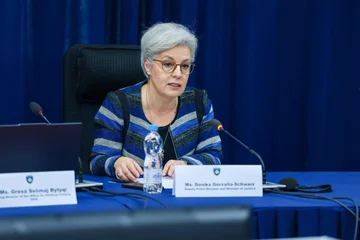
Serbian nationalist song, Gërvalla at meeting with the EU: Kosovo’s independence cannot be denied





