
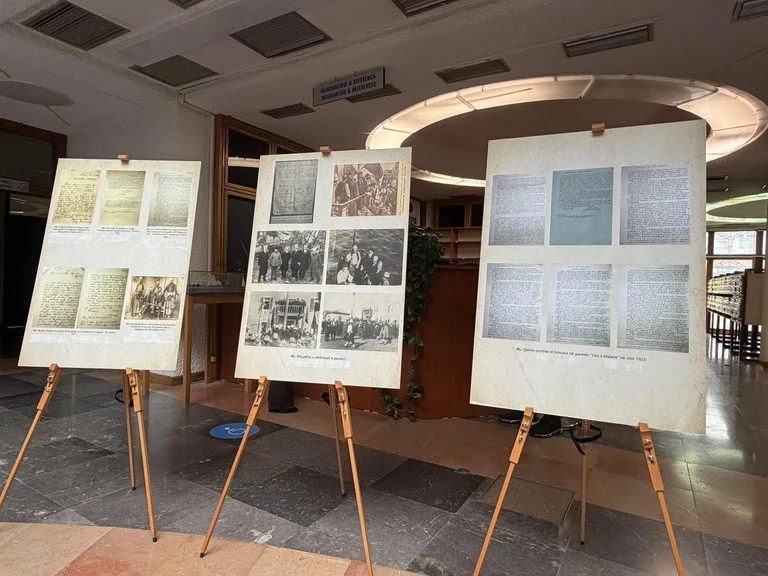
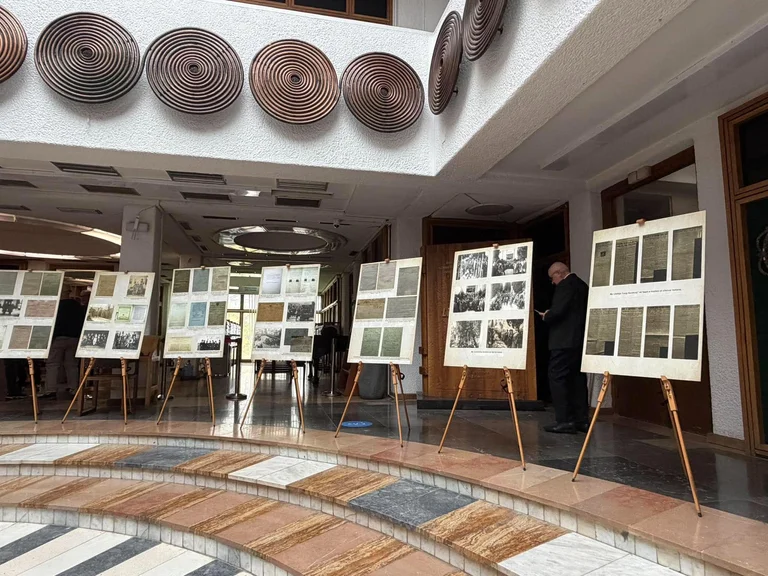
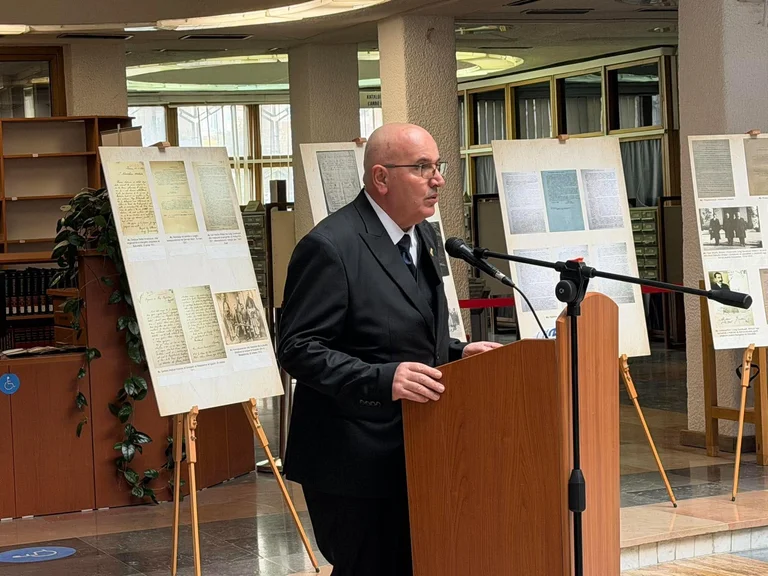
The exhibition “Luigj Gurakuqi in the Documents of the Central State Archive” has opened in Pristina. It was organized by the “Ali Hadri” Institute of History in cooperation with the General Directorate of Archives of Albania and the State Archives Agency, Ekonomia Online reports. Teuta Shala, director of the “Ali Hadri” Institute of History, said the exhibition offers a unique opportunity to […]
Exhibition “Luigj Gurakuqi in the Documents of the Central State Archive” Opens, Honoring His Contribution to Albanian National History
The exhibition “Luigj Gurakuqi in the Documents of the Central State Archive” has opened in Pristina. It was organized by the “Ali Hadri” Institute of History in cooperation with the General Directorate of Archives of Albania and the State Archives Agency, Ekonomia Online reports.
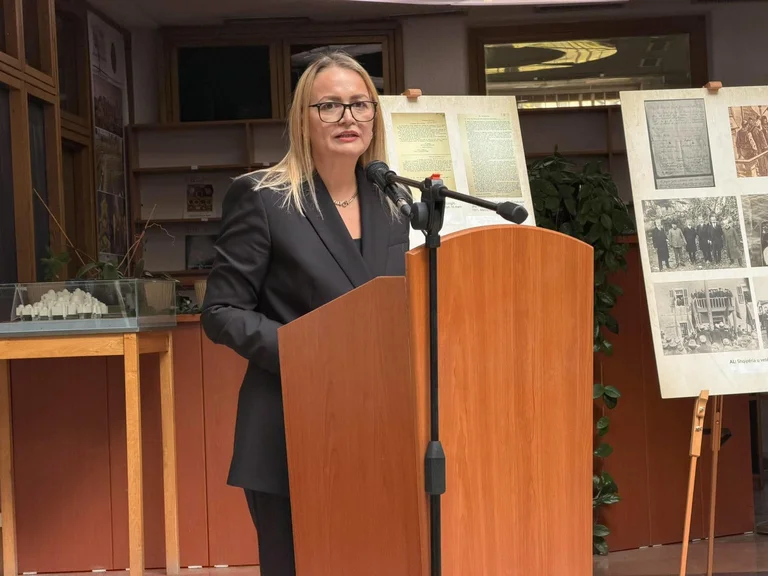
Teuta Shala, director of the “Ali Hadri” Institute of History, said the exhibition offers a unique opportunity to gain a closer understanding of Luigj Gurakuqi’s life and contribution to Albanian national history.
“This exhibition is being organized within the framework of the cooperation agreement between the two institutions, and it provides a unique opportunity to gain a closer understanding of Luigj Gurakuqi’s life, activities and contribution to Albanian national history through archival documents that attest to his engagement in education, the Albanian language and the national cause,” Shala said.
She emphasized that the archival documents attest to his commitment to education, the Albanian language and the national cause.
“Archival documents are valuable testimonies to the past. Through them, history is not only preserved, but also becomes more tangible and understandable to researchers and younger generations. Therefore, cooperation between our institutions in presenting and studying documentary heritage is particularly important for preserving historical memory and strengthening our institutional and scientific ties,” Shala added.
Meanwhile, Auron Rrokaj, Director General of the Archives of Albania, said the aim of the exhibition on Luigj Gurakuqi and the scientific conference was to present his work to the citizens of Kosovo and Albania.
“Tomorrow’s conference will illustrate aspects of Luigj Gurakuqi’s life through the researchers who will take part. The aim of the exhibition and tomorrow’s conference is not simply for people to listen to the papers prepared by the researchers; it is to bring the work of this great patriot to the citizens of Kosovo and Albania. This is the mission of the two archival directorates and the Institute of History: to bring history to our fellow citizens, to revise history through documents, to address those parts that raise questions, and to attract young people to the documents, to their roots, to their heritage, because without roots, no young person today, in these turbulent times, can be a good citizen or, in the future, a good subject of the state,” Rrokaj declared.
Rrokaj said that archival institutions are tasked with preserving documents, as well as making them available to citizens, researchers and students.
“This is a mission not only for institutions, but also for you, whether you are researchers, journalists, or hold any other position or role in public and social life. History is not an end in itself, and neither are documents or their preservation. Documents and history must reach the people, the citizens. Initiatives such as these—exhibitions, conferences, outreach, attracting young people, and sharing these events and these topics with the public—would be a success,” he said.
He added that, through cooperation agreements with institutions in Kosovo, the aim is to facilitate access to archival documents and promote a better understanding of history through facts and documentary evidence.
“As the General Directorate of Archives, to facilitate this entire mission, we have cooperation agreements with the Institute of History and work closely with our counterparts in Kosovo, so that everyone—not only researchers, but also young people, history students and ordinary citizens—can have easier and freer access to documents, facts and history,” Rrokaj added.
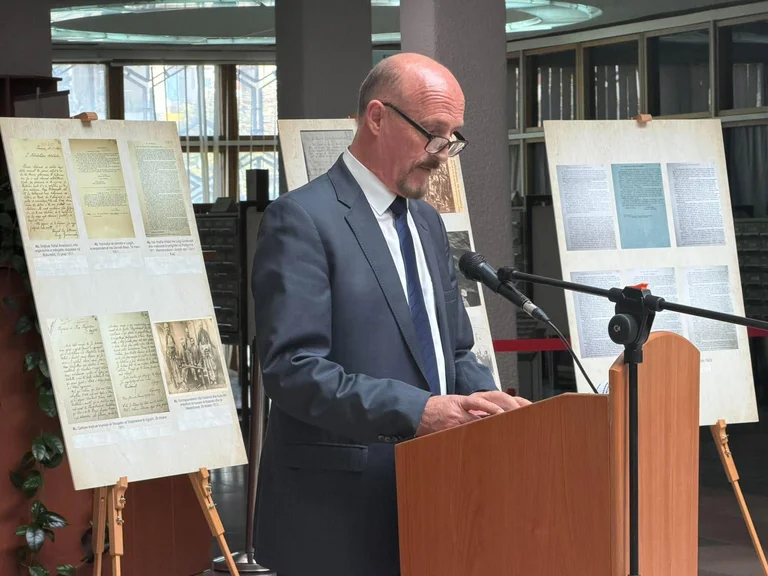
Mehmet Xhemajli, deputy executive director of the State Archives Agency of Kosovo, said the exhibition dedicated to Luigj Gurakuqi was the result of cooperation between the archival institutions and the “Ali Hadri” Institute of History.
“This exhibition is the result of cooperation between the State Archives Agency of Kosovo, the ‘Ali Hadri’ Institute of History and the General Directorate of Archives of Albania. The joint commitment of these institutions to preparing and staging it demonstrates the importance of interinstitutional cooperation in preserving, studying and promoting our documentary and historical heritage,” Mehmet added.
He emphasized that Gurakuqi was one of the distinguished figures of the Albanian National Renaissance, highlighting his contribution to the development of Albanian-language education, the declaration of Albania’s independence and the consolidation of the Albanian state.
“Luigj Gurakuqi was one of the distinguished figures of the Albanian National Renaissance, an intellectual, educator and dedicated advocate of the national cause. His contribution to the development of Albanian-language education, the declaration of Albania’s independence and the consolidation of the Albanian state makes him an important and distinctive figure in our national history. Through the archival documents presented in this exhibition, the public has the opportunity to learn more about his life and activities,” he added.
Xhemajli said archival documents are irreplaceable sources for scientific research, preserving collective memory and passing history on to future generations.
“Archival documents are authentic testimonies of the past century and irreplaceable sources for scientific research, preserving collective memory and passing it on to future generations,” Xhemajli added.
He expressed gratitude to the institutions and professionals involved in organizing the exhibition, and voiced hope that the event would spark public interest and further interinstitutional cooperation.
Related
National
A person with victim status in the Hague trial dies; the Specialist Chambers allow a family member to continue the proceedings
National
Gërvalla visits the Office for Victim Protection and Assistance, urges reporting violence to 0800 11112
National
KPMM Asked to Account for Delays in Licensing Investors
National
Ireland-Kosovo Match, Irish Ambassador: Historic Moment, We Expect a Great Match

National
VITA calls for an investigation by the Prosecution, saying more than 650 samples have been taken since July without the results being provided
National
Çitaku after failure of Presidency meeting: We expect the law on the Specialist Chambers to be voted on this week
National
Indictment against three people for selling around two kilograms of heroin
National
Klestor Veseli calls for an institutional response after The Hague decision
National
He killed him three years ago after a property dispute in Podujeva; sentenced to 24 years in prison
National
Fadil Fazliu’s son: My father and the others should have been acquitted
National
Supreme Court fully repeals the CEC Regulation, lawyer Ardian Bajraktari: No institution is above the law
National
Supreme Court annuls in its entirety the CEC Regulation on amendments to the internal organization and job classification





