
Reflection has already begun testing this model through a partnership for an “AI factory.” The U.S. startup Reflection, backed by Nvidia, is preparing to release a powerful open-weight Artificial Intelligence model, in a development that could reshape competition between American and Chinese AI companies. The new model is expected to offer […]
A powerful model is expected to shake up the AI race
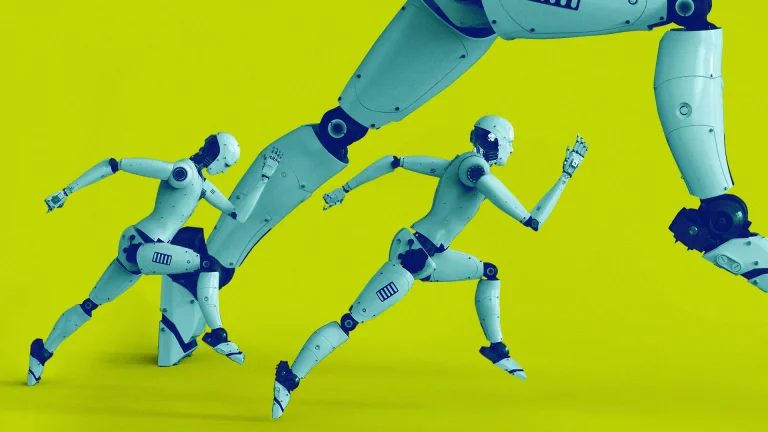
Reflection has already begun testing this model through a partnership for an “AI factory.”
The U.S. startup Reflection, backed by Nvidia, is preparing to release a powerful open-weight Artificial Intelligence model, in a development that could reshape competition between American and Chinese AI companies.
The new model is expected to offer a cheaper alternative to systems from companies such as OpenAI, Anthropic, and Google, giving businesses the opportunity to download, adapt, and use the technology for their own needs.
According to Axios sources, Reflection’s model is not initially expected to match the level of the most advanced American models, but aims to compete with the most powerful open-weight models produced in China.
This could enable companies to build customized AI systems at lower cost by combining the model with their internal data.
In some cases, a less expensive model adapted to a company’s specialized data can achieve results comparable to much more costly, latest-generation systems.
From AI model to “AI factory”
Reflection’s long-term ambition is to create what the company calls an “AI factory” – a platform through which institutions can build their own customized Artificial Intelligence ecosystems.
In this scenario, a company would use:
- its own confidential data;
- Reflection’s models;
- its computing infrastructure;
- to create an AI system tailored specifically to its operations.
This concept has attracted interest particularly from institutions that manage highly sensitive data, such as investment funds and financial trading companies.
Reflection has already begun testing this model through a partnership for a sovereign “AI factory” with Shinsegae Group in South Korea.
Nvidia’s support
An important element of the project is Reflection’s connection with Nvidia and its use of the company’s GPUs.
The startup is securing substantial computing capacity and recently signed agreements with Nebius and SpaceX to lease AI servers equipped with Nvidia GPUs.
The idea aligns with Nvidia CEO Jensen Huang’s vision of an ecosystem in which companies can combine powerful hardware with open models while retaining control over their data.
Why are open-weight models gaining ground?
Open-weight models differ from closed systems such as ChatGPT or Claude because the model weights can be made available for download and adaptation.
Many of the most powerful models of this kind currently come from China, posing a challenge for American companies.
However, using Chinese models is problematic for some Western companies and institutions because of concerns about data security and control of information. This creates an opening for American companies such as Reflection.
Reflection’s model is expected to be released soon, followed later this month by other open-weight models from Western companies.
If these models achieve high performance at lower cost, the AI race could shift in part away from exclusive models controlled by a handful of large companies toward an ecosystem in which businesses can build and control their own Artificial Intelligence systems.
Related

Technology
GTA 6 is launching this week, here are the date and details you need to know

Technology
YouTube, Facebook or TikTok? Here’s which social network Americans use most

Technology
Microsoft says its services have fully recovered after a day-long global outage

Technology
Microsoft outage paralyzes businesses, schools and government institutions around the world

Technology
Microsoft Platforms Face a Global Outage

Technology
Robot Takes on Humans in Antarctica Marathon, but Gives Up After 3 Kilometers

Technology
Google will add a dictionary to Gboard that saves words corrected during voice dictation

Technology
WhatsApp introduces “Events Home,” making it easier to organize get-togethers

Technology
Honda puts revolutionary V3 engine into production

Technology
WhatsApp tests a new feature

Technology
DokuTech 13, Kurti: Technology, the most dynamic sector of the economy
Technology
Windows 11 Gets Significantly Faster





