
The Anti-Corruption Agency (AKP) has launched its Strategic Development Framework for 2026–2030, through which it aims to strengthen institutional mechanisms for preventing corruption, increase transparency and improve accountability in public institutions, reports Ekonomia Online.
AKP launches Strategic Development Framework 2026–2030, sets six key objectives
The document sets out six strategic objectives, which include consolidating the legal framework, advancing professional capacities for administrative investigations, increasing transparency and public communication, regional and international cooperation, digital transformation, and the Agency’s organizational development.
As part of the objective to consolidate the legal framework, the AKP aims to harmonize legislation with European standards and improve mechanisms for asset declarations, conflicts of interest and corruption prevention.
Meanwhile, in the area of administrative investigations, the plan calls for advancing standard operating procedures, training professional staff, and improving mechanisms for monitoring and analyzing corruption cases.
An important part of the strategy is also devoted to transparency and public education through communication with citizens, the organization of awareness-raising activities, and cooperation with the media, civil society and educational institutions.
The document also envisages strengthening cooperation with regional and international mechanisms, including partners such as GRECO, RAI, NEIWA and OECD/ACN.
As part of the digital transformation, the Agency aims to modernize its systems, automate administrative processes, improve data security and create mechanisms for managing security incidents.
The strategy covers the period 2026–2030 and provides for annual action plans, measurable performance indicators and periodic reports to monitor the implementation of the objectives.
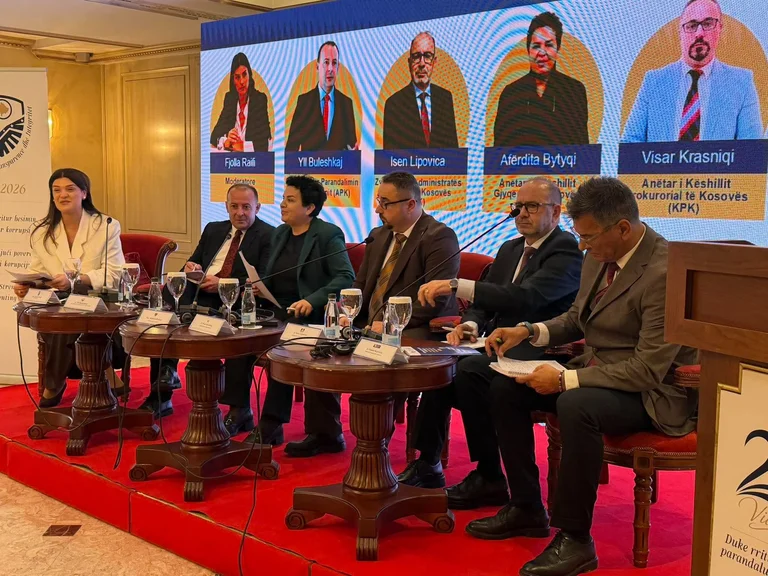
AKP Director Yll Buleshkaj said that the donor community and civil society had also contributed to drafting the document, having been involved during the final phase of the process.
He thanked the OSCE for its support through workshops during the drafting of the document, as well as UNDP for its assistance in finalizing and presenting it.
“I should emphasize that this document also includes contributions from the donor community, as well as civil society, because the document was shared with these two important groups of the Agency during its finalization phase. Special thanks for this drafting process go to the OSCE, which helped us with many workshops throughout the drafting process, and to UNDP, which helped us finalize the document and present it in the format you saw today,” Buleshkaj said.
Buleshkaj stressed that integrity should not be viewed only as a legal requirement, but as a daily standard of work in institutions.
"For us as an Agency, integrity is not just a legal requirement; it is more of a work standard, a way of behaving, every day in our institutions. But since it is a process, we cannot say that it stops; it must always be developing," he emphasized.
Buleshkaj said that corruption prevention cannot be carried out by a single institution, which is why the strategy envisages close cooperation with institutions that can contribute to this process.
“Likewise, the process of preventing corruption cannot be carried out by one institution alone. For this reason, as you will see later in the document, we have envisaged close cooperation with institutions that can contribute to our work. Preventing corruption first requires institutions with integrity; it requires functional institutions and mechanisms, transparency, professionalism and sustainable cooperation,” Buleshkaj said.
Aferdita Bytyqi, a member of the Kosovo Judicial Council (KJC), said the Council had drafted a strategic plan to increase efficiency in handling cases of corruption, abuse of official duty and organized crime for the period 2025–2027.
During the presentation, Bytyqi said that, as part of this strategy, the basic courts and the Court of Appeals had drafted their own action plans for its implementation.
“The Judicial Council has a strategic plan and several strategic plans published on the Council’s website, and anyone interested can go in and see what strategic plan the Council has in the fight against corruption. Perhaps here at this roundtable, or in this format, it is worth highlighting the Judicial Council’s strategic plan for the efficient handling of cases of corruption, abuse of official duty and organized crime, which covers 2025–2027. The Council has approved this strategy, as well as the strategy for combating corruption—that is, for handling corruption cases more efficiently—and the courts implementing this strategic plan then draft their own action plans. Each court—the basic courts of the Republic of Kosovo, as well as the Court of Appeals—has an action plan for implementing this strategy, specifically for the most efficient possible handling of corruption cases. The Council has gone even further and established a commission to monitor, evaluate and report on the implementation of this strategy,” Bytyqi stated.
She stressed that the KJC had also established a five-member commission, composed of Supreme Court judges, to monitor, evaluate and report on the implementation of the strategy.
“This commission was established by the Judicial Council and consists of five members drawn from among the Supreme Court judges. The commission is required to monitor the implementation of this strategy and report to the Council on the results and on any challenges that arise. The Council then takes further measures based on the commission’s reports. For example, if the commission reports challenges in handling a case, the Council should intervene and strengthen its response to that issue or problem, or help resolve the problem and strengthen the mechanisms that support the most successful possible handling of that case,” Bytyqi said.
Visar Krasniqi, a member of the Kosovo Prosecutorial Council (KPC), said strategic documents were important for increasing institutional efficiency, but that they should include clear objectives and mechanisms to oversee their implementation.
“And to achieve this efficiency, our institutions must, of course, have well-planned, well-organized documents with clear actions and objectives. And when you have these clear objectives, you also need a mechanism—as the judge mentioned earlier—to oversee the strategic plan. The Prosecutorial Council also has such a document, and the Council also oversees its implementation,” Krasniqi said.
He stressed that, unlike other institutions, the prosecutorial system has a separate department dealing with corruption and financial crime, while high-profile cases are handled by the Special Prosecution Office.
“However, unlike perhaps other institutions, we already have a law—the Law on the Special Prosecution Office—and it provides for a separate department that deals with corruption and financial crime. In the prosecution service, high-profile cases are handled there. And, of course, we must acknowledge that over the past four years, the absence of a State Chief Prosecutor has created a major vacuum in the handling of cases, efficiency and so on,” he emphasized.
Isen Lipovica, Deputy Director of the Kosovo Tax Administration (KTA), said that combating corruption was a matter of particular importance to the institution, both institutionally and in economic and fiscal terms.
Lipovica stressed that the KTA has access to taxpayer data and plays an important role in providing information to other institutions.
“Given the role and function played by the Tax Administration in our economic system, the human resources it has—as one of the largest agencies—and the fact that we have a continuous presence in the field, we have access to every citizen who earns income under the law and Kosovo’s taxpayer system. What this shows is that corruption is a matter of vital institutional, economic and fiscal importance, to which the Tax Administration attaches particular importance,” Lipovica said.
According to him, this system processes data from taxpayer declarations and information obtained from other actors, so that the institution’s assessments and actions are based on risk analysis.
“When we talk about data, its quality and the analysis on the basis of which the Tax Administration operates, I am particularly pleased to share this information: the Tax Administration is undoubtedly a repository of data, the ‘granary’ of data, as it were, in everyday parlance, because it provides data to all the other actors present in our society. This means that decision-making has also reached this level: today, every decision in the Tax Administration passes through the filter of the division we know as the Risk Analysis and Management Division,” he stated.
Related

National
A person with victim status in the Hague trial dies; the Specialist Chambers allow a family member to continue the proceedings

National
Gërvalla visits the Office for Victim Protection and Assistance, urges reporting violence to 0800 11112

National
KPMM Asked to Account for Delays in Licensing Investors

National
Ireland-Kosovo Match, Irish Ambassador: Historic Moment, We Expect a Great Match

National
VITA calls for an investigation by the Prosecution, saying more than 650 samples have been taken since July without the results being provided

National
Çitaku after failure of Presidency meeting: We expect the law on the Specialist Chambers to be voted on this week

National
Indictment against three people for selling around two kilograms of heroin

National
Klestor Veseli calls for an institutional response after The Hague decision

National
He killed him three years ago after a property dispute in Podujeva; sentenced to 24 years in prison
National
Fadil Fazliu’s son: My father and the others should have been acquitted
National
Supreme Court fully repeals the CEC Regulation, lawyer Ardian Bajraktari: No institution is above the law
National
Supreme Court annuls in its entirety the CEC Regulation on amendments to the internal organization and job classification





