
Members of the Parliamentary Investigative Commission into institutional actions and inactions related to the murder of Arlinda Zeka have expressed disagreements over how the investigation should be conducted and whether the Prime Minister’s Office should be included on the list of institutions from which documents and evidence will be requested, reports Ekonomia Online. Commission chair Burim Ramadani has criticized the approach […]
Arlinda Zeka case sparks clashes in the Investigative Commission
Members of the Parliamentary Investigative Commission into institutional actions and inactions related to the murder of Arlinda Zeka have expressed disagreements over how the investigation should be conducted and whether the Prime Minister’s Office should be included on the list of institutions from which documents and evidence will be requested, reports Ekonomia Online.
Commission chair Burim Ramadani criticized the approach of the Vetëvendosje Movement, saying that the party had come to the commission with firm, predetermined positions.
“It is clear that the Vetëvendosje Movement has come with a barricaded decision, with a blockade and firm positions that were formulated before coming to the commission. The whole point today regarding the action plan is that the Vetëvendosje Movement does not accept that we send requests to the Prime Minister’s Office as well. We are talking about the part under discussion; I am not going into details. In any case, we believe that the obstructive approach—to keep the commission from including it on the list of institutions to which it is entitled to send requests for documents and evidence, for proof—is not about the witness stage; it is about keeping the Prime Minister’s Office from being included at all, on the assumption that they are in the majority and will outvote us. I urge my colleagues from VV to sit down and think, and on Monday to change their firm position that we should not make requests to the Prime Minister’s Office,” Ramadani said.
Meanwhile, PDK MP Besa Kabashi-Ramaj expressed regret that the commission was unable to overcome political divisions, despite the importance of the case under consideration.
“It is painful to see that a commission dealing with a very serious case, which should overcome political divisions and serve a national cause, is unable to overcome these divisions. We have presented a detailed plan for each stage that needs to take place, and lists, starting with the smallest link and going all the way to political responsibility. Everyone who had a hand in this chain must be held accountable before the investigative commission, not as individuals, but as responsible institutions that failed to protect a woman who had sought their protection. It is very important for an investigative commission like this to function; it must not be politicized. A minister may perform excellently, but if a tragic case occurs, even if there is no criminal responsibility, there is moral responsibility,” she said.
PDK MP Eman Rrahmani also criticized the situation in the commission, saying that the request for documents from the Prime Minister’s Office should have been fulfilled.
“We are very sorry to find ourselves in such a situation. The deadline for the Prime Minister’s Office to bring us the documents was yesterday. They made excuses and sought other ways to communicate. During the meeting, VV’s request was that it not be included on the list of institutions from which documents would be requested. An investigative commission cannot continue if the entire process is being obstructed. This is a contribution, not an investigation. What was said at the beginning made us think that the Prime Minister’s Office was not functioning properly, but it was deliberate,” Rrahmani stated.
Meanwhile, LDK MP Doarsa Kica-Xhelili said she had tried to find a solution between the parties, proposing that the investigation begin at the local level and then continue at the central level.
“It is a great misfortune because we are dealing with an important case. I tried to understand both sides. I insisted that we pass this item even without the prime minister’s name, for a reason. Because I assessed that this would reveal two key elements: first, that we understand the resistance to a name that is responsible for the policies created within a state. To show that our investigation is truly factual, I proposed that we not conduct interviews from the top down, but start first with municipal officials. From there, the Centers for Social Work, prosecutors, police officers, and finally the central level, so that we can identify the real problems and know what questions to address to the central level. The proposal made by LVV also included the name of the mayor of the Municipality of Peja, and my argument was this: if the municipal level includes only that name, without the directorates, then the equivalent at the central level is one prime minister, who has the ministries,” Kica stated.
Related

Uncategorized
Around 200 Infrakos workers on strike, demand pay raises
Uncategorized
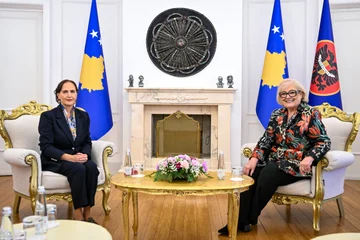
President Justina Shiroka Pula meets with the Kosovo Women's Network, discusses preventing violence against women
Uncategorized
British Prime Minister’s letter to Kurti; former ambassador: Trendafilova called European countries, asked them to threaten Kosovo over the Specialist Chambers
Uncategorized
Sadikaj: A woman’s life is mourned after she is murdered; before the murder, she does not count
Uncategorized
Adnon Jashari, accused in the Diana Kastrati case, declared wanted
Uncategorized
Reports on Sveçla’s niece being appointed as a diplomat, Konjufca: I don’t deal with proper names
Uncategorized
IMF assesses ATK's progress in implementing reforms and modernizing the tax administration
Uncategorized
Putin Is Panicking Ahead of U.S. Elections, Says Congressman Whitesides
Uncategorized
Clash between ruling and opposition parties in Health Committee over report on essential medicines and waiting lists
Uncategorized
Edona Podrimja appointed Deputy Minister of Health
Uncategorized
German Ambassador Meets Members of the Committee on Foreign Affairs and Diaspora
Uncategorized
Arlinda’s letter to the judge, Osmani: So far, zero measures by the judicial system





