
Lawyer Ardian Bajraktari said that the Specialist Prosecutor’s Office in The Hague had failed to prove the existence of the essential elements of the criminal offenses of obstruction of the administration of justice, for which the Specialist Chambers are expected to make public their decision on former President Hashim Thaçi and others on Tuesday, November 17.
Bajraktari convinced of Thaçi’s innocence in “obstruction of justice” case, but does not trust the Specialist Chambers: Anything is possible
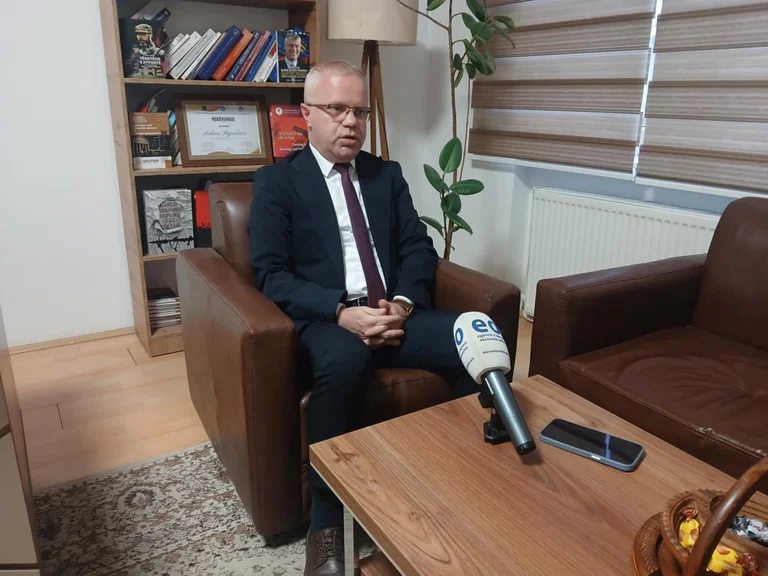
In an interview with Ekonomia Online, Bajraktari said that the trial had not established who had been obstructed or what the consequences of the actions alleged by the Prosecution had been.
“Tomorrow, the Specialist Chambers will make public their decision regarding Mr. Thaçi and the others on the criminal offenses of obstruction of the administration of justice, which fall within the jurisdiction of these chambers. What has been seen during the course of this trial is that the prosecution has failed to prove the existence of the essential elements, with particular emphasis on the criminal offense related to obstructing a public official in the performance of official duties. Because, with reference to Article 401 of the Criminal Code, the essential elements of this offense are the use of force or a serious threat—which, in circumstances where a person has already been in detention for more than six years, is of course impossible to happen,” Bajraktari said.
Bajraktari said he was convinced that the prosecution had failed to establish either the identities of the people who were obstructed or the impact of the actions alleged by the Prosecution.
“Likewise, the prosecution has failed to substantiate who was obstructed and what the impact of this was, that is, the consequences of these obstructions, as essential and important elements of the full characterization of the criminal offense,” he emphasized.
For Bajraktari, the Prosecution’s request for Thaçi and the others to be sentenced to six years in prison is inconsistent with the law and the practice to date in imposing sentences for such offenses.
“However, despite this, with particular reference to Mr. Thaçi, it has requested that he be sentenced to six years in prison, which is, of course, inconsistent—a proposal of this kind is inconsistent not only with the law, but also with the practice of imposing such sentences—because even when there have been actions, that is, confirmed acts of brutally obstructing the administration of justice, the maximum sentence ever imposed for these offenses by the relevant tribunals has been up to two years,” he emphasized.
The well-known lawyer from Pristina said that, despite these arguments, it remained to be seen what decision the Specialist Chambers would make, since, according to him, this judicial institution had not so far applied the principle of acquittal.
“But nevertheless, despite all this, we are dealing with a court that has never once applied the principle of declaring a person innocent, so anything is possible, and it remains to be seen what will happen tomorrow,” Bajraktari concluded.
The hearing against former Kosovo President Hashim Thaçi, former KIA chief Bashkim Smakaj, former Malisheva mayor Isni Kilaj, former Justice Minister Hajredin Kuçi, and Fadil Fazliu, on the charge of “obstruction of justice,” will be held on Tuesday at the Kosovo Specialist Chambers in The Hague.
According to the announcement, the hearing will begin at 10:00, and the accused are also required to be physically present at the hearing.
According to the indictment confirmed on November 29, 2024, Thaçi and the others are accused of criminal offenses related to allegations of unlawful attempts to influence witnesses’ testimony in the war crimes trial.
The indictment alleges that, during the period from April 12 to November 2, 2023, Thaçi provided Smakaj, Kilaj, Fazliu, and Kuçi with confidential information concerning witnesses for the Specialist Prosecutor’s Office, as well as instructions to influence their testimony.
The Prosecution also alleges that Thaçi coordinated three separate groups for the purpose of influencing witnesses’ testimony in the war crimes trial.
Related
Policy
The Alliance convenes its Presidium, with organizational issues and political developments in focus
Policy
Foreign Ministry Signs $50,000-a-Month Contract for Lobbying in the U.S.
Policy
President Shiroka Pula receives Slovenian ambassador; bilateral cooperation and Euro-Atlantic integration in focus
Policy
Çitaku: PDK will enter a regular election cycle to elect a new leader
Policy
Gola on Thaçi’s sentence: We express regret
Policy
Çitaku after Thaçi’s sentence: A shameful and unacceptable decision
Policy
Government after Thaçi’s sentence: Our reservations about the Specialist Chambers’ ability to ensure a fair trial remain steadfast
Policy
Tahiri insists that Thursday’s session be held and the president’s decree on the Law on the Specialist Chambers be returned to the Assembly
Policy
Presidium meeting fails
Policy
“The whole people should rise to their feet,” an outraged citizen after Thaçi’s sentencing
Policy
Shiroka Pula meets Japanese ambassador, discusses deepening cooperation between the two countries
Policy
Serbian nationalist song, Gërvalla at meeting with the EU: Kosovo’s independence cannot be denied





