
When Kosovo and Serbia agreed to establish the Association of Serb-Majority Municipalities in 2013, the European Union described the agreement as a step that brought both countries closer to Europe.
The “bogeyman” that could open Europe’s doors to Kosovo
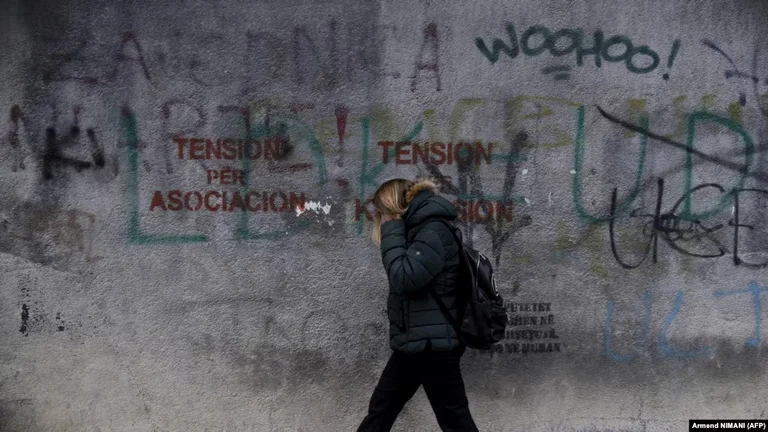
Thirteen years later, the Association has not been established, Kosovo continues to wait for progress in European integration, and the EU insists that this obligation be fulfilled.
The change of power in Serbia has revived discussions about the possibility of a new approach to the Association. For Kosovo, however, another question arises: whether it can take steps without waiting for Belgrade and use them to advance in international integration processes.
In a response to Radio Free Europe, a European Union spokesperson said that Kosovo and Serbia must implement all the obligations undertaken במסגרת the dialogue, without further delays and without preconditions, if they want to advance on their European path.
This also includes ensuring “an appropriate level of self-management” for the Serb community in Kosovo, in line with the 2023 Basic Agreement.
The EU’s demand dates back to the April 2013 Brussels Agreement, when Kosovo and Serbia agreed to create a mechanism for cooperation among Serb-majority municipalities, with a role in local economic development, education, healthcare, and urban and rural planning.
Catherine Ashton, then the EU’s foreign policy chief and the agreement’s mediator, described it as a step that brought both countries closer to Europe.
In Pristina, the agreement sparked strong opposition from the Vetëvendosje Movement. Its leader, Albin Kurti, then in opposition, warned that the Association could endanger the functioning of the state. During a parliamentary session, he also displayed a map of Kosovo without the north, to illustrate what he saw as the risk of the country’s partition.
Kurti later took over the Government, but did not fundamentally change his position.
He continued to oppose the creation of a mono-ethnic mechanism with executive powers and to make progress conditional on action by Serbia.
Following the Student List’s victory in Serbia’s October 25 elections, Minister for Communities and Returns Nenad Rašić suggested that Kosovo’s Government was more willing to establish the Association.
Vetëvendosje denied changing its position, while the Government, in its response to Radio Free Europe, reiterated its demands of Belgrade.
It is asking Serbia to sign the 2023 Basic Agreement as a guarantee of its implementation, hand over Milan Radoičić, who is accused in Kosovo of the armed attack in Banjska, and withdraw the letter from former Prime Minister Ana Brnabić, through which Belgrade expressed reservations about some of the agreement’s obligations.
These conditions continue to impede progress, although both the substance of the Association and the circumstances in which it would operate have changed over the years.
From agreements to realities on the ground
In 2015, Kosovo and Serbia also agreed on the principles governing the Association’s operation, including its structure, powers, and funding.
Kosovo’s Constitutional Court found that some of them were not in line with constitutional standards and called for them to be harmonized. The ruling did not rule out the establishment of the Association, but set the limits within which it could operate.
The issue returned in the 2023 Basic Agreement, through the wording on “an appropriate level of self-management for the Serb community.”
That same year, European partners also presented a draft statute, which was not implemented.
In the absence of political progress, Kosovo’s authorities took steps to close a range of institutions backed by Belgrade, including administrative and financial structures and social work centers.
Education and healthcare, however, continue to operate largely within Serbia’s system, making their integration one of the main challenges for Kosovo’s institutions.
Agon Maliqi, a nonresident fellow at the Atlantic Council, believes that the Association could serve precisely this purpose.
“Healthcare and education continue to operate in Kosovo under Serbia’s system. The Association could be the instrument that resolves this anomaly in the service of Kosovo Serbs, while at the same time giving Kosovo the opportunity to integrate these services into its own legal order,” Maliqi tells Radio Free Europe’s Expose program.
Integrating schools and hospitals would also require solutions for their funding, the status of their employees, and continuity of services.
Miloš Pavković, from the Center for European Policy in Belgrade, warns that a unilateral process could deepen the Serb community’s mistrust of Kosovo’s institutions.
In his view, the Association would be the most appropriate way to manage this process.
“If it is done by sending the police into hospitals and schools, it would provoke opposition from the Serb community,” he tells Expose.
The European Union has also called for institutions and services supported by Serbia to be addressed in a coordinated manner and in consultation with the Serb community.
For this reason, the debate over the Association is no longer limited to its powers alone.
It is also linked to how Kosovo can integrate services that still operate within Serbia’s system without interrupting their provision to citizens.
Such a process would require cooperation between Pristina and Belgrade, the prospects for which remain unclear even after the political change in Serbia.
What is expected from the new government in Belgrade?
The Student List’s victory in the October 25 parliamentary elections ended Aleksandar Vučić’s 14-year rule in Serbia, but the winners have yet to indicate what approach they will take toward Kosovo.
In their response to Radio Free Europe, representatives of the Student List said they would comment on the Association and other dialogue issues only after the new Government is formed and the documents and current situation have been reviewed.
Robert English, a professor at the University of Southern California, is skeptical that the change of power will bring rapid progress.
He recalls that representatives of the student movement took hard-line positions on Kosovo even while opposing Vučić, accusing him of not having sufficiently defended Serbs’ interests.
“We have seen that the same students who led the democratic movement took hard-line positions on issues related to Kosovo even before the elections—in some cases, even harder-line than the outgoing president, Aleksandar Vučić,” English tells Expose.
According to him, the new Government will have other priorities, while improving relations with Kosovo could take years and depend on democratic developments and Serbia’s international orientation.
Pavković sees more opportunities for progress if Serbia’s next Government seeks to accelerate European integration.
Normalizing relations with Kosovo is part of Chapter 35 of Serbia’s EU accession negotiations, while European funds could provide an additional incentive.
“There are many funds frozen under the Growth and Reform Facility, for both Serbia and Kosovo. These funds could serve as a strong incentive for both sides to engage more constructively in the dialogue,” Pavković says.
It remains to be seen whether Serbia’s new Government will seize this opportunity.
For Kosovo, meanwhile, waiting for a change in Belgrade could also mean further postponing its own obligations.
Can Kosovo act without waiting for Serbia?
Maliqi believes that Kosovo has room to take steps in cooperation with Western partners, but that its long-standing political opposition to the Association has made this more difficult.
“This has already become a taboo subject in Kosovo politics, mainly because of Albin Kurti’s opposition to the Association when he was in opposition. In this way, Kosovo has limited its own room for maneuver, turning the Association, in my view, into a bogeyman bigger than it really is,” he says.
According to Maliqi, one way to change this approach would be for Kosovo to link steps toward establishing the Association with progress in international integration, through an agreement with Western allies.
“For example, there has already been discussion about the possibility of granting Kosovo candidate status in the EU in return for some step regarding the Association, as well as membership in the Council of Europe. So that Kosovo and the West can move forward on their own, without waiting for much engagement from the new Government in Belgrade,” he says.
This possibility is linked to two processes in which Kosovo has not made the progress it sought.
It applied for membership in the European Union in December 2022, but remains the only country in the Western Balkans without candidate status.
Its bid to join the Council of Europe also stalled in 2024, after several member states called for concrete steps toward establishing the Association.
In both cases, progress depends on decisions by European partners and cannot be guaranteed through Kosovo’s actions alone.
And at a time when crises and security challenges are taking up most of Europe’s attention, it is becoming increasingly important for Kosovo to find ways to keep its integration on Brussels’ agenda. /RFE
Related
Policy
The Alliance convenes its Presidium, with organizational issues and political developments in focus
Policy
Foreign Ministry Signs $50,000-a-Month Contract for Lobbying in the U.S.
Policy
President Shiroka Pula receives Slovenian ambassador; bilateral cooperation and Euro-Atlantic integration in focus
Policy
Çitaku: PDK will enter a regular election cycle to elect a new leader
Policy
Gola on Thaçi’s sentence: We express regret
Policy
Çitaku after Thaçi’s sentence: A shameful and unacceptable decision
Policy
Government after Thaçi’s sentence: Our reservations about the Specialist Chambers’ ability to ensure a fair trial remain steadfast
Policy
Tahiri insists that Thursday’s session be held and the president’s decree on the Law on the Specialist Chambers be returned to the Assembly
Policy
Presidium meeting fails
Policy
“The whole people should rise to their feet,” an outraged citizen after Thaçi’s sentencing
Policy
Shiroka Pula meets Japanese ambassador, discusses deepening cooperation between the two countries
Policy
Serbian nationalist song, Gërvalla at meeting with the EU: Kosovo’s independence cannot be denied





