
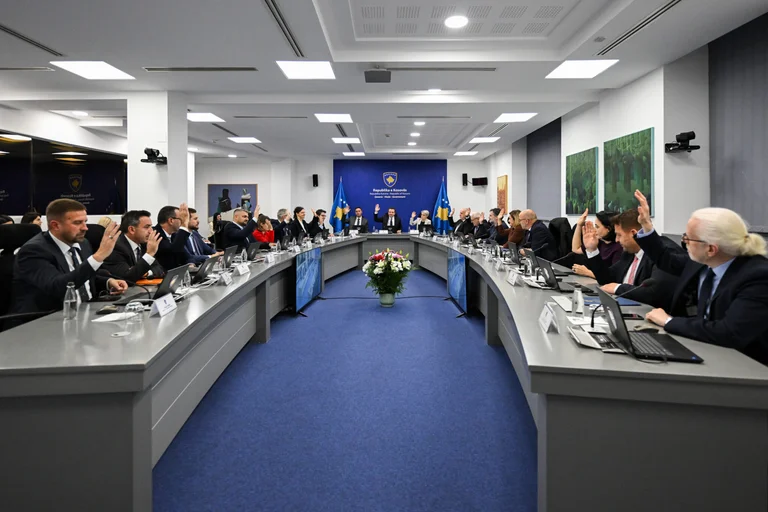
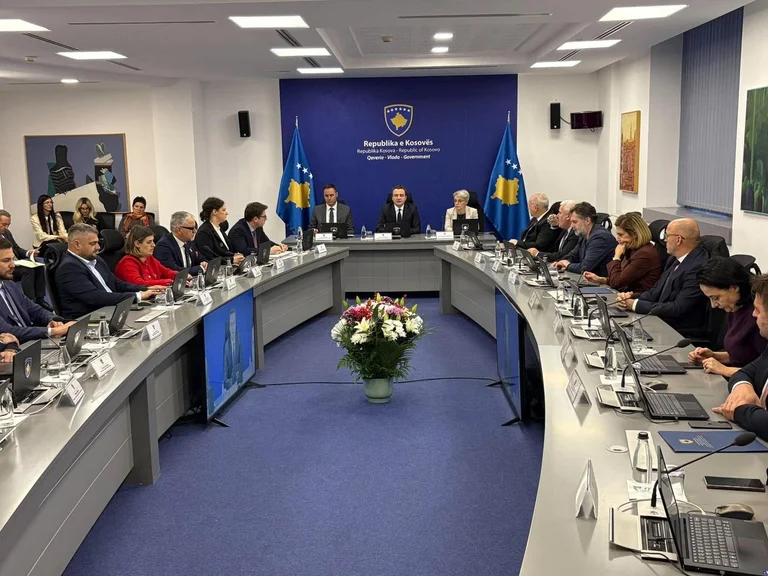
The Government of Kosovo has approved the Draft Law on Budget Allocations for the Budget of the Republic of Kosovo for 2027 at its ninth meeting, reports Ekonomia Online. During the presentation of the draft budget, Minister of Finance Hekuran Murati said it is based on economic growth, expansion of the labor market and the sustainability of public finances. Murati […]
Draft Law on the 2027 Budget Approved
The Government of Kosovo has approved the Draft Law on Budget Allocations for the Budget of the Republic of Kosovo for 2027 at its ninth meeting, reports Ekonomia Online.
During the presentation of the draft budget, Minister of Finance Hekuran Murati said it is based on economic growth, expansion of the labor market and the sustainability of public finances. Murati stated that in 2027, Kosovo’s gross domestic product is expected to reach 30.4 billion euros, while budget revenues will exceed 4 billion euros for the first time.
“So, a budget that I am presenting to you with optimism, but with confidence, because it is based on an economy that is growing, a labor market that is expanding and sound public finances. Kosovo today has an economy with steady growth. In 2027, gross domestic product is expected to reach 13.4 billion euros. Budget revenues will exceed 4 billion euros for the first time, while public debt remains at around 16% of gross domestic product, one of the lowest levels in the region. This means more jobs, higher wages and better services for our citizens,” Murati said.
The minister said that preparation of the budget began in May of this year, noting that the Ministry of Finance had held consultations with budget organizations to include the priorities and needs of public institutions.
“The process of preparing this budget began in May of this year, with the completion of the process of submitting the medium-term expenditure framework. And clearly, the Ministry of Finance has held intensive consultations with all budget organizations to ensure that this budget includes all the priorities of our program and the needs of each public institution. Through the 2027 draft budget, we have made a fair allocation of funds for government priorities arising from the National Strategy for Economic Development, the Economic Reform Program, sectoral strategies and the medium-term expenditure framework,” he said.
Murati said that economic developments in Kosovo had been encouraging, despite the difficult global situation, geopolitical uncertainty, trade tensions and high energy prices.
“This budget proposal is closely linked to economic, fiscal and financial trends, and these trends are encouraging. Because despite a difficult global environment, characterized by geopolitical uncertainty, trade tensions, armed conflicts and high energy prices, Kosovo’s economy has continued to grow faster than the region and has demonstrated strong resilience. As the prime minister also noted, in the first half of 2026, we recorded real growth of 5.44%. This growth was driven by consumption, investment and exports. Total private and public investment grew by 7.9%, while merchandise exports rose by 22.9% in the January–July period and services exports by 10.9%,” the minister said.
Speaking about the labor market, Murati said that according to data from the Kosovo Tax Administration, 445,542 people were recorded as employed in the first half of 2026, or 5.2 percent more than in the same period of the previous year.
“Economic growth is also directly reflected in employment. According to the KTA’s data, 445,542 people were employed in the first half of 2026, or around 5.2% more than a year earlier in the same period. Meanwhile, the labor force participation rate rose to 50% in 2025, from 43.3% the previous year. The increase in the minimum wage, the addition of jobs in the private sector and wage increases in both the private and public sectors have led to a 19.5% rise in personal income tax revenues in the first nine months of this year,” Murati said.
He also mentioned price levels, describing them as the main challenge, and said that average inflation through September 2026 had reached 6.6 percent.
“The main challenge, then, continues to be price levels, which have been directly affected by international energy and food markets. Average inflation through September 2026 stood at 6.6%. However, inflation is expected to fall to 4% in 2027 and stabilize at 2% in the medium term. Budget revenues have continued their satisfactory performance during the January–July period of this year, with an increase of 6.6% compared with the same period last year. This is the result of increased economic activity, as well as measures to encourage voluntary compliance and combat the informal economy,” the minister said.
As for economic forecasts for the coming years, Murati said Kosovo’s economy is expected to record real growth of 4.2 percent in 2027, with even higher growth forecast for 2028 and 2029.
“The discussion of our forecasts confirms that economic growth will accelerate in 2027, reaching around 4.2% in real terms for the full year, and 8.6% in nominal terms. In the medium term, real growth is expected to be even higher, at 4.5% in 2028 and 4.6% in 2029, when gross domestic product is expected to exceed 15 billion euros. Growth will be supported by private consumption, driven by the minimum wage increase, lending and remittances, as well as by investment, which is forecast to grow by 5.7%, supported by fiscal stimulus policies for the private sector, especially exporters, and the accelerated implementation of public investment in priority sectors,” Murati emphasized.
The minister said that the expansion of economic activity is expected to contribute to the creation of new jobs, the formalization of employment and growth in exports of goods and services.
“This expansion of economic activity will create new jobs, while measures to formalize employment will continue to increase the number of registered employees. Exports of goods and services will continue to make a positive contribution thanks to fiscal measures supporting domestic producers, which have also begun to partially replace imports,” Murati added.
Related
Policy
The Alliance convenes its Presidium, with organizational issues and political developments in focus
Policy
Foreign Ministry Signs $50,000-a-Month Contract for Lobbying in the U.S.
Policy
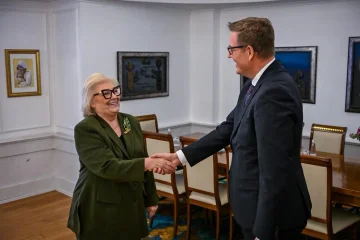
President Shiroka Pula receives Slovenian ambassador; bilateral cooperation and Euro-Atlantic integration in focus
Policy
Çitaku: PDK will enter a regular election cycle to elect a new leader
Policy
Gola on Thaçi’s sentence: We express regret
Policy
Çitaku after Thaçi’s sentence: A shameful and unacceptable decision
Policy
Government after Thaçi’s sentence: Our reservations about the Specialist Chambers’ ability to ensure a fair trial remain steadfast
Policy
Tahiri insists that Thursday’s session be held and the president’s decree on the Law on the Specialist Chambers be returned to the Assembly
Policy
Presidium meeting fails
Policy
“The whole people should rise to their feet,” an outraged citizen after Thaçi’s sentencing
Policy
Shiroka Pula meets Japanese ambassador, discusses deepening cooperation between the two countries
Policy
Serbian nationalist song, Gërvalla at meeting with the EU: Kosovo’s independence cannot be denied





