
The leader of the Social Democratic Initiative, Fatmir Limaj, has sharply criticized the work of the judicial panel in the trial of former KLA leaders in The Hague, reports Ekonomia Online.
Limaj: In The Hague, it was impossible to tell who was the prosecutor and who was the judge; the equality of the parties was undermined
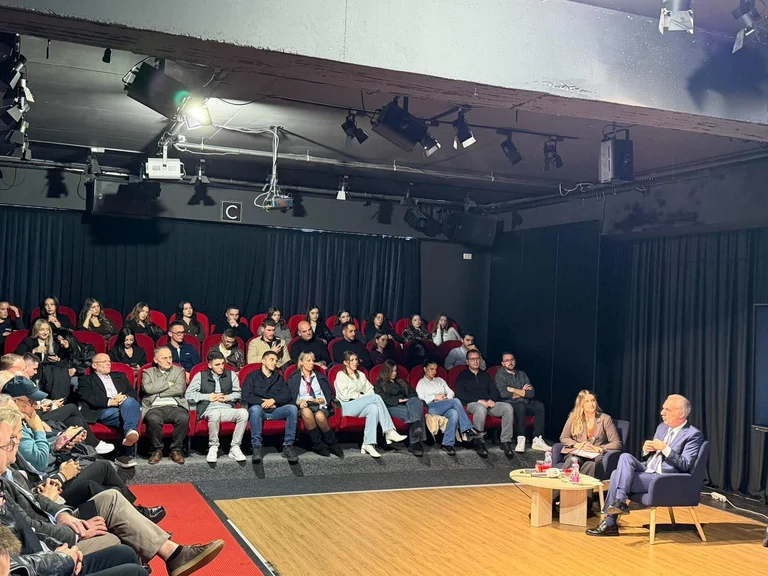
At a discussion panel on the topic “Kosovo after September 16,” Limaj expressed his concern about how the trial was conducted, questioning the impartiality and integrity of the judicial panel.
He said that in a trial, the judge must be neutral and guarantee equality between the parties, while the burden of proof rests with the prosecution.
“For the accused, there is nothing more important than having a judicial panel before him that inspires confidence—confidence that the law is being applied, confidence that it is capable and has integrity. What I have seen in this case is that the judicial panel in the justice system, in the case of the four who were tried, the burden of proof rests with the prosecution, the one accusing you; the judge is silent, the judicial panel is silent, it is neutral, it balances, it hears facts and evidence from the parties, the defense on one side and the prosecution on the other. The judge never takes an active role in relation to either party. The judicial panel is more inclined to preserve and protect the rights of the accused than to help the prosecution in the courtroom,” Limaj said.
Limaj alleged that during the trial in The Hague, the judicial panel was overly active in questioning witnesses, comparing this to the role of the prosecution. “What did we see? Anyone who followed this trial saw a judicial panel that, in my view, was shocking; it acted as an extension of the prosecution, taking an active role during the trial in the examination, questioning, and the prosecution’s own case. The judges asked questions for 74 hours; they were active in the trial for 74 hours, and their questions were questions a prosecutor would ask. Wherever the prosecutor left off, the judge continued, doing twice as much as the prosecutor,” Limaj said.
He also referred to his own experience in the trial in The Hague, saying that during the two years of his trial, the judicial panel had asked only seven questions, which, according to him, had favored the defense.
“To illustrate an example of why this should not happen: in my case in The Hague, during two years of trial, the court—the judicial panel in my case—asked seven questions; in two years, just seven questions. All seven questions favored the defense. The court’s interventions in the courtroom consisted of those seven questions in favor of the defense, while preserving the integrity of the trial. It did not allow the prosecution to go beyond the rules and standards,” he added.
According to Limaj, in the trial of former KLA leaders, it is difficult to distinguish the prosecutor’s role from that of the judge, which, he said, undermines the principle of equality of arms.
“In this case, it was difficult to see who was the prosecutor and who was the judge, and that shows a lack of integrity on the part of this judge. This then undermines the so-called equality of arms. Equality of arms is when both parties have the equal opportunity and right to present their evidence, their defense, or their accusations before the judicial panel. And for equality of arms to be guaranteed, there must be a judicial panel that guarantees equal rights, and that judicial panel must not take sides in the trial for either party. Another thing that was missing in this trial was the standard of proof. Tomorrow, when you study legal practice here, you will learn that evidence is very important. It is the foundation, the heart of an entire trial that you will conduct in the future,” Limaj said, among other things.
Related
Policy
The Alliance convenes its Presidium, with organizational issues and political developments in focus
Policy
Foreign Ministry Signs $50,000-a-Month Contract for Lobbying in the U.S.
Policy
President Shiroka Pula receives Slovenian ambassador; bilateral cooperation and Euro-Atlantic integration in focus
Policy
Çitaku: PDK will enter a regular election cycle to elect a new leader
Policy
Gola on Thaçi’s sentence: We express regret
Policy
Çitaku after Thaçi’s sentence: A shameful and unacceptable decision
Policy
Government after Thaçi’s sentence: Our reservations about the Specialist Chambers’ ability to ensure a fair trial remain steadfast
Policy
Tahiri insists that Thursday’s session be held and the president’s decree on the Law on the Specialist Chambers be returned to the Assembly
Policy
Presidium meeting fails
Policy
“The whole people should rise to their feet,” an outraged citizen after Thaçi’s sentencing
Policy
Shiroka Pula meets Japanese ambassador, discusses deepening cooperation between the two countries
Policy
Serbian nationalist song, Gërvalla at meeting with the EU: Kosovo’s independence cannot be denied





