
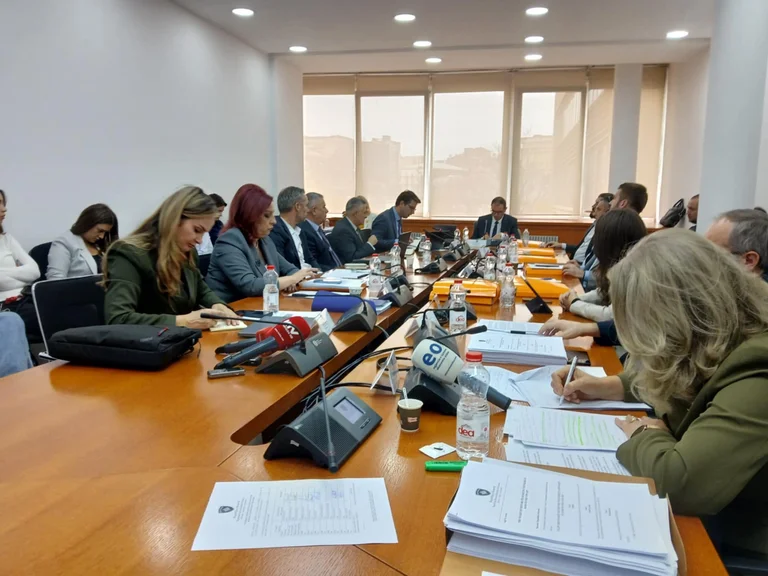
Finance Minister Hekuran Murati presented, at its first reading, Draft Law No. 11/L-028 on budget appropriations for the Budget of the Republic of Kosovo for 2027, which envisages expenditures of €4.2687 billion. During his presentation to the members of the committee, Murati said the budget was drafted based on expectations of economic growth, increased revenues and the preservation of public finance sustainability, Ekonomia Online reports.
Murati defends himself over inflation: The war in Ukraine and the blockade in the Strait of Hormuz are to blame
“So, a budget that we are bringing before you with optimism and confidence, because it is based on a growing economy, a developing employment trend and sound public finances. As for next year’s budget, I will go straight to the figures. We are talking about a budget of €4.2687 billion in budget expenditures. These expenditures are financed primarily by revenues amounting to €4.002 billion, while the remainder is deficit financing, which is within the fiscal rule,” Murati said.
He announced that the budget deficit for 2027 is projected to be 2 percent of Gross Domestic Product, estimated at €13.3 billion, while financing needs amount to €266 million.
“Accordingly, we have complied with the fiscal rule, while at the same time seeking to reflect economic growth, which is seen through increased revenues; on the other hand, we have sought to distribute these revenues as fairly as possible, while also implementing and relying on the government’s priorities,” the minister said.
Regarding budget allocations by economic category, Murati said that €1.0849 billion has been planned for salaries, €588 million for goods and services, €1.446 billion for subsidies and transfers, €11.9 million for the current reserve, and €55 million for interest on public debt.
“Meanwhile, capital investments are projected at €1.07 billion, and here I should also emphasize that, starting next year, there will be no more investment clauses. In other words, the entire amount of planned capital investments is financed by the budget grant as well as by the deficit, and all of it is included within the projected 2% deficit under the fiscal rule. So there is no exceeding the 2% limit, as we have had until the current year under the fiscal rule, whereby financing or capital projects funded through the investment clause were exempt,” Murati said.
He described the budget as a plan with a record level of revenues and expenditures, and called for the draft law to proceed to the next stage.
“Considering this budget and this record level of revenues, as well as expenditure planning, I consider it extremely important that it proceed to the next stage,” the minister concluded.
After the minister’s presentation, committee member Mergim Lushtaku of the Democratic Party of Kosovo criticized the planning and implementation of capital investments, saying that, in his view, the government had continued to plan large amounts for this category, but implementation had remained low.
“But in reality, looking at and comparing this with the auditor’s reports and expenditure reports for 2026, 2025 and beyond, under this government we have consistently seen large amounts planned for capital investments, but implementation has in fact been poor,” Lushtaku said.
He also referred to a GAP Institute report for the 2021–2024 period, according to which more than €1 billion in planned investments had not been spent.
“Indeed, in some reports, such as the GAP report for 2021–2024, more than €1 billion in planned investments was not spent. This directly affects citizens, meaning fewer roads, fewer bridges, unbuilt schools, unbuilt centres, and many projects that make people’s lives easier. Of course, this also directly affects household finances, as well as the rising cost of living,” he said.
Lushtaku stressed that an increase in the nominal value of the budget does not necessarily mean improved public welfare, linking this to the rate of inflation.
“A large budget, or a budget with big figures, does not mean that people are better off, because inflation has been very high. Various reports show different figures. For example, inflation is reported at 7.8%, while other figures put it at up to 7.1% through October 2026. Comparing nominal and real projections, growth comes to around 1%, because the money available in 2026 was not spent, and it has certainly lost value over the past years and days,” Lushtaku said.
He also discussed the difference between planned revenues and expenditures, citing a shortfall of around €258 million.
“Therefore, budget planning and budget revenues stand at €4.02 billion, while planned expenditures, including investments, are up to €4.268 billion, which means we are short by approximately €258 million,” he said.
According to Lushtaku, it is important for citizens to see which budget policies directly affect their lives. He also criticized the lack of projects that, in his view, have been completed from start to finish under the current government.
“All these projections are certainly important for citizens, so they can see which policies directly affect their lives, while not a single project has been completed from start to finish by you,” Lushtaku said.
He also devoted part of his remarks to agriculture and support for farmers, saying that although subsidies have been planned, they are not being distributed on time.
“In this regard, I have several issues to raise, especially concerning agriculture and farmers, for whom a number of subsidies have been planned, but unfortunately they are not received on time,” he said.
Lushtaku recalled that in previous discussions he had also proposed amendments to change how subsidies are paid to farmers, so that financial support would be provided in instalments and made available at the beginning of agricultural work.
“As for support, I believe you also remember previous occasions when I proposed direct amendments to help farmers, in a way, receive subsidies in instalments, so they would have support from the very beginning of their work in the fields,” he stressed.
At the end of his remarks, the MP raised concerns about projects listed in the draft budget with zero euros, as well as new projects allocated an initial amount of just one million euros.
“Also, another thing that caught my attention is the projects in this budget that are planned at zero. How many are there in total? Were there 65 projects, or how many budget codes have been set at zero? Then there are the new projects with only €1 million planned, which are actually scheduled to be implemented in 2028 and 2029,” Lushtaku concluded.
In response to Lushtaku’s criticism, Minister Hekuran Murati said that the low level of capital investment execution was not an issue that had arisen only in recent years, but one that, in his view, had recurred over many years.
“As for the execution of capital projects, this is a chronic situation; it is not limited to this year or to some of the previous years. As far back as I can remember, and anyone who has worked in the public sector and dealt with public finance knows that project execution has continually lagged behind. In 2010, 2011 and 2012, and so on, execution was always below budget,” Murati said.
He cited several factors that, in his view, affect the full implementation of capital investments, singling out the implementation capacity of line ministries and municipalities, as well as procedures that often cannot be accurately anticipated during budget planning.
“This is mainly due to several factors that are beyond the Ministry of Finance’s control. First, there is the implementation capacity of line ministries in terms of planning; this also includes the local level, among budget organizations—in other words, municipalities. It is also a matter of procedures that often cannot be included in precise plans because they can take time,” the minister said.
However, Murati said that the trend in capital investment execution was improving.
“As for the execution of capital investments, I can say that the trend is improving,” he said.
Responding to criticism over inflation and the rising cost of living, Murati said this was a challenge affecting not only Kosovo, but other countries around the world as well.
“As for inflation, the rising cost of living is certainly a problem in Kosovo, as it is in all other countries around the world. There are two causes: first, the war in Ukraine, which contributed to a global shock in energy and food prices, and most recently the new wave resulting from the conflict in the Persian Gulf,” Murati added.
Related
Policy
The Alliance convenes its Presidium, with organizational issues and political developments in focus
Policy
Foreign Ministry Signs $50,000-a-Month Contract for Lobbying in the U.S.
Policy
President Shiroka Pula receives Slovenian ambassador; bilateral cooperation and Euro-Atlantic integration in focus
Policy
Çitaku: PDK will enter a regular election cycle to elect a new leader
Policy
Gola on Thaçi’s sentence: We express regret
Policy
Çitaku after Thaçi’s sentence: A shameful and unacceptable decision
Policy
Government after Thaçi’s sentence: Our reservations about the Specialist Chambers’ ability to ensure a fair trial remain steadfast
Policy
Tahiri insists that Thursday’s session be held and the president’s decree on the Law on the Specialist Chambers be returned to the Assembly
Policy
Presidium meeting fails
Policy
“The whole people should rise to their feet,” an outraged citizen after Thaçi’s sentencing
Policy
Shiroka Pula meets Japanese ambassador, discusses deepening cooperation between the two countries
Policy
Serbian nationalist song, Gërvalla at meeting with the EU: Kosovo’s independence cannot be denied





