
Two months after being sentenced to 25 years in prison for war crimes, Kosovo’s former president, Hashim Thaçi, faces the possibility of another sentence from the Specialist Chambers in The Hague.
Verdict in The Hague tomorrow in case of obstruction of justice; what a University of Amsterdam professor expects
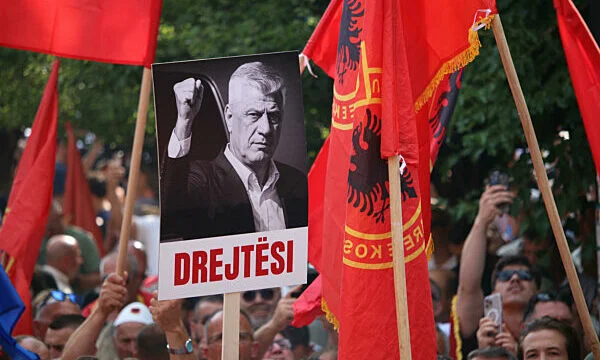
On November 17, the court will deliver its judgment in a separate trial in which he is accused of offenses against the administration of justice, including attempts to influence Prosecution witnesses.
If found guilty, Thaçi could receive additional years in prison. If acquitted, his earlier sentence will not automatically change.
Mathias Holvoet, a lecturer in International Criminal Law at the University of Amsterdam, tells Radio Free Europe that, according to the practice of international criminal courts, sentences for obstruction of justice are usually added to those for international crimes.
Why is Thaçi being tried for a second time?
The trial concerns alleged attempts to influence Prosecution witnesses during the war crimes trial of Thaçi and three other former Kosovo Liberation Army leaders: Kadri Veseli, Jakup Krasniqi and Rexhep Selimi.
According to the indictment, from April to November 2023, Thaçi allegedly gave confidential information about Prosecution witnesses to Bashkim Smakaj, Isni Kilaj and Fadil Fazliu during their visits to the detention center in The Hague.
The Prosecution alleges that Thaçi, in collaboration with them and other individuals, tried to influence the testimony of certain people with the aim of obstructing the court’s work.
He is also accused of having reached an agreement with former Justice Minister Hajredin Kuçi for the latter to contact Prosecution witnesses, in violation of a court order.
According to the indictment, Kuçi also contacted another witness on his own initiative.
Thaçi faces 11 counts in the indictment: three for attempting to obstruct officials in the performance of their duties, four for violating the secrecy of proceedings and four for contempt of court.
All five accused have pleaded not guilty.
In their closing statements, the Prosecution sought six years in prison for Thaçi, three years each for Smakaj, Kilaj and Fazliu, and nine months for Kuçi.
The defense teams disputed the charges and asked that all five accused be acquitted.
The trial began on February 27 and concluded on September 14.
Judge Christopher Gosnell will deliver the judgment.
Could a possible new sentence be added to his 25-year term?
The Prosecution has asked that, if Thaçi is sentenced to six years in prison, this sentence be added to the 25-year term handed down for war crimes.
Mathias Holvoet, a lecturer in International Criminal Law at the University of Amsterdam, says such a request is consistent with the practice of international criminal courts.
“If found guilty, he is likely to receive additional years in prison. The approach of international criminal courts is to add sentences for crimes against the administration of justice to sentences handed down for international crimes,” he tells Radio Free Europe.
According to Holvoet, if the court follows the Prosecution’s request, Thaçi could face two sentences that together amount to 31 years in prison.
However, such an outcome is not predetermined.
The court must first decide whether the charges have been proven beyond a reasonable doubt and, in the event of a guilty verdict, determine the sentence.
The Prosecution’s request is not binding on the court.
The final length of imprisonment will also depend on the outcome of the appeals proceedings and how the sentences are carried out.
In the war crimes judgment, Thaçi was credited for the time spent in detention since November 2020.
What happens if Thaçi is acquitted?
An acquittal on November 17 would not overturn the 25-year sentence handed down in September.
Holvoet says that in such a scenario, he does not expect major changes to Thaçi’s legal position.
“If he is acquitted, I don’t think much will change. He will remain in detention pending the appeal in the war crimes case,” he says.
This is because the two proceedings are based on separate charges.
An acquittal in the obstruction of justice case would mean that the charges in that proceeding had not been proven beyond a reasonable doubt, without changing the war crimes judgment, which is not yet final.
Could the new judgment affect the appeal?
Regardless of the November 17 decision, Thaçi has the right to appeal the 25-year sentence.
Holvoet does not expect the judgment for obstruction of justice to affect the review of that appeal.
“I don’t think either an acquittal or a conviction will have—and neither should have—any impact on the appeal proceedings. They are two separate proceedings,” he says.
As an example, he points out that, when determining the 25-year sentence, the trial panel did not consider the separate charges against Thaçi for obstruction of justice as an aggravating circumstance.
But what happens if the war crimes sentence is reduced or overturned on appeal?
Such a decision would not automatically overturn a possible sentence for obstruction of justice, as it would be based on a separate judgment.
However, a change to the first sentence could affect the overall length of imprisonment if Thaçi is also convicted in the second trial.
The November 17 judgment can also be appealed, in accordance with legal procedures.
What did the court decide in the war crimes case?
On September 16, the Specialist Chambers sentenced Thaçi to 25 years in prison for war crimes.
In the same trial, Jakup Krasniqi was sentenced to 25 years, Kadri Veseli to 18 and Rexhep Selimi to 13 years in prison.
All four were found guilty of war crimes, including arbitrary detention, cruel treatment, torture and murder.
They were acquitted of crimes against humanity after the court determined that the Prosecution had not proven beyond a reasonable doubt the existence of a widespread or systematic attack against the civilian population.
All four have denied all the charges.
What happens next?
The September judgment is not final.
The parties have the right to appeal it, and the deadline for filing notices of appeal is November 27.
Appeals may challenge alleged errors in the application of the law, the assessment of facts and the determination of the sentence.
The Court of Appeals panel may uphold, amend or overturn the judgment, under the conditions set out by law.
Thus, the November 17 decision will clarify whether Thaçi will face another sentence, but not how much time he will ultimately spend in prison. /RFE
Related

National
A person with victim status in the Hague trial dies; the Specialist Chambers allow a family member to continue the proceedings
National
Gërvalla visits the Office for Victim Protection and Assistance, urges reporting violence to 0800 11112

National
KPMM Asked to Account for Delays in Licensing Investors

National
Ireland-Kosovo Match, Irish Ambassador: Historic Moment, We Expect a Great Match

National
VITA calls for an investigation by the Prosecution, saying more than 650 samples have been taken since July without the results being provided
National
Çitaku after failure of Presidency meeting: We expect the law on the Specialist Chambers to be voted on this week

National
Indictment against three people for selling around two kilograms of heroin
National
Klestor Veseli calls for an institutional response after The Hague decision

National
He killed him three years ago after a property dispute in Podujeva; sentenced to 24 years in prison
National
Fadil Fazliu’s son: My father and the others should have been acquitted
National
Supreme Court fully repeals the CEC Regulation, lawyer Ardian Bajraktari: No institution is above the law
National
Supreme Court annuls in its entirety the CEC Regulation on amendments to the internal organization and job classification





