
The Kosovo Government’s decision to ban electricity trading with companies from Serbia does not guarantee that such trading will stop unless an alternative for importing electricity is secured in advance.
Ymeri: Ban on electricity trading with Serbia risks remaining only at the declarative level
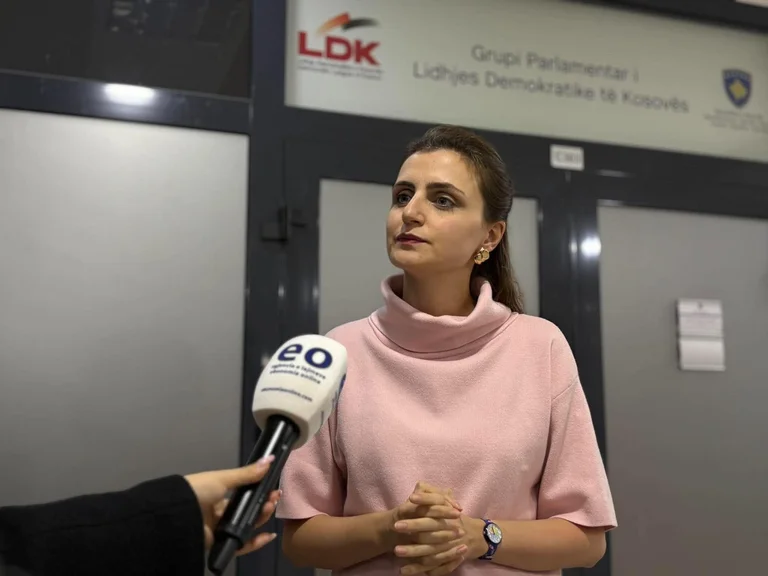
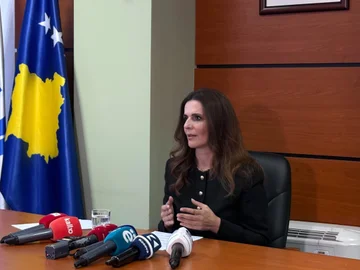
This is the assessment of Democratic League of Kosovo (LDK) MP Janina Ymeri, who told Ekonomia Online in an interview that, because Kosovo needs energy, trade with Serbian energy entities may continue even after this decision.
According to Ymeri, the Government must sign a contract to import electricity from another company for the decision to have an effect in practice. She emphasized that the problem is not just public statements about banning trade, but the lack of concrete solutions for energy supply.
“Today, the decision may serve as a justification for what happened earlier, but I do not believe it can stop trade with Serbia’s energy entities, because, to date, no agreement has yet been reached by the national government on where Kosovo should get its electricity. Given that it is in great need of electricity, regardless of today’s statements, under the current conditions it will still end up trading with Serbian entities. That remains to be seen,” Ymeri said.
Asked about the Government’s statements that it has never traded directly with Serbia, and that companies did so through their own choices, Ymeri said the Ministry of Economy was responsible for overseeing this process and permitting the trade.
She emphasized that her criticism was not that the Government had acted as a business company, but that it had continually allowed electricity trading with Serbian entities.
“Yes, the Ministry of Economy is not a business entity that trades with companies, with entities from Serbia, but its role has been oversight. That is the problem. I am not aware that any of us has said the government is a business and is doing business with Serbian entities, but it is allowing it and has allowed it endlessly. And even now there is no guarantee that it will stop it. It could have been just a public statement by Kurti, but things are much deeper and more serious than the government is portraying them today,” she stressed.
Ymeri also commented on the justifications, saying that such statements do not change the responsibility that, in her view, the institutions had in this process.
“As for what the government spokesperson said, that is what the party says to justify itself, but that does not mean it is right,” the LDK MP pointed out.
Speaking about the decision’s impact on the energy sector, Ymeri said the Government must first secure a contract to import electricity, at least for a six-month period, through which it could secure energy at the lowest price.
According to her, if the need for imports remains the same and there is no alternative company that can supply Kosovo, the ban on trade with Serbian companies may remain only at the declarative level.
“For today’s decision to have an impact in the energy sector, a contract must be made, at least for six months within the government, to import energy from a company that can secure the lowest price. However much it is said that electricity will not be obtained from Serbian entities, if the need remains as it is now, there is no other solution anyway but to allow electricity trading with Serbian entities,” Ymeri said.
She added that the Government should focus on addressing the need for imports and not merely on public statements which, in her view, may serve political purposes.
“The idea, the goal, is to eliminate the need, not to make public statements for political propaganda. Kurti’s sin has been leaving Kosovo in this situation, not saying ‘yes’ or ‘no’ to getting electricity from Serbian entities. What he did today was acknowledge that there has been electricity trade with Serbian entities, something we have been saying for a long time. Now he has acknowledged it. Whether he will stop it is worth nothing unless he says so,” she added.
Asked whether she expects the decision approved by the Government to be implemented in the coming days as well, Ymeri said that remains to be seen, but warned that without a supply contract through the Universal Service Supplier, imports may continue through Serbian entities.
“It remains to be seen what happens with the decision, but if imports are as high as expected, if it does not have a contract with a specific company within the Universal Service Supplier (USS) or universal service supplier, it will still end up, one way or another, with Serbian entities. And everything else it says remains just political propaganda,” Ymeri told EO.
Separately, at a meeting held today, the Government approved the draft decision to ban electricity trading, specifically its purchase from companies originating in Serbia.
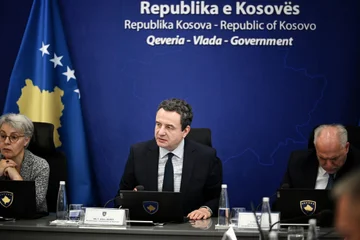
At the beginning of the meeting, Prime Minister Albin Kurti said the measure was a response to Serbia’s blocking of cross-border lines for energy trading.
At the meeting, the Government also approved two other decisions related to the electricity sector: declaring emergency measures for energy supply and imposing a public service obligation on the Kosovo Energy Corporation (KEK) to secure cross-border transmission capacities.
All three decisions are part of the Government’s measures to address challenges in the electricity sector and ensure energy supply in the country.
Related
Policy
The Alliance convenes its Presidium, with organizational issues and political developments in focus
Policy
Foreign Ministry Signs $50,000-a-Month Contract for Lobbying in the U.S.
Policy
President Shiroka Pula receives Slovenian ambassador; bilateral cooperation and Euro-Atlantic integration in focus
Policy
Çitaku: PDK will enter a regular election cycle to elect a new leader
Policy
Gola on Thaçi’s sentence: We express regret
Policy
Çitaku after Thaçi’s sentence: A shameful and unacceptable decision
Policy
Government after Thaçi’s sentence: Our reservations about the Specialist Chambers’ ability to ensure a fair trial remain steadfast
Policy
Tahiri insists that Thursday’s session be held and the president’s decree on the Law on the Specialist Chambers be returned to the Assembly
Policy
Presidium meeting fails
Policy
“The whole people should rise to their feet,” an outraged citizen after Thaçi’s sentencing
Policy
Shiroka Pula meets Japanese ambassador, discusses deepening cooperation between the two countries
Policy
Serbian nationalist song, Gërvalla at meeting with the EU: Kosovo’s independence cannot be denied





