
Acting Minister for Communities and Returns Nenad Rashiq has said that the Vetëvendosje Movement is the first partner he intends to talk to about forming new institutions, but has called for the process not to be limited to the election of a government, but also to include an agreement on the election of the president and the full functioning […]
Rashiq: Institutions should be formed in a “package” to leave no room for blockades
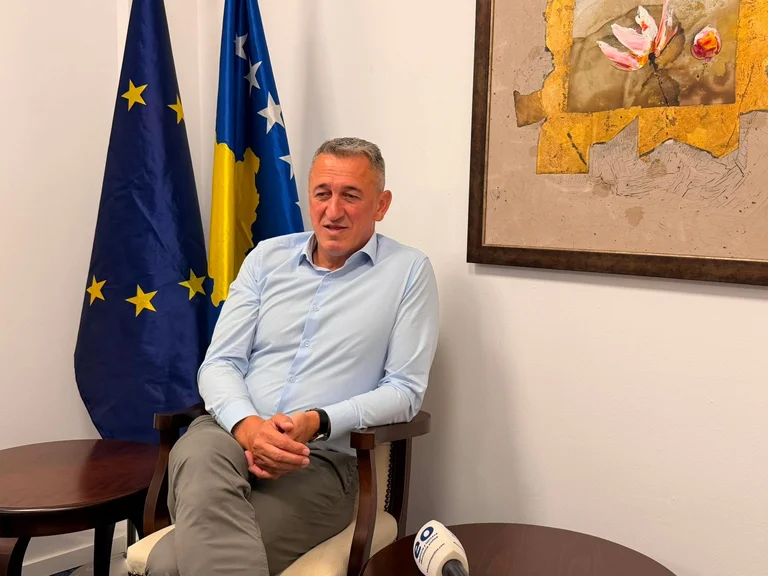
Acting Minister for Communities and Returns Nenad Rashiq has said that the Vetëvendosje Movement is the first partner he intends to talk to about forming new institutions, but has called for the process not to be limited to the election of a government, but also to include an agreement on the election of the president and the full functioning of the institutions.
In an interview with Ekonomia Online, Rashiq said that election results must be respected, while stressing that after four rounds of elections, it is time for Albanian political parties to reach an agreement to put an end to institutional crises.
“Look, of course, I have said this before: naturally, the Vetëvendosje Movement is the first point of contact. Not only because of the experience we have had over the past three or four years, but because the Vetëvendosje Movement has won 53 seats in the Assembly out of the 100 allocated to Albanians. Therefore, it has a majority of Albanian MPs, and in that respect this fact must be respected; naturally, the first point of contact in this case is the Vetëvendosje Movement. When the time comes to talk, I will have some proposals for strengthening or potentially improving communication and relations, especially cooperation, because things can always be better. I see a lot of room for improvement in that direction,” he said.
Rashiq said that cooperation with Vetëvendosje should be proactive and should also include proposals from community parties.
“Therefore, the Vetëvendosje Movement is the first point of contact, but certainly not just for passive cooperation. In this case, it should be cooperation that allows us to present and propose our ideas—not only me as the head of a small party, but also my colleagues from the communities—which we believe will help in establishing the institutions. Therefore, as I said, not passive cooperation, but, I would say, proactive cooperation in which our ideas are also taken into consideration and implemented together,” he told Ekonomia Online.
He said he would ask Vetëvendosje to take initiatives to reach consensus with Albanian parties, particularly on the election of the president.
“We have not yet formed the group, so I am speaking for myself, not on behalf of the group, because we do not yet have one. First, I will ask the prime minister—or Vetëvendosje—to use every form of initiative that could bring us to cooperation, particularly with the Albanian parties regarding the selection of the president, because I consider this to be the key, so to speak, or a potentially weak point in this whole process we are in after the elections. And I myself will ask the parties to make comprehensive plans. It should not be one phase at a time, or some institutions should not be established without a plan for what will happen with the other institutions. To put it in more everyday terms, it is very important that we have everything in one package, so that we do not enable the enemies of Kosovo’s institutions to exert influence again through pressures or manoeuvres that could certainly lead us into a very bad situation, as has happened until now,” he told Ekonomia Online.
According to Rashiq, political parties must avoid another year lost because of a political crisis.
“I place a lot of weight on the strategic assessments made by the European Union. Since we acknowledge that the EU is an unavoidable destination, the only destination that all of us politicians and all the systems in the Balkans should have, its words—when it said that 2025 was a lost year—affected me personally, because I do not want us, as institutions, to lose years because of political crises. Therefore, let us avoid the next assessment that 2026, too, was a lost year. Let us put together a package defining the institutions or the methods for selecting representatives within these institutions, and then vote on whatever we need to,” he said.
He called on political parties to set aside their clashes and cooperate.
“All the institutions. I would say that all political parties—I understand, especially among the Albanian political parties, that an animosity has developed which sometimes seems very absurd to me, but the fact is that there is animosity which is largely psychological, and which also creates problems for us. You have the expression ‘out of spite,’ but the truth is that citizens are suffering. And I am not that kind of person; I have always believed in taking responsibility and in tolerance. Democracy means that you, too, have the right, not just me. Therefore, we need to meet somewhere in the middle of our positions, where we have to cooperate,” he said.
Asked whether he would once again be part of the government as a minister, Rashiq said that the Constitution provides for representation of the Serb community in the executive, while the selection is up to the Albanian parties.
“Look, in this case, you know that the Constitution provides that at least one minister from the Serb community must be there. And if, hypothetically, there were no such minister—for example, in the vote on the government—then such a vote, without a minister from the Serb community, would not be legal. Therefore, it is inevitable; the selection is now up to the Albanian parties, which must take responsibility. Whether they select me, as the only person outside the Serb List, or the Serb List—that is their decision,” he said.
Finally, Rashiq said that failing to form the institutions would be unjustifiable.
“To tell you the truth, if there is no solution now, then we politicians really need a special law, a special commission, with a psychiatrist as its chair. There really is no other explanation, because for me personally this would be a failure of the system I have believed in for 20 years. But let me remind you that in January I marked 20 years in politics, and I believe the system has a future, but the human-capacity factor is always a challenge for us,” he said.
Related
Policy
The Alliance convenes its Presidium, with organizational issues and political developments in focus
Policy
Foreign Ministry Signs $50,000-a-Month Contract for Lobbying in the U.S.
Policy
President Shiroka Pula receives Slovenian ambassador; bilateral cooperation and Euro-Atlantic integration in focus
Policy
Çitaku: PDK will enter a regular election cycle to elect a new leader
Policy
Gola on Thaçi’s sentence: We express regret
Policy
Çitaku after Thaçi’s sentence: A shameful and unacceptable decision
Policy
Government after Thaçi’s sentence: Our reservations about the Specialist Chambers’ ability to ensure a fair trial remain steadfast
Policy
Tahiri insists that Thursday’s session be held and the president’s decree on the Law on the Specialist Chambers be returned to the Assembly
Policy
Presidium meeting fails
Policy
“The whole people should rise to their feet,” an outraged citizen after Thaçi’s sentencing
Policy
Shiroka Pula meets Japanese ambassador, discusses deepening cooperation between the two countries
Policy
Serbian nationalist song, Gërvalla at meeting with the EU: Kosovo’s independence cannot be denied





