
The Central Election Commission has certified the results of the snap elections held in Kosovo on June 7. With this step, the way has also been opened for the creation of new institutions and the start of the deadline for constituting the Assembly of Kosovo. Eugen Cakolli of the Kosovo Democratic Institute has said that the 30-day deadline for holding […]
“Government or president?”, Cakolli explains the procedures for forming institutions
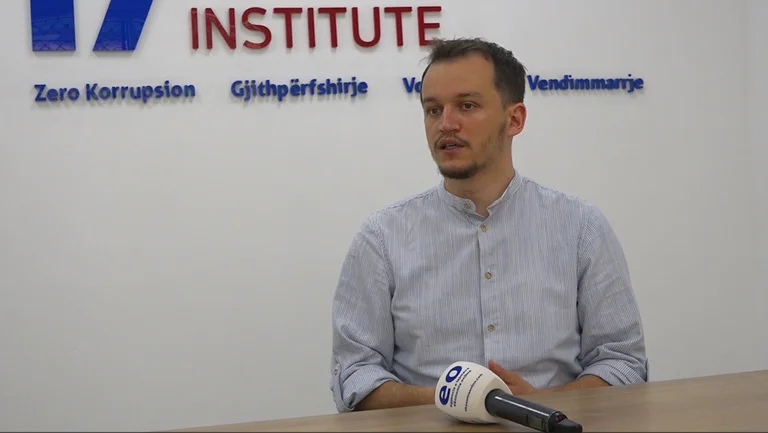
The Central Election Commission has certified the results of the snap elections held in Kosovo on June 7.
With this step, the way has also been opened for the creation of new institutions and the start of the deadline for constituting the Assembly of Kosovo.
Eugen Cakolli of the Kosovo Democratic Institute has said that the 30-day deadline for holding and successfully concluding the constitutive session of the Assembly begins tomorrow, July 9, and ends on August 7, 2026.
According to him, the session must be called by Albulena Haxhiu, in her capacity as Acting President.
He added that if this does not happen within the deadline, the Assembly convenes on its own on the thirtieth day.
“Before the session, Albulena Haxhiu, in her capacity as Speaker of the previous legislature, must call a preparatory meeting with the leaders of the 15 political entities that have won seats in the Assembly. This meeting is held no later than five days before the constitutive session and serves to prepare the agenda and assign the seats where members of parliament will sit in the chamber, according to their political entities,” Cakolli said.
He added that, until the Speaker of the Assembly is elected, the constitutive session will be chaired by the oldest member of parliament, Avni Dehari of LVV, assisted by the youngest member of parliament, Fatma Taçi of KDTP.
According to him, the order of business is already predetermined. First, the Temporary Committee for the Verification of the Quorum and Mandates is formed, and its report is voted on by a majority vote.
“Then the members of parliament are sworn in; afterwards, the Speaker of the Assembly is elected, and finally, the Deputy Speakers of the Assembly. The Speaker of the Assembly is nominated by LVV, as the largest parliamentary entity, and is elected with at least 61 votes. If the same candidate does not receive the votes after three attempts, another candidate must be nominated. The vote for Speaker must be open, unless there is consensus to change the voting method,” he said.
After the Speaker is elected, according to Cakolli, the Assembly proceeds to elect the five Deputy Speakers.
“Three are nominated by the three largest parliamentary entities, LVV, PDK and LDK. One is nominated by the members of parliament from the Serb community, namely by LS, while one is nominated by members of parliament from the other non-majority communities. All are elected with at least 61 votes. In principle, the Deputy Speakers should be voted on as a slate. At least the three Deputy Speakers nominated by the largest parliamentary entities may be voted on in one ballot, while the two Deputy Speakers from the non-majority communities may be voted on in another. The Assembly is considered constituted only after the Speaker and all five Deputy Speakers have been elected,” he added.
According to him, only after the Assembly is fully constituted do two separate constitutional procedures begin: one for forming the Government and one for electing the President.
“These procedures are not mutually exclusive, and neither the Constitution nor the Constitutional Court’s judgments make the formation of the Government conditional on the prior election of the President,” Cakolli said.
Related
Policy
The Alliance convenes its Presidium, with organizational issues and political developments in focus
Policy
Foreign Ministry Signs $50,000-a-Month Contract for Lobbying in the U.S.
Policy
President Shiroka Pula receives Slovenian ambassador; bilateral cooperation and Euro-Atlantic integration in focus
Policy
Çitaku: PDK will enter a regular election cycle to elect a new leader
Policy
Gola on Thaçi’s sentence: We express regret
Policy
Çitaku after Thaçi’s sentence: A shameful and unacceptable decision
Policy
Government after Thaçi’s sentence: Our reservations about the Specialist Chambers’ ability to ensure a fair trial remain steadfast
Policy
Tahiri insists that Thursday’s session be held and the president’s decree on the Law on the Specialist Chambers be returned to the Assembly
Policy
Presidium meeting fails
Policy
“The whole people should rise to their feet,” an outraged citizen after Thaçi’s sentencing
Policy
Shiroka Pula meets Japanese ambassador, discusses deepening cooperation between the two countries
Policy
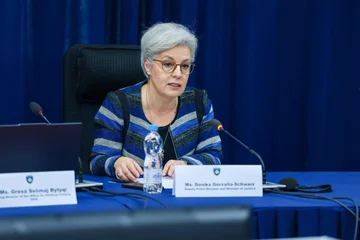
Serbian nationalist song, Gërvalla at meeting with the EU: Kosovo’s independence cannot be denied





