
Machine learning is driven by a loss function that penalizes its bad guesses, leading it to offer options that err on the side of the average and the safe. John Naughton is an Irish academic and journalist, known for his writing and analysis on technology, the internet and their impact on society. In […]
We already live in ‘clone towns’ – AI is making things worse
Machine learning is driven by a loss function that penalizes its bad guesses, leading it to offer options that err on the side of the average and the safe.
John Naughton is an Irish academic and journalist, known for his writing and analysis on technology, the internet and their impact on society.
In 2004, the New Economics Foundation (NEF) conducted a national survey of the UK’s high streets, which at the time were still economically active.
It found that genuine local shops had been replaced by a multitude of identical chain stores, making high streets across the country practically indistinguishable from one another. It also came up with a new vocabulary for talking about urban areas.
In this terminology, a “home town” is a place that retains its individual character and is immediately recognizable and distinctive to the people who live there, as well as to those who visit. A “clone town”, by contrast, is a place whose high-street shops’ individuality has been replaced by a “monochrome strip of global and national chains”. This meant that its retail heart could easily be mistaken for dozens of other ordinary town centres across the country. Of the towns surveyed, NEF concluded: 41% were clone towns, 33% were home towns and 26% were “border towns”, meaning somewhere in between.
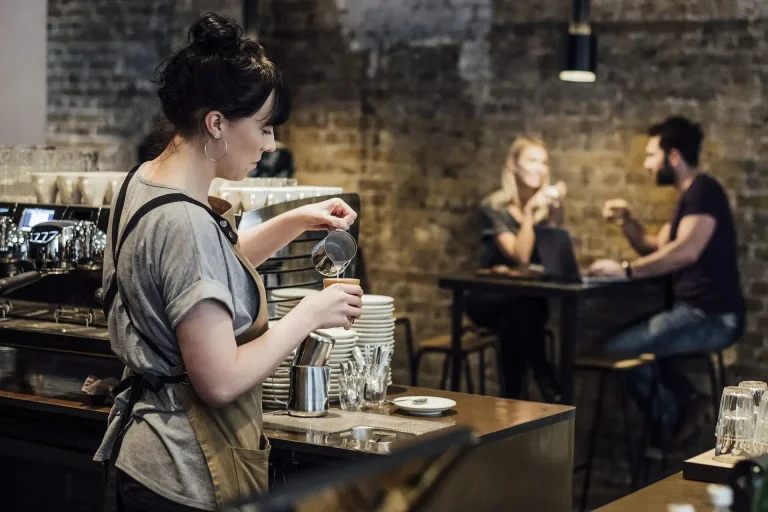
This lack of diversity is not confined to towns. It is everywhere. You see it in property listings for new apartments or homes that have been modernized for resale. Kitchens like operating theatres (and luxury ones with the obligatory island); living rooms with white sofas and overstuffed cushions, polished wooden floors and big TVs. Or cafés with exposed brick and an expectation that oat-milk flat whites and smashed avocado are what you want. Or the legion of young Instagram influencers who look increasingly indistinguishable.
What is driving this seemingly relentless march towards uniformity? Modern capitalism, of course. And social media, undoubtedly. But at the root of all this is a particular technology and philosophy that increasingly determines how corporations make investment decisions and how consumers make choices.
The tech industry calls it AI, but it is really machine learning. It is software that tries to predict what you are likely to want next – a song, a video, a product, a location, an apartment, whatever – and then shows it to you, based on patterns in your past behaviour (what you clicked on, watched, bought or rated) and the online behaviour of people the machine thinks might be like you.
These machines are essentially statistical guessers. They are trained by giving them an objective – a measure of what they are supposed to maximize – and a loss function , which is essentially a penalty for making incorrect guesses. And, as social data scientist Lauren Leek explains in an excellent Substack post, Temperature Zero for Culture: Why Everything Is Starting to Look the Same , it is the loss function that leads these machines – and their unwitting users – into a bad state.
This is because the most common loss function is “squared error”. It is calculated by taking the difference between the machine’s guess and the correct answer and multiplying it by itself. This means that it actually penalizes large discrepancies. Which, in turn, means that the machine’s algorithm always plays it safe by predicting the average of all the available possibilities.
And in this process, it suppresses ideas that were wild, but also potentially original. As Leek writes: “The weird Georgian-Japanese street-food fusion restaurant that no one can classify… the song that sounds different from what came before, most will never matter. But some will. A world that keeps removing the impossible also removes the things that could have become the future’s possibilities.”
Which brings us back to those identical high streets. NEF’s clone towns were not the product of any coordinated plan to homogenize Britain, but the result of thousands of independent and separate decisions, each made in its own context. No government or corporation decided that every town needed the same clothing chain, café and supermarket.
Leek’s point is that, in a world driven by artificial intelligence, the mathematics may explain why something like this keeps happening, at every scale, from the high street to the streaming platform: any system trained to minimize error will always be pulled towards the average, because the average is the safest guess when you are not completely sure.
Related

Technology
GTA 6 is launching this week, here are the date and details you need to know

Technology
YouTube, Facebook or TikTok? Here’s which social network Americans use most

Technology
Microsoft says its services have fully recovered after a day-long global outage

Technology
Microsoft outage paralyzes businesses, schools and government institutions around the world

Technology
Microsoft Platforms Face a Global Outage

Technology
Robot Takes on Humans in Antarctica Marathon, but Gives Up After 3 Kilometers

Technology
Google will add a dictionary to Gboard that saves words corrected during voice dictation

Technology
WhatsApp introduces “Events Home,” making it easier to organize get-togethers

Technology
Honda puts revolutionary V3 engine into production

Technology
WhatsApp tests a new feature

Technology
DokuTech 13, Kurti: Technology, the most dynamic sector of the economy

Technology
Windows 11 Gets Significantly Faster





