
After years of rumors, leaks and great anticipation, Apple has finally unveiled its first foldable phone, the iPhone Duo. With a short and relatively wide form factor, already familiar in the Android phone market, the iPhone Duo goes head-to-head with the Samsung Galaxy Z Fold8. The two rivals […]
iPhone Duo vs. Galaxy Z Fold8: A Battle of Foldable Phone Giants
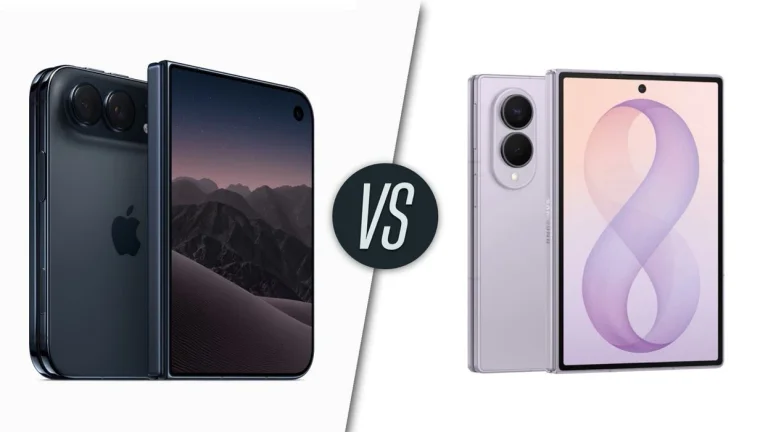
After years of rumors, leaks and great anticipation, Apple has finally unveiled its first foldable phone, the iPhone Duo.
With a short and relatively wide form factor, already familiar in the Android phone market, the iPhone Duo goes head-to-head with the Samsung Galaxy Z Fold8.
The two rivals face off in a fierce battle over design, display, performance, cameras, battery life and price.
Design and durability
Samsung has a clear advantage in weight. The Galaxy Z Fold8 is 53 grams lighter than the iPhone Duo, while it is also thinner both when folded and when open.
The difference in weight is expected to be noticeable in everyday use. Apple, on the other hand, is aiming for a more premium feel, using a titanium frame, while Samsung continues with an aluminum construction.
In terms of water and dust protection, the iPhone Duo has a slight advantage with its IP68 rating, while the Galaxy Z Fold8 comes with IP48.
Both phones have camera modules that protrude noticeably from the back, although the iPhone Duo’s appears to be slightly more pronounced.
Displays
On the outer display, the two models are almost identical in terms of dimensions, resolution, refresh rate and peak brightness.
The Galaxy Z Fold8 offers a more uniform look, while the iPhone Duo has rounded edges. Apple also uses a larger cutout for the selfie camera, positioned in the corner, while Samsung has a more compact cutout positioned in the center.
When the phone is opened, both models have the same diagonal display size. However, the iPhone Duo has a slightly higher resolution of 1878 x 2670 pixels, with a density of 430 ppi.
Another advantage for Apple is the selfie camera hidden under the display, creating a cleaner and less interrupted look.
Both displays offer a variable refresh rate from 1 to 120Hz and peak brightness of up to 3000 nits.
The iPhone Duo also adds a version with a Nano Texture finish, designed to significantly reduce reflections. Apple also offers support for using a stylus, a feature not available on the Galaxy Z Fold8.
Performance
In terms of processing power, Apple brings its new A20 Pro chip, manufactured using a 2nm process.
The company calls it “the fastest processor in any smartphone,” while real-world performance will need to be confirmed through independent tests and benchmarks.
The A20 Pro also has an additional GPU core, while Apple claims it delivers up to 40 percent more graphics performance compared with the A19 Pro.
On the other hand, the Galaxy Z Fold8 uses the Snapdragon 8 Elite Gen 5, manufactured using 3nm technology and currently among the most powerful processors in the Android ecosystem.
Both phones come standard with 12GB of RAM and 256GB of storage.
Samsung offers up to 16GB of RAM in the 512GB and 1TB storage versions, while the iPhone Duo goes further in terms of internal storage, with a maximum configuration of 2TB.
Cameras
In terms of photography, both phones have similar configurations, with a main camera and an ultrawide camera on the back.
Apple appears to use a slightly larger sensor in the main camera, measuring 1/1.28″, compared with Samsung’s 1/1.56″ sensor.
However, neither model has a dedicated telephoto camera, meaning optical zoom is not their strongest point.
The Galaxy Z Fold8 has an advantage in video recording, as it can record up to 8K at 30 frames per second.
Battery and battery life
As is often the case with Apple, the company has not disclosed the iPhone Duo’s actual battery capacity.
Apple claims up to 31 hours of video playback using the inner display and up to 44 hours when using the outer display. If both displays are used equally, the company says it offers around 24 hours of use.
Samsung, on the other hand, has equipped the Galaxy Z Fold8 with a 4800 mAh Si/C battery, which achieved a result of 13 hours and 59 minutes of active use in battery tests.
In video playback tests, the Fold8 lasted more than 20 hours, but these results cannot be directly compared with Apple’s figures, as the companies use different testing methods.
Charging
For wired charging, Apple claims the iPhone Duo reaches 50 percent battery in 20 minutes.
The Samsung Galaxy Z Fold8 reached around 65 percent in the same period, according to tests conducted.
Apple makes up for the disadvantage in wireless charging, with support for 25W, compared with 20W on the Galaxy Z Fold8.
Both phones have USB Type-C 3.2 ports.
However, Samsung has a significant advantage for professional users: Samsung DeX, which turns the phone into a computer-like environment when connected to an external display.
The iPhone Duo, in this respect, does not offer a similar desktop mode.
Connectivity and SIM
Both phones support the latest connectivity technologies, including Wi-Fi 7, Bluetooth 6.0 and UWB.
The iPhone Duo has the advantage of a second-generation UWB technology.
Another difference is the use of a physical SIM. The Galaxy Z Fold8 retains a physical SIM slot, while the iPhone Duo is eSIM-only.
Price – Samsung’s advantage
The biggest difference between the two phones may be the one on the price tag.
The Galaxy Z Fold8 currently costs 1,649 dollars or 1,929 euros, while the iPhone Duo starts at 1,999 dollars or 2,299 euros.
This means the iPhone Duo is around 350 dollars or 370 euros more expensive in the base configuration.
In a matchup where both phones offer very advanced specifications, this considerable price difference gives the Galaxy Z Fold8 a significant advantage in terms of value for money.
Ultimately, Apple is aiming to win with its display, new chip, premium materials and integration into its ecosystem, while Samsung relies on its lower weight, slimmer profile, DeX, faster charging and lower price.
Related

Technology
GTA 6 is launching this week, here are the date and details you need to know

Technology
YouTube, Facebook or TikTok? Here’s which social network Americans use most

Technology
Microsoft says its services have fully recovered after a day-long global outage

Technology
Microsoft outage paralyzes businesses, schools and government institutions around the world

Technology
Microsoft Platforms Face a Global Outage

Technology
Robot Takes on Humans in Antarctica Marathon, but Gives Up After 3 Kilometers
Technology
Google will add a dictionary to Gboard that saves words corrected during voice dictation

Technology
WhatsApp introduces “Events Home,” making it easier to organize get-togethers

Technology
Honda puts revolutionary V3 engine into production
Technology
WhatsApp tests a new feature

Technology
DokuTech 13, Kurti: Technology, the most dynamic sector of the economy

Technology
Windows 11 Gets Significantly Faster





