
The leader of the Vetëvendosje Movement and, at the same time, Prime Minister of Kosovo, Albin Kurti, spoke about the murder of Arlinda Zekaj at a meeting of the party’s General Council, calling for accountability from all institutional officials who have failed to perform their duties, reports Ekonomia Online. Kurti said that Arlinda’s case has […]
Kurti on the murder of Arlinda Zekaj: Every official who has neglected their duty must face disciplinary and criminal accountability
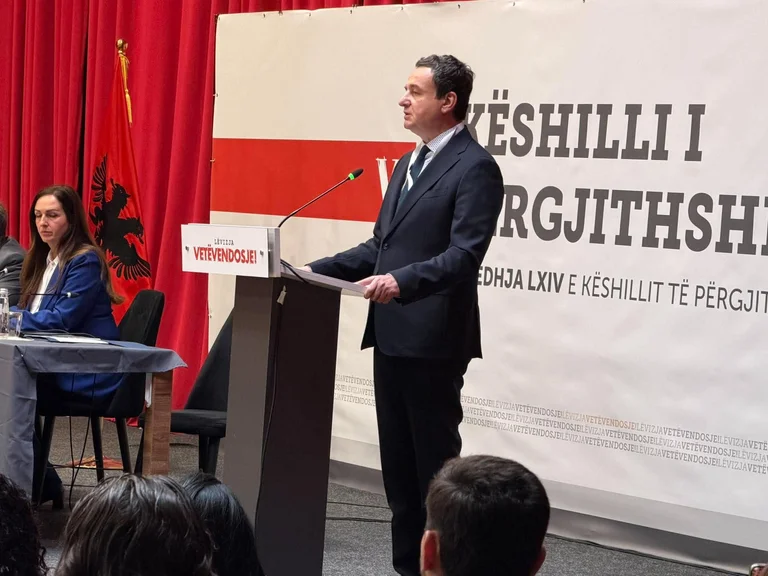
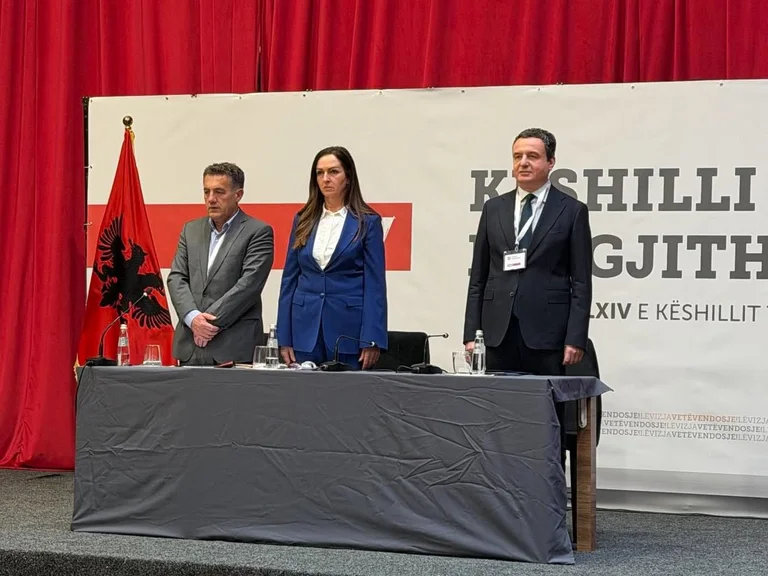
The leader of the Vetëvendosje Movement and, at the same time, Prime Minister of Kosovo, Albin Kurti, spoke about the murder of Arlinda Zekaj at a meeting of the party’s General Council, calling for accountability from all institutional officials who have failed to perform their duties, reports Ekonomia Online.
Kurti said that Arlinda’s case has once again confronted society with a harsh truth: even after reporting violence and seeking protection from institutions, a woman can end up murdered.
“The murder of Arlinda Zekaj has once again confronted us with a harsh truth: a woman can follow every avenue provided by law, report violence, seek protection, even warn in writing that her life is at risk, and still end up murdered. Arlinda did what institutions ask women to do when they face violence. Yesterday, we shared with the public the course of the case and the chain of failures identified in the relevant institutions, with the exception of those that refused to cooperate,” Kurti said.
He reiterated that they would remain committed to ensuring that every responsible official who has failed to perform their duty is held accountable, including through disciplinary and criminal proceedings.
“On this occasion, I reiterate that we will remain committed to ensuring that every responsible official who has failed to perform their duty is held accountable, both disciplinarily and criminally. Every person responsible and the responsibility of every link in the chain must be investigated. Anyone who has neglected their work or violated their legal obligations must be held accountable and will face disciplinary and criminal measures,” he said.
In his speech, Kurti also addressed the patriarchal mindset in society, saying that it continues to regard women as property and to see their independence as disobedience to male authority.
“Arlinda’s murder also confronted us with a deeper social problem: a patriarchal mindset that still considers women property or objects over which men can exercise power and force, that sees their independence as disobedience and the decision to leave a relationship as an affront to male authority. This mindset cannot be changed through laws alone. It requires continued confrontation within families, schools, institutions and our own political organizations,” Kurti said.
He stressed that changing this mindset must begin with the education of children, announcing further reviews of educational curricula at all levels.
“But changing this mindset must begin much earlier, with the education of children. We will continue to review the curricula, starting with preschool education and continuing at all levels of education, so that equality, respect for others, personal autonomy and the resolution of conflicts without violence are taught from childhood, in an age-appropriate way,” he said.
Kurti also criticized the traditional way of raising girls and boys, stressing that inherited gender roles should be examined in school textbooks as well as in family upbringing.
“We cannot continue raising girls to be obedient and patient, while raising boys to be dominant. We must courageously examine these inherited roles, both in school textbooks and in the way we raise our children. The emancipation of a society is measured by the freedom it recognizes for women, but also by the men it raises. Therefore, the fight against femicide also requires a genuine education policy that treats gender equality as part of forming a citizen, from early childhood,” the prime minister said.
The head of government also addressed economic inequality, saying that patriarchy is reproduced through inequality in property ownership, unpaid work that weighs on women, and unequal opportunities in employment and decision-making.
“In addition, we must understand that patriarchy is sustained not only by outdated mindsets. It is also reproduced through economic inequality, through property being left to sons rather than daughters, through unpaid work that weighs on women, and through unequal opportunities in employment and decision-making. Therefore, emancipation will continue to be part of our education, economic and social policies,” Kurti said.
He stressed that society’s emancipation must begin with the education of children and extend to the sharing of family responsibilities, the guaranteeing of property rights and the creation of opportunities for women’s economic independence.
“We must start with how we educate children, how we share responsibilities within the family, how we guarantee women’s property rights and how we enable their economic independence,” he said.
Finally, Kurti said that gender equality must be demonstrated through concrete decisions and policies, as well as through the way institutions protect women when their lives are at risk.
“Gender equality must be demonstrated in the decisions we make, the policies we implement and the way we protect women when their lives are at risk. We have made significant progress in this regard, and we have a political responsibility to demand accountability for every violation identified,” Kurti concluded.
Related

Uncategorized
Around 200 Infrakos workers on strike, demand pay raises
Uncategorized
President Justina Shiroka Pula meets with the Kosovo Women's Network, discusses preventing violence against women

Uncategorized
British Prime Minister’s letter to Kurti; former ambassador: Trendafilova called European countries, asked them to threaten Kosovo over the Specialist Chambers
Uncategorized
Sadikaj: A woman’s life is mourned after she is murdered; before the murder, she does not count

Uncategorized
Arlinda Zeka case sparks clashes in the Investigative Commission
Uncategorized
Adnon Jashari, accused in the Diana Kastrati case, declared wanted
Uncategorized
Reports on Sveçla’s niece being appointed as a diplomat, Konjufca: I don’t deal with proper names
Uncategorized
IMF assesses ATK's progress in implementing reforms and modernizing the tax administration

Uncategorized
Putin Is Panicking Ahead of U.S. Elections, Says Congressman Whitesides
Uncategorized
Clash between ruling and opposition parties in Health Committee over report on essential medicines and waiting lists
Uncategorized
Edona Podrimja appointed Deputy Minister of Health
Uncategorized
German Ambassador Meets Members of the Committee on Foreign Affairs and Diaspora





