
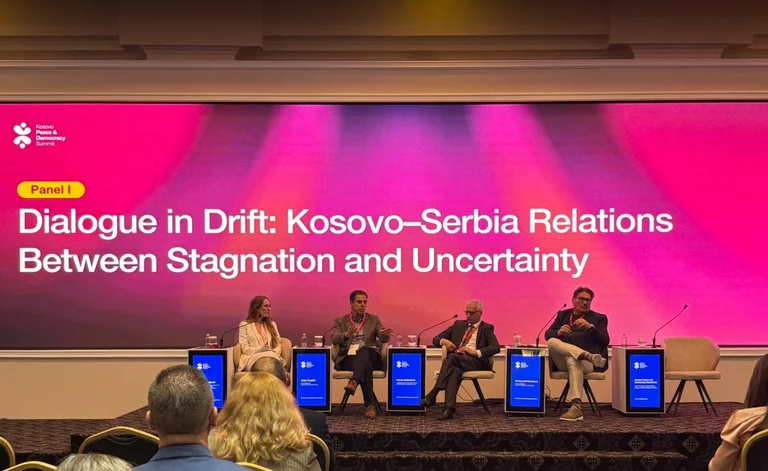
At the Kosovo Peace and Democracy Summit, held this year under the theme “The Age of Entropy,” the first panel discussed the Kosovo-Serbia dialogue, the role of the European Union and the political challenges hindering progress toward normalizing relations. Naim Rashiti, Goran Svilanović and Miodrag Miki Marinković said that progress […]
Peace and Democracy Summit, Rashiti: There will be no progress in the dialogue without cooperation between Vetëvendosje and PDK
At the Kosovo Peace and Democracy Summit, held this year under the theme “The Age of Entropy,” the first panel discussed the Kosovo-Serbia dialogue, the role of the European Union and the political challenges hindering progress toward normalizing relations. Naim Rashiti, Goran Svilanović and Miodrag Miki Marinković said that progress in this process depends on the responsibility of political leaders, the implementation of agreements and a credible prospect of European integration, reports Ekonomia Online.
Naim Rashiti, executive director of the Balkan Policy Research Group, said that cooperation between the Vetëvendosje Movement and the Democratic Party of Kosovo could create a new opportunity to implement the dialogue agreements. He stressed that, after a decade of clashes and mutual accusations over the 2013 and 2023 agreements, it is essential for the two main political entities to find a way forward.
“Something good has happened in Kosovo, something that has been missing for a very long time: cooperation between Vetëvendosje and PDK is the first bridge of its kind to have been created through the election of the president. We have a very credible president in office, who will be different in this political landscape. We saw this some time ago, but we want to build on it further. A government led by PDK made the 2013 agreement, and a government led by Vetëvendosje made the 2023 Brussels agreement. Over these ten years, they have clashed with one another and blamed one another for the content of the agreements, neither of which they truly liked. We hope, and will apply considerable pressure, for these two parties to find a way to implement both agreements, from 2013 and 2023. This is extremely important. Until we see these two main political actors cooperating, we will not see any significant progress in the dialogue, nor any significant progress in other state-building policy processes and their respective agendas,” Rashiti said.
He stressed that responsibility for implementing the agreements should not rest with Kosovo alone, but that the European Union must also be held accountable to prevent the process from dragging on for decades more. He said civil society would continue to apply pressure mainly at the domestic level, so that Kosovo’s institutions meet their obligations, while the EU ensures a more accountable and effective process.
“With regard to these two agreements, Kosovo will have to be held accountable for implementation during this decade, but we will call on the EU to take greater responsibility to prevent us from reaching 2033 or 2043. We cannot allow the agreements to be dragged from one decade to the next, so our pressure and the role of civil society will focus mainly at the domestic level. Kosovo must take care of two segments of this process: first, the constitutional order in terms of community rights, which constitutes an important component of the Brussels dialogue and requires additional arrangements for the rights of communities in this country,” he said.
Rashiti emphasized that the constitutional order includes not only community rights, but also mechanisms for checks and balances, the separation of powers and the powers of municipal government. He called on the government to establish a high-level mechanism to oversee the implementation of constitutional guarantees and the agreements reached in the dialogue.
“When I speak about the constitutional order, there are two elements in its entirety: mechanisms for checks and balances, in which Kosovo is unique compared with the rest of the region, and community rights. We often address community rights in Kosovo while preserving checks and balances, the separation of powers, the competencies and powers of municipal government, in addition to the basic chapters on community rights. This also includes elements arising from the dialogue, including the agreements. We will call for—and are calling for even now—the government to establish a high-level office within the government, hopefully with a coordinator, to oversee the implementation of these constitutional guarantees and the Brussels dialogue,” Rashiti said.
Meanwhile, diplomat and former Secretary-General of the Regional Cooperation Council Goran Svilanović said he did not expect political changes in Belgrade to automatically bring a willingness to address the issue of Kosovo. According to him, in Serbia, engaging in efforts to resolve this issue is often perceived as political betrayal, leading leaders to avoid difficult decisions.
“I do not have high expectations that whoever is in office in Belgrade tomorrow will jump into addressing a difficult issue. For anyone in Belgrade, regardless of political affiliation, addressing Kosovo is something that makes you feel as if you are giving something up. I am simply sharing a feeling; I am not saying this is true, but that is how it is. This is what people see: you are a traitor if you start dealing with this. So it is better to do nothing. And that is what we have seen in recent years,” Svilanović said.
He said that one of the main reasons for Belgrade’s lack of engagement is waning confidence in Serbia’s prospect of EU membership. According to him, when leaders and citizens no longer believe that membership is a real possibility, their willingness to pay the political price of resolving difficult issues, including normalizing relations with Kosovo, also diminishes.
“The moment Belgrade realized that membership was not going to happen, they stopped talking about Kosovo. So why would they do anything? Why would they pay a price? Why was addressing this issue seen as paying a price for something bigger and better? That is why I was saying: look, if you are stuck with Belgrade when it comes to EU membership, then you are really stuck, believe me. As long as people in Serbia do not start believing in membership again—and at the moment they do not—the situation will remain difficult. I fully appreciate what Marko is sharing with us. There is a substantial effort by the commissioner and the Commission to send the message that we are working on the regulations, trying to make the process possible, trying to overcome bilateral issues and limit the votes. But do you know how many people in Belgrade are really following this? Unfortunately, I am telling you frankly: the situation is worse than you think,” Svilanović said.
Miodrag Miki Marinković, executive director of the Center for Social Affirmative Action, said that the government led by Serbian President Aleksandar Vučić had used public communication strategies to present itself as willing to pursue European integration, while, he said, developments on the ground had contributed to the weakening of democracy and independent institutions.
“The government led by Vučić has used PR strategies to communicate its readiness for EU integration, while on the ground it has facilitated processes that lead to the erosion of democracy and institutions. Meeting the basic conditions for EU membership, such as democratization and the establishment of independent institutions, would cause Serbia’s leadership to lose power. This makes the integration process a paradox and a sham,” Marinković said.
He said the situation in Kosovo was different, noting that stable institutions create conditions for progress in the European integration process. However, he said, securing the support of the five EU member states that do not recognize Kosovo’s independence remains a challenge.
“The situation in Kosovo is different, with the stable institutions recently established providing the basic conditions for Kosovo to engage in this process over the next four years. Kosovo has shown great success in aligning itself geostrategically and politically with EU values. However, another challenge for Kosovo remains securing support from the five non-recognizing countries, which fear the creation of a precedent similar to Serbia’s secession in 1999. These five countries are seeking some form of tacit consent from Belgrade, while the normalization process and the EU-facilitated dialogue aim to align these conditions and secure international recognition of Kosovo,” Marinković said.
Related

Uncategorized
Around 200 Infrakos workers on strike, demand pay raises
Uncategorized
President Justina Shiroka Pula meets with the Kosovo Women's Network, discusses preventing violence against women
Uncategorized
British Prime Minister’s letter to Kurti; former ambassador: Trendafilova called European countries, asked them to threaten Kosovo over the Specialist Chambers
Uncategorized
Sadikaj: A woman’s life is mourned after she is murdered; before the murder, she does not count

Uncategorized
Arlinda Zeka case sparks clashes in the Investigative Commission
Uncategorized
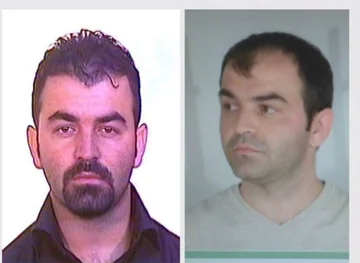
Adnon Jashari, accused in the Diana Kastrati case, declared wanted
Uncategorized
Reports on Sveçla’s niece being appointed as a diplomat, Konjufca: I don’t deal with proper names
Uncategorized
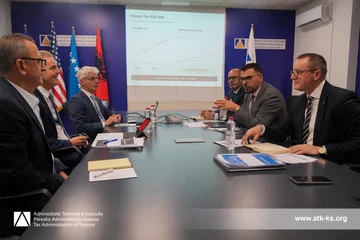
IMF assesses ATK's progress in implementing reforms and modernizing the tax administration
Uncategorized
Putin Is Panicking Ahead of U.S. Elections, Says Congressman Whitesides
Uncategorized
Clash between ruling and opposition parties in Health Committee over report on essential medicines and waiting lists
Uncategorized
Edona Podrimja appointed Deputy Minister of Health
Uncategorized
German Ambassador Meets Members of the Committee on Foreign Affairs and Diaspora





