
Kosovo and the Western Balkans are no longer among the top priorities of the foreign policy of the United States of America and the European Union, while changes in the US administration have brought a more bilateral-relations-focused approach, says Naim Rashiti, executive director of the Balkan Policy Research Group (BPRG), reports Ekonomia Online. […]
Rashiti: Kosovo and the Balkans are no longer a priority for the US and the EU
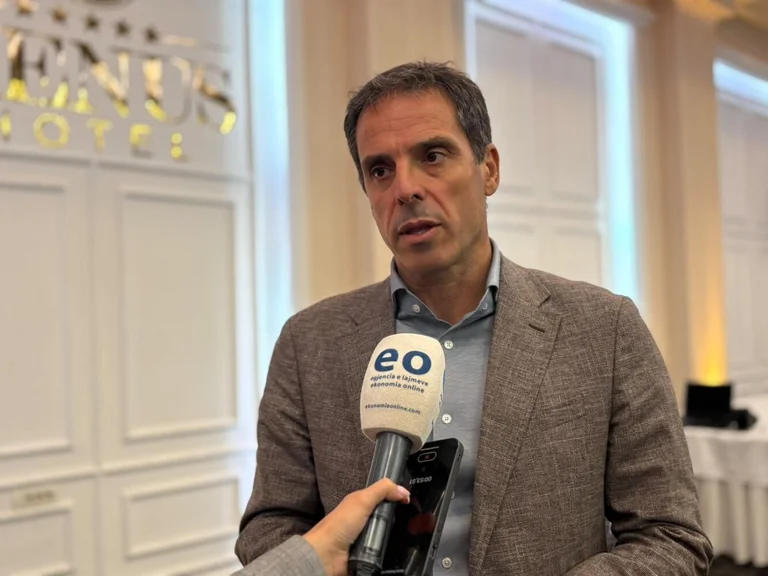
Kosovo and the Western Balkans are no longer among the top priorities of the foreign policy of the United States of America and the European Union, while changes in the US administration have brought a more bilateral-relations-focused approach, says Naim Rashiti, executive director of the Balkan Policy Research Group (BPRG), reports Ekonomia Online.
According to Rashiti, new global developments, international conflicts and changes in US foreign policy have shifted attention away from the Balkans, making it more difficult to predict Washington’s future policies toward the region.
“Look, a great deal has changed in the world, from new conflicts—not only in Ukraine, after and beyond Ukraine, but also the Middle East, the war with Iran. This has changed all global priorities, including the impact on energy and the supply of fuel, and so on. First, that is the major change. The second major change has to do with the change in administration. The new US administration has brought many major changes, entirely different, radical approaches compared with the multilateral policy that functioned relatively well in relations with the EU, especially, and NATO,” he told Ekonomia Online.
Rashiti said the new US administration is pursuing a policy that, in his view, is not clearly defined and relies more on bilateral relations than on cooperation through international mechanisms.
“And now we have a policy that is not well defined; it is being made as it goes along, it is not set, it is ad hoc and continues to be so, whether in cooperation with NATO or with—well, it is a policy that does not apply multilateralism, does not apply cooperation with international organizations, but is primarily based on bilateral relations. And the major changes under this administration, first and foremost in different countries, are defined more through bilateral relations—with Kosovo, Albania, Serbia, Greece, Turkey—than through relations via multilateral mechanisms. Whether this has been successful, or how well defined it has been, or how stable or consistent this policy has been, we do not know; it is difficult to predict. From our point of view, the biggest flaw is that we are seeing neither any particular achievements by the US administration nor any definition of policies, and so on,” he said.
He said that despite several resolutions and laws passed by the US Congress and Senate that influence the formulation of policy toward Kosovo and the Balkans, the region is no longer at the center of international security, integration and development agendas.
“Nevertheless, in the best-case scenario, we have a positive approach, with Congress and the Senate having passed several resolutions and laws that, in a way, shape US policy toward Kosovo and the Balkans. But simply put, for neither the US nor the EU are Kosovo and the Balkans a policy priority or a priority on international agendas, whether in terms of the security agenda, the integration agenda or the development agenda. The Balkans has been in the spotlight for a long time, for many years, but no longer,” he said.
In this situation, Rashiti believes Kosovo and the countries of the region should take greater responsibility for resolving their problems through regional cooperation and by developing policies that reduce dependence on international actors.
“And this should be the lesson for Kosovo’s politics, since we are talking about Kosovo, but also for the Balkans: there needs to be an awakening and mobilization to make policy. This is happening with the EU too, if you recall Vice President Vance’s speech in Munich, where he said, ‘Enough, Europe—you have been protected, you have lived under American protection for 80 years; wake up and build under your own protection.’ This applies to the Balkans too. Enough—wake up, establish cooperation, solve problems, pursue development, and consolidate with as little dependence as possible on the main international actors,” he said.
Speaking about developments in US policy toward the region over the years, Rashiti said the gradual shift in attention away from the Balkans began earlier, while tensions between the US and the EU have created uncertainty for Kosovo, especially in the processes of dialogue, integration and investment.
“Well, this happened gradually starting in the Obama era, with a kind of disengagement from the Western Balkans. Some damage was also done to Kosovo during President Obama’s time. Then, during President Trump’s first term—not directly affecting Kosovo, but the deterioration in relations with the EU had a major impact on Kosovo’s agenda. The conflict between the US and the EU, if you recall, over the dialogue process, integration, investment and the Open Balkans, caused a lot of damage to Kosovo and created a great deal of uncertainty and confusion,” he said.
He said the Joe Biden administration also failed to sustainably restore the Balkans agenda, while Donald Trump’s second term has brought further changes that, in his view, make it more difficult to determine US policy toward Kosovo.
“Then the return of the Biden administration, the Democrats, did not properly restore the Balkans agenda. In a way, there was an alignment with the EU, whose position had been weakened and whose agenda for the Balkans had been scaled back, and almost four years passed in silence, without any major impact. The new changes in President Trump’s second term have also brought further changes, making it difficult to define Kosovo’s position precisely. Nevertheless, Kosovo must preserve the alliance in certain strategic areas, including security and capital projects, and maintain this relationship, because Kosovo needs the US under any circumstances as one of the countries with which it can form an alliance and find support in every situation. For example, Kosovo’s membership of NATO—or, more precisely, Kosovo’s rapprochement with NATO—depends exclusively on the US,” he said.
According to Rashiti, Kosovo should take a more proactive approach toward Washington and preserve its strategic alliance with the US, even when requests or issues arise that do not fully align with its positions. He also stressed the importance of strengthening relations with the United Kingdom and EU countries.
“And it should take a very proactive approach, sometimes even confronting specific requests, challenges and issues that are not necessarily in line with, or consistent with, Kosovo’s policy. But you have to face them, because this alliance is very important in the long term. The changes we have seen in the US over recent decades are fluid; they can be positive or negative, so this alliance must be preserved. This is also demonstrated by examples from other countries and other developments, including after Brexit. Kosovo should now further consolidate its relations with the United Kingdom, as well as with EU countries. Kosovo cannot achieve full international integration without the support of these international actors and must always be highly cooperative,” he said.
Related

Uncategorized
Around 200 Infrakos workers on strike, demand pay raises
Uncategorized
President Justina Shiroka Pula meets with the Kosovo Women's Network, discusses preventing violence against women

Uncategorized
British Prime Minister’s letter to Kurti; former ambassador: Trendafilova called European countries, asked them to threaten Kosovo over the Specialist Chambers

Uncategorized
Sadikaj: A woman’s life is mourned after she is murdered; before the murder, she does not count

Uncategorized
Arlinda Zeka case sparks clashes in the Investigative Commission
Uncategorized
Adnon Jashari, accused in the Diana Kastrati case, declared wanted
Uncategorized
Reports on Sveçla’s niece being appointed as a diplomat, Konjufca: I don’t deal with proper names
Uncategorized
IMF assesses ATK's progress in implementing reforms and modernizing the tax administration
Uncategorized
Putin Is Panicking Ahead of U.S. Elections, Says Congressman Whitesides
Uncategorized
Clash between ruling and opposition parties in Health Committee over report on essential medicines and waiting lists
Uncategorized
Edona Podrimja appointed Deputy Minister of Health
Uncategorized
German Ambassador Meets Members of the Committee on Foreign Affairs and Diaspora





