
Experiments involving groups, open spaces and different cultures revealed the same pattern: people tend to turn counterclockwise, even when nobody is directing them. This scientific story began, like many others, entirely by chance. During the coronavirus pandemic in 2020, a team of scientists was studying practical situations – how people move indoors when asked to keep their distance? […]
Almost Everyone Tends to Walk Left Unconsciously – The Discovery That Is Astonishing Physicists
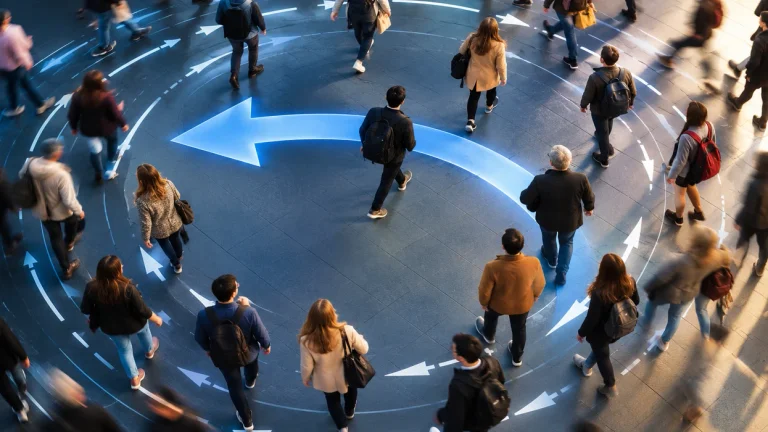
Experiments involving groups, open spaces and different cultures revealed the same pattern: people tend to turn counterclockwise, even when nobody is directing them.
This scientific story began, like many others, entirely by chance. During the coronavirus pandemic in 2020, a team of scientists was studying practical situations – how do people move indoors when asked to keep their distance?
As they repeatedly analyzed the recordings, they noticed an unusual phenomenon: almost all the participants walked in circles that consistently veered in the same direction, counterclockwise. Even stranger was that none of them was aware they were doing it.
This observation launched a five-year investigation aimed at discovering what lies behind this unconscious pattern of human behavior.
Right-handed people veer left more often, while left-handed people veer right
When a group of people is allowed to move freely within an enclosed space, without a specific destination, the crowd gradually starts turning left. Nobody directs this movement, and nobody consciously decides to do so.
To physicists, this seemed like a typical example of so-called “emergent behavior” – a collective pattern that arises from a large number of small interactions between individuals and their environment or one another.
The scientists’ first hypothesis was that the walls of the space and the dominant hand determined the direction. Earlier neuroscience studies have shown that right-handed people veer left more often, while left-handed people veer right, because of small differences between the brain’s hemispheres.
The physicists assumed that turning left was simply the result of the individual tendencies of right-handed people interacting with the walls.
To test this, they organized a new experiment. First, they tested volunteers individually to see which way they veered when approaching a wall, and then formed groups made up only of left-handed people or people who always veered right.
The expectation was that these groups would start turning clockwise. But that did not happen. Regardless of the group’s composition, the leftward, counterclockwise rotation continued.
They then moved the experiment to an open schoolyard measuring around 3,000 square meters, with no walls or obstacles. The effect not only failed to disappear, but became even more pronounced.

Culture and traffic rules have no influence
The scientists then suspected cultural habits. In Europe and Spain, where the study began, people generally move to the right when passing one another, leaving more space on the left.
It was assumed that in Japan, where traffic drives on the left side of the road, people would turn clockwise.
In collaboration with colleagues in Tokyo, an experiment was conducted with Japanese participants. The hypothesis failed again – the Japanese group also moved counterclockwise.
The final cultural hypothesis concerned the convention of running tracks. For this reason, preschool-age children, who have not yet learned adult conventions, were tested. Their tendency to move left was more pronounced than in any other group tested.
The answer seems to lie within the individual
After the influences of the group, environment and social habits had been ruled out, only one possibility remained: an intrinsic biomechanical or neurological characteristic of the individual.
When more than 200 volunteers were asked to walk entirely alone in an empty arena, with nobody near them, the vast majority continued spontaneously to walk in circles to the left.
In fact, the movement data of just one person were sufficient to reproduce the behavior of the entire group using a computer model.
“Honestly, we still don’t know exactly what causes this tendency at the individual level. We have looked for links with dominant hand, foot, eye, gender and other factors, but we haven’t found anything,” the study’s authors admit.
Studies of people walking with their eyes covered suggest that there may be small asymmetries in the inner ear, which could slightly alter our sense of direction. However, for now, science still has no definitive answer.
Despite this, the fact that this tendency appears to originate within the individual is of great importance for the design of public spaces, such as airports, railway stations and museums, where guiding crowds is very important.
It is also interesting that, as the researchers point out, the same impulse to veer left also appears in the animal world – in schools of fish or colonies of ants.
This may indicate that the force prompting an individual to turn left is much older than humanity itself.
Related

Psychologist
Are We Really Hungrier in Winter: Cold Is Not the Only Reason

Psychologist
10 Negative Consequences of Being Too Kind

Psychologist
Why do two people remember the same event completely differently: Is one of them lying?

Psychologist
10 Traits of Smart People That Have Nothing to Do with Intelligence

Psychologist
Symptoms of mental illnesses that look like normal behavior

Psychologist
Are you constantly afraid that you are ill? When concern about your health turns into anxiety

Psychologist
10 Habits That Destroy the Brain

Psychologist
From Struggling to Ask for Help to Self-Doubt: Signs of Being Misunderstood in Childhood

Psychologist
Don’t recognize yourself anymore? Six changes in your behavior may reveal that you’re under major stress
Psychologist
Do you keep saying “I’m fine” while suffering inside? Here’s what happens to your body when you bottle up your emotions

Psychologist
When They Don’t Reply, the Mind Starts Making Up Scenarios: How Anxious Attachment Can Wear Down a Relationship

Psychologist
What happens in the brain when we can’t stop laughing? Scientists identify two different networks





