
I did not have a happy adolescence, but the truth is that I did not want to be happy. I wanted to be a Prince Hamlet, a Raskolnikov, even a Werther, and I probably became one, but I did not realize that I was playing the role of a romantic young man, as all “angry young men” do. These are romantic games, pointless and, I would say, insignificant. I do not know whether I have given them up now, but I feel relatively happy. Perhaps because now I am more or less who I am […]
A rare interview with Borges about loneliness and blindness…
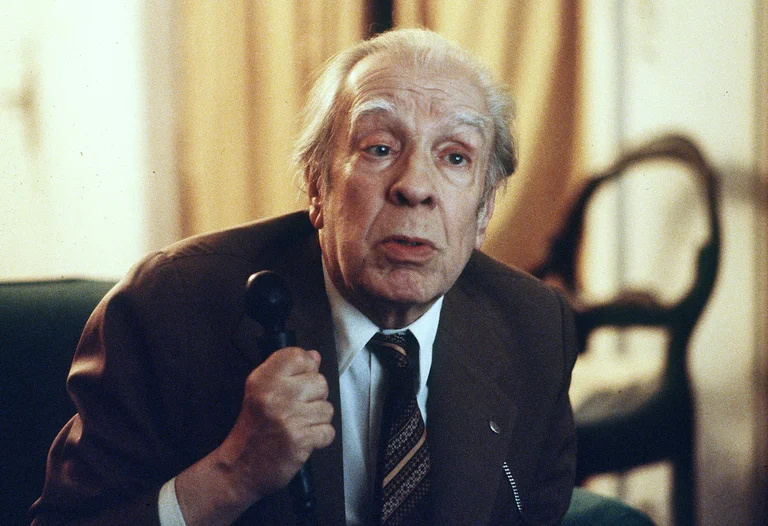
I did not have a happy adolescence, but the truth is that I did not want to be happy. I wanted to be a Prince Hamlet, a Raskolnikov, even a Werther, and I probably became one, but I did not realize that I was playing the role of a romantic young man, as all “angry young men” do. These are romantic games, pointless and, I would say, insignificant. I do not know whether I have given them up now, but I feel relatively happy. Perhaps because now I am more or less who I am
Oscar Wilde’s “The Happy Prince” is an 1888 story about a metal statue that befriends a bird. Jorge Luis Borges translated it into Spanish when he was nine years old. When he turned twelve, he read Hamlet, and at the age of fifteen he wished, as he said above, to become the Prince of Denmark.
In his fifties, Borges became completely blind as a result of a genetic disease, but although he was no longer able to read, he never stopped writing. His mother became his personal secretary for most of his life, and before she died at the age of 99, she tried to marry her blind son off to a woman who could take care of him.
Which was Borges, the metal statue or the bird? This is one of his most comprehensive interviews, given to the American writer Richard Burgin.
-Was there ever a time when you were not in love with literature?
Jorge Luis Borges: No. I have always thought of myself as a writer, even before I wrote a book. I might even say that before I wrote anything, I knew I could do it. I do not think of myself as a good writer, but I knew that my future and my fate were bound up with literature. I never thought of becoming anything else.
-Did you never think of starting a career? I mean, your father was a lawyer.
JLB: Yes. But besides that, he tried to be a literary man and failed. He wrote some very pleasant sonnets. But he thought this was the destiny I was meant to fulfill, didn’t he? And he advised me not to rush into publishing.
-But you published when you were quite young. In your twenties.
JLB: Yes, I know, but he told me: “There is no need to hurry. Write, check what you have written, destroy it, take your time. What matters is that when you publish something, you should consider it quite good, or at least the best you could do.”
-When did you start writing?
JLB: When I was little, I wrote a ten-page handbook on Greek Mythology, in very poor English. That is the first thing I wrote.
-Do you mean something original about mythology, or a translation?
JLB: No, no, no, no, no. It was explanatory material, how shall I put it, “Hercules did the work of twelve workers,” or “Hercules killed the Nemean Lion.”
-So you had read these books when you were very young.
JLB: Yes, of course. I am very fond of mythology. Still, it was nothing much, no more than fifty pages… with the stories of the Golden Fleece, the Labyrinth, and Hercules, who was my favorite, and something about the loves of the gods and the tales of Troy. That was the first thing I read. I remember writing the handbook in very bad handwriting, because I had problems with my eyesight. That is all I can say about that book. In fact, I think my mother kept a copy of it for a while, but since we were constantly traveling, it was lost, and of course that is what had to happen, because we had no other reason to value that book except for the fact that it had been written by a little boy. Later I read two chapters of “Don Quixote,” and then I tried to write in Old Spanish. That saved me from trying to write in English again, fifteen years later. Since I had tried it once and failed.
-Do you remember much of your childhood?
JLB: I had problems with my eyesight, so when I think of childhood, I think of books and their illustrations. I can remember every illustration in “Huckleberry Finn,” “Life on the Mississippi,” and so on. Also the illustrations in “The Arabian Nights,” by Dickens, Cruikshank, and Fisk. I also have memories of being in the countryside, riding on the farm, when I was in Uruguay and Argentina. I remember my parents’ house with its large courtyard, and so on. But what I mostly remember are the little things. Because they were things I could actually see. I remember the illustrations in encyclopedias and dictionaries quite well. “Chambers Encyclopedia” or the American edition of “ Encyclopaedia Britannica,” with engravings of animals and pyramids.
-So you remember the books of your childhood more than people.
JLB: Yes, because I could see them. Have you corresponded with other writers?
JLB: No.
-I thought so. You were a loner.
JLB: Besides, I do not write many letters. I am very fond, for example, of my mother. I love her very much. I am always thinking about her. Then, I have to dictate my letters. But even when I am away from her, I always send her very poor letters, because somehow I understand that she knows how I feel without my having to say anything. I can be blunt, cheerful, or ordinary, but she understands exactly what state I am in at every moment. So the letters I send her—sometimes they are also postcards to help me along—I think are completely meaningless to anyone else, but they have a secret writing code between us, although neither of us has ever spoken about it. She knows me and I know her. I think six months could go by without my receiving a letter from her and, if I knew she was well, it would not bother me. She would feel more or less the same way about me. Of course, I worry in case she falls ill or something happens to her. But if I get confirmation from all sources that she is managing, I have no need to worry about her, and she has no need to worry about me.
-She must be a remarkable woman.
JLB: She is a remarkable woman. She was in prison during Perón’s time. So was my sister.
-You noticed something quite interesting about “Don Quixote”: that he never killed anyone throughout all his adventures, although he often took part in duels.
JLB: Ah, yes! That surprised me.
-And you wrote something about this allegory.
JLB: I believe the real reason may be that Cervantes wanted to keep the work within the limits of farce, and if he had killed someone, the book would have been very real. Don’t you think so? I mean, if Quixote kills someone, then in some way he is a bad man, however he may justify his action. I do not think Cervantes wanted to go that far, did he? He wanted to keep his book within certain limits, and if Quixote had killed someone, it would have done Cervantes no good.
–You have also mentioned that in some cases in the book, the author himself becomes a main character. So perhaps Cervantes could not kill anyone if he had become Don Quixote.
JLB: Yes, but I imagine he must have killed many people during his life as a soldier. But that is different, isn’t it? Because when a soldier kills someone, he does not kill them personally. Don’t you think so? I mean, if you kill someone as a soldier, you have not killed them. You are simply an instrument. Someone else has killed them through you. You do not have to take any responsibility. I do not believe a soldier feels guilty about the people he has killed. Except for the one who dropped the bomb on Hiroshima.
-Many of them went mad. I mean the people who had anything to do with that bomb.
JLB: Yes, but somehow, I think you are, I should not tell you this…
-Well, say it.
JLB: I do not think Hiroshima was worse than any other battle.
-What do you mean?
JLB: It ended the war in a day. The fact that many people were killed is no different from the fact that one person is killed. Every person experiences their own death and can die in an infinite number of ways. Besides, hardly anyone knows all those who were killed in Hiroshima. After all, Japan supported violence, empire, war, cruelty; they were not early Christians or anything like that. In fact, if they had had the bomb, they would have done the same thing to America.
I know I should not say these things, because they make me seem heartless. But, I do not know why, I have never been able to feel anything else about Hiroshima. Perhaps something new is happening to humanity, but I think that if you accept war, I must say this, if you accept war, you must also accept cruelty; then you must accept slaughter, bloodshed, and such things. After all, being killed by a rifle, or by a stone, or by a knife, is essentially the same thing. Hiroshima is different because so many innocent people were involved and because it all happened in a single instant.
-Did you read a lot before you began writing, or did you let the two develop together?
JLB: I have always been better as a reader than as a writer. I began to lose my sight permanently in 1954, and since then I have read through someone else. When someone is unable to read, his mind works in a different way. In fact, I can say that there is some benefit in being unable to read, because you think time flows differently. When I could see, if I had to spend even half an hour without doing anything, I would go mad, because I had to read. But now I can be alone for a long time; long train journeys do not bother me, nor does staying alone in a hotel or walking through the streets, because I cannot say I am thinking all the time, as that would be boasting. I think I am able to live without preoccupations. I do not have to talk to people or do anything. If someone has gone out and I come home to find the house empty, then I would like to sit for two or three hours and then go out for a short walk, but I would not feel sad or lonely. This happens to everyone who has gone blind.
-What do you think about during that time—some specific problem, or…
JLB: I may not be thinking about anything. I simply live. I can let time pass, or perhaps rummage through memories of the past, or I might be walking along a bridge trying to remember my favorite passages, or perhaps I may be doing nothing, simply living. I have never understood why people say they are bored because they have nothing to do. Sometimes I have nothing to do, but I do not feel bored. It pleases me not to be occupied with something all the time.
–Have you never been bored in your life?
JLB: I do not think so. Certainly, when I had to lie in bed for ten days after an operation, I felt anxious, but not bored.
-You are a metaphysical writer, but many writers, such as Jane Austen, Fitzgerald, or Sinclair Lewis, seem to have no metaphysical sensibility at all.
JLB: When you say Fitzgerald, do you mean Edward Fitzgerald, right? Or Scott Fitzgerald?
-The latter.
JLB: Ah, yes. I was just mentioning a writer who seems not to have any metaphysical sensibility.
JLB: He was always superficial, wasn’t he? After all, why not mention him?
-Certainly many people seem to live and die without really thinking about the problems of time, space, or infinity.
JLB: That happens because they take the universe for granted. They take things for granted. They take themselves for granted. That is the truth. They are never amazed by anything. They do not think it is strange that they have to live. The first time I felt this was when my father told me: “It is quite a strange thing that I have to live, as others say, within the limits of what we see and think. I wonder, does that make sense?” That was the first time I felt this, and I began to think about it seriously, because I knew what he was saying. Many people find this difficult to understand. They say: “But where else could you live?”
–Do you think there is something in people’s minds that blocks their understanding of the wondrous, perhaps something many human beings have in common that prevents them from thinking about these things? Because, after all, if they spent their time thinking about the wonders of the universe, they would not have time to do the work on which the fate of civilization depends, and perhaps they would do nothing at all.
JLB: But I think many things have been achieved today. Yes, of course.
Sarmiento writes about how he once met a peasant who told him, “The village is so beautiful that I do not need to think about the causes of its beauty.” It is very surprising, isn’t it? It is a kind of logical conclusion. He should have started thinking about what caused that beauty. But I imagine he meant that he was drunk on all that beauty, which had made him feel very happy, and he did not see the point of thinking more deeply. In general, I think men are more inclined toward metaphysical wonder than women. I think women take the world for granted. And things, themselves, and circumstances, too. Especially circumstances.
–They see every moment as separate from the next and do not think about the circumstances that lead to them.
JLB: No, because they believe that…
-They take things one at a time.
JLB: Yes, they take things one at a time, and then they are afraid of making a bad impression, or they see themselves as actresses. As if the whole world were watching them and, of course, admiring them.
-They seem more timid than men in everything. Do your writings always have their source in other books?
JLB: Yes, that is true. That is because I think of reading a book as an experience no different from traveling or falling in love. I think reading Berkeley, Shaw, or Emerson is as real an experience for me as a visit to London. Of course, I see London through Dickens, Chesterton, and Stevenson. Many people tend to think of life in one way, which means toothache, headache, travel, and so on. Then there is the other side, imaginary and sophisticated life—that is, the arts. But I do not think there is any difference between these. I believe everything is part of life. For example, today I was telling my wife that I had traveled, not throughout the whole world, I cannot say that, but throughout the whole West. Still, I see that I have written poetry mostly about gloomy street corners. I have never written poetry about any great subject, I mean, a famous subject. For example, I like New York very much, but I do not think I will ever write about it. Perhaps I will write about some little corner of it, since so many others have written about New York.
-Which writer do you think is able to create characters?
JLB: Conrad and Dickens. Conrad, certainly, because with him you feel that everything is real and at the same time very poetic. I would place Conrad much higher than Henry James. When I was young, I thought Dostoevsky was the greatest writer. About ten years later, when I read him, I felt very disappointed. I felt as though the characters were not real and were all part of a plot. Because in real life, even in a difficult situation, even if you are very upset about something, even if you feel anxiety or hatred—I have never felt hatred—or love, or rage, you also live along other lines, don’t you? I mean, when a man is in love, he is also interested in the cinema at the same time, or thinks about mathematics, poetry, or politics. Whereas in many novels, the characters live only through what happens to them. Perhaps that can happen with some very simple people, but I do not think it is something that happens.
-Do you think that a book like “Ulysses,” for example, was, among other things, an attempt to show the whole spectrum of thought?
JLB: Yes, but I think “Ulysses” is a failure. While reading it, you learn about thousands of circumstances the characters go through, but you do not know the characters themselves. If you think about Joyce’s characters, you do not think of them in the same way as you think of Stevenson’s or Dickens’s characters, because in the case of characters in a work by Stevenson, for example, a man appears and may last only one page, but you still have the feeling that you know him, or you see in him many things that are worth discovering. But in the case of “Ulysses,” thousands of situations about the characters are told to you. For example, you know they went into the living room twice, you know all the books they read, you know exactly where they are sitting or standing, but you do not know them at all. It is just as if Joyce had passed over them with a microscope.
-You have been associated with Henry James and Kafka before—it seems that in your mind you are connected with them for some reason.
JLB: I think there is a similarity between them. In the things that become obscure, meaningless, in the idea of living in a meaningless universe, in things that become multifaceted and ultimately inexplicable. Henry James wrote to his brother that he thought of the world as a diamond museum, a museum of monsters. I think he felt life in the same way.
-And yet James’s and Kafka’s characters are always struggling to find something clear. They always have clear goals.
JLB: They have clear goals, but they never achieve them. As soon as you read the first page of the novel “The Trial,” you understand that he will never find out why he is being tried, why he is being put on trial. The same thing happens with Henry James’s characters. From the moment you learn that the man has set out to find the Aspern Papers, you understand that he will never find them, but even if he does, they will be useless. You feel this.
-Then it is more a feeling of powerlessness than of obscurity.
JLB: It is both. In Henry James’s work “The Outcry,” the whole story is told as a tale of revenge, and in the end the reader does not understand whether revenge is the right solution. Because, after all, the letters of the widow’s husband could be published, and nothing might come of them. The whole story, then, is about the feeling of revenge, but when you reach the last page, you do not find out whether the woman will achieve her goal or not. A very strange story… I suppose you prefer Kafka to Henry James.
-No, to me they are very different from one another.
JLB: Really?
-You may not think the way I do, but I think Henry James believed in society; he never questioned the social order.
JLB: I do not think so.
-I think he accepted society. He could not conceive of the world without society, he believed in human beings and, moreover, believed in certain conventions. He was a student of human behavior.
JLB: Yes, I know, but he believed in them desperately, because they were the only thing he could grasp.
-He had a sense of order.
JLB: But I do not think he was happy. Kafka’s imagination was much more metaphorical.
JLB: Yes, but I think you can get much more from James than you can from Kafka. For example, with Henry James you tend to feel that there is a meaning behind every experience, perhaps more than one. Whereas with Kafka you understand that he knows much more than you do about the castle, the judges, or the trial. Because the castle and the judges are symbols of the universe, and no one is expected to know anything about the universe. But in Henry James’s castle, you think he may have had his own personal theory, or you feel that he knows more than he says. I mean, even though his stories may be allegories of the subject, they were not written by him to be allegories. I think he was very interested in resolving conflict; perhaps he had two or three solutions, and at this point I see Henry James as much more complex than Kafka, but that may be a weakness of his. Perhaps Kafka’s strength lies in his lack of complexity.
–Do you accept the association of your name with Kafka’s, and do you like being compared with him?
JLB: I think Kafka taught me to write two poor stories, “The Library of Babel” and “The Lottery of Babylon.” Of course, I owe Kafka a debt. I enjoyed him. At the same time, I could not go on reading Kafka all the time, so I left it at that. I wrote only two stories following his model, then gave it up. Of course, I owe Kafka a great deal. I admire him, as I believe every reasonable person does.
-In “The Library of Babel” you included a word: Qaphqa. I think the only way to pronounce it is Kafka. Did you use this word to show that you were aware you were writing like Kafka?
JLB: Of course.
What do you particularly admire about Stevenson?
JLB: I admire everything about Stevenson. I admire the man, his work, his courage. I do not think he was indifferent to even a single line. Every sentence in Stevenson’s work is where it should be. There is also another writer I admire: Chesterton. But he would not have been who he was if it had not been for Stevenson. For example, if you read Chesterton’s “Father Brown,” “The Man Who Was Thursday,” or “The Living Man,” we see the same fabulous London that was created or dreamed up by Stevenson in “The New Arabian Nights.” I think I should be grateful to Stevenson. We should all be grateful to him. I do not understand why you asked me this question. It is as clear as day.
-In Cincinnati, when an admirer told you, “May you live a thousand years!”, you replied, “I am walking happily toward death.” What did you mean by that?
JLB: I meant that when I am unhappy, which happens to all of us quite often, I find comfort in the thought that within a few years, or within a few days, I might die, and then nothing matters to me anymore. But if I think that my death is merely an illusion, that my life would continue after death, then I would feel very, very sad. In truth, I am thoroughly fed up with myself. (Translated by: Marsel Lela/Mapo.al)
Related
Arts
José Saramago, the writer who challenged the world with the power of words

Arts
‘Star Wars’ and ‘James Bond’ actress found dead
Arts
The National Theatre of Kosovo’s “Romeo and Juliet” to be presented at the “Moisiu” Albanian Theatre Festival in Skopje
Arts
The film “DUA,” Kosovo’s Oscar submission, presented to the public in New York
Arts
“All About Eve,” the drama that revealed the ambition and rivalry behind the glamour of the stage

Arts
Creative Europe Opens New Calls for Artists and Cultural Professionals
Arts
“Sacrifice” fills theaters at premiere, story of five brothers moves audience to tears

Arts
This Is What the Kosovo Opera and Ballet Theatre Is Expected to Look Like

Arts
Blerta Rugova presents her first book, “RUGOVISM – The quiet revolution that begins within us”

Arts
Johnny Depp turned down the role in “Titanic” because he couldn’t read 15 pages of the script: I struggled
Arts
“Kadare’s Kosovo” exhibition opens on the 90th anniversary of the writer’s birth
Arts
“Kadare’s Kosovo,” an exhibition dedicated to the 90th anniversary of the great writer’s birth





