
The mystification of historical truths and keeping them frozen, even through the authority of censorship, as certain academic circles have recently been demanding, is a scientific as well as a moral crime, since the inability to free ourselves from deceptions turns society into a perpetual victim, susceptible to any kind of manipulation! Martin Heidegger, […]
Our Historiography Needs Corrections and Rewriting
The mystification of historical truths and keeping them frozen, even through the authority of censorship, as certain academic circles have recently been demanding, is a scientific as well as a moral crime, since the inability to free ourselves from deceptions turns society into a perpetual victim, susceptible to any kind of manipulation!
Martin Heidegger rightly raised the issue that every generation has the right to review history in accordance with its “views on its own truth.” This is justified by the fact that historiography, as a distinct social science, has a duty to take into account the logic of interpretations offered by facts as they emerge, as well as the fact that certain positions, whether acceptable or imposed at a given time, are assessed, reviewed, or even corrected in accordance with the social changes that shape political relations.
Since the Albanian state-building process (in Albania in 1912 and in Kosovo in 2008) has passed through phases of international oversight and ideological control for more than half a century, it was to be expected that what Albanian authors presented as “authentic” historiography would also be influenced by these circumstances, particularly by Serbian historiography, which, together with its well-known ideological discourse, can be said to have set its framework of “truths” in accordance with Serbian hegemonic programs over the past two centuries. Naturally, alongside factors arising from the balance of power, the dictates of Serbian historiography over Albanian historiography were also aided by the “scholarly” impulses that came from Vienna’s “Slavist circle” and the Russian school of the 19th and 20th centuries, directly serving the well-known policy of Russian Pan-Slavist hegemony in the Balkans from the Eastern Crisis onward, which also influenced political and state borders. It was therefore to be expected that Albanians would be excluded from the political maps of Europe as much as possible, that their share of them would be as small as possible, and, if possible, that they would be placed under the tutelage of neighboring states (Serbia, Greece, and Bulgaria), most of which were established and expanded over the trunk of the Albanian ethnicity.
This policy required that Albanians’ place in history be obscured, particularly in antiquity and the Middle Ages, as well as their role as “conquerors” and “oppressors” during the Ottoman Empire, having supposedly come from the Caucasus, whereby, with Ottoman help and their conversion to Islam, they allegedly destroyed the “medieval Serbian state” as well as the “Serbian Orthodox Church”! Thus, the hegemonic platforms—the “Načertanije” of Garašanin and the Greek “Megali Idea” of 1844—together with the accompanying literature, full of outright lies and forgeries, also set the framework and scope for the distorted view of Albanian history, not only in certain European research and academic centers (with the exception of the German school), but also influenced the beginnings of institutional Albanian historiography (after the 1920s) and, in particular, its ideological forms under the communist regime, which largely remained captive to them, especially on matters concerning the High and Late Middle Ages, where the dogma of the so-called medieval Serbian state, identified with the tribal Rascia-based Nemanjić dynasty (a tribe that belonged to the Illyrian world), and the Serbian Orthodox Church, allegedly autocephalous in the 13th century, remain untouched!
Over half a century, ideological historiography in Tirana, alongside its efforts at least to link Albanian origins to antiquity through the Illyrian theory (always within the framework of Indo-European studies), albeit for the first time under Hellenic influence, nevertheless submitted to the clichés of Serbian historiography and its falsifications, always under ideological diktat from Belgrade. It accepted historical discontinuity, particularly ethnic and cultural discontinuity during the Byzantine and Ottoman empires, thereby helping to stigmatize a people portrayed as obscured and outside social and political structures in the Middle Ages—even where these structures were among the most powerful of their time, such as the “Despotate of Epirus” in the mid-13th century, the “Kingdom of Albania” of the Angevins in 1272, and the dynasties of the Balshaj, Thopia, Kastrioti, Dukagjini, and others! This also deprived Albanians of recognition for their role in the emergence of Christianity and afterward, when they were among the first to embrace it and help spread it throughout Illyricum. Indeed, the well-known Illyrian-Dardanian emperors Constantine the Great, Justinian, and others, who may rightly be considered part of Albania’s glorious Arberian-Albanian historical heritage—and upon whom political and social identity within the autonomous formations of the time should also be grounded—are excluded from it and appropriated by others!
Alongside its exclusionary discourse about the Middle Ages and the social and political life of that period, serving Slavic-Orthodox dictates, institutional Albanian historiography, still under ideological diktat, created new opportunities for the same discourse to directly influence internal anti-historical relations as well, particularly those brought about by the beginning and end of the Second World War. The victory of communist ideology and the forcible incorporation of Albanians into it caused great damage to all those developments which, in keeping with the circumstances of the time, sought to reverse the decisions of the London Conference of Ambassadors.
Thus, ideological historiography gave “alibis” to the victory of Albanian communists within the ranks of the Anti-Fascist Front, as well as to the grave crimes they committed after seizing power in collaboration with Yugoslav partisans, in the name of “class struggle” and settling accounts with “quislings and fascists”! The slogan “national liberation struggle” was also distorted to the point of abuse, given that “communism” not only excludes “nationalism” but also combats it, as in fact happened. In this spirit, then, of combating every effort of nationalism and its spirit during the Second World War, the labels “quislings” and “fascists” were also applied to those who worked for a common Albanian state in accordance with the circumstances of the time, such as the independent Albanian state of 1943, which emerged from the Second Assembly of the Albanian League of Prizren in November 1943 and included most of the Albanian ethnic territories forcibly severed during the Serbian and Greek occupation of 1912.
Albanian historiography must reexamine and address the Albanian government of 1943–1944 and the circumstances that brought it into being, in accordance with its historical role and the consequences it produced as a patriotic act by intellectual elites, whose duty was to make use of the balance of political forces in the national interest, as in the effort to create a common Albanian state. This review, together with an examination of what followed Belgrade’s reoccupation of Kosovo in November 1944, made possible by the internationalist collaboration between Albania’s communists and Tito’s, with tragic consequences for Kosovo (more than 50,000 killed by partisan terror), and other issues relating to the historical continuity of Albanians in all its phases, from antiquity and the Middle Ages to our own time, naturally entails a series of corrections: from the continuity of the Pelasgians, to the recognition of the three royal Illyrian lineages in antiquity (Macedonian, Dardanian, Epirote), the role of Illyricum in the founding of Byzantium, and the autonomous feudal structures within it during its decline, to the Ottoman conquests and the creation of five centuries of social and political realities there. It is then necessary to explain the National Renaissance and all the developments that led to Albania’s independence in 1912, when, under the decisions of the London Conference, the historic center (Kosovo) was turned into a periphery, facing the tragic fate of being extinguished as a historical and cultural ethnicity through assimilation or genocide.
As part of these changes, alongside a focus on the role of the great powers in the fate of the Albanian state and the Albanian question in general, from the First World War through the Second, particular importance attaches to examining the labels “revolution” and “counterrevolution.” They do not imply a mechanical shifting back and forth, with one state of affairs replacing another, as has been done until now, but call for correcting existing views and rewriting history accordingly. These labels did not dominate political logic only in the 1940s and 1950s in Albania and in Kosovo, occupied by Belgrade, but did so continually on both sides of the Albanian wall: on one side, they were used to strengthen the Stalinist dictatorship, while on the other, they were used to suppress Albanians’ will to achieve equality, as in the case of the demand for a Kosovo republic raised in 1968 and forcefully revived in 1981.
Therefore, the call for historiographical corrections and reassessments is not only every generation’s right to its own truth, as Heidegger says, but above all a necessity for Albanian society to free itself from ideological deceptions and external dictates, particularly those of Serbian historiography, in order to create the conditions for internal spiritual and cultural unity, as well as social and political unity. Mystifications, keeping them “under a moral embargo,” and similar practices, for fear that they might cause division, are merely anti-historical justifications that prevent the catharsis needed by every society that has lived under prolonged subjugation…
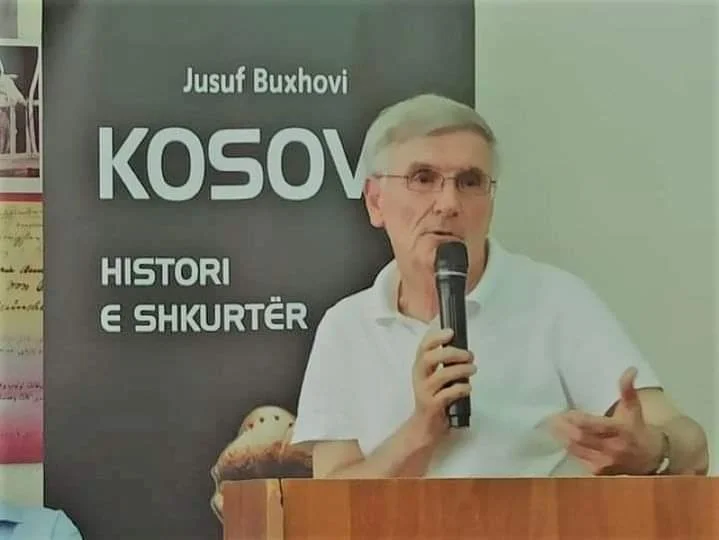
(Remarks from the promotion of the work: “Kosovo – A Brief History” in Prizren)
Related
Arts
José Saramago, the writer who challenged the world with the power of words
Arts
‘Star Wars’ and ‘James Bond’ actress found dead
Arts
The National Theatre of Kosovo’s “Romeo and Juliet” to be presented at the “Moisiu” Albanian Theatre Festival in Skopje
Arts
The film “DUA,” Kosovo’s Oscar submission, presented to the public in New York
Arts
“All About Eve,” the drama that revealed the ambition and rivalry behind the glamour of the stage
Arts
Creative Europe Opens New Calls for Artists and Cultural Professionals
Arts
“Sacrifice” fills theaters at premiere, story of five brothers moves audience to tears

Arts
This Is What the Kosovo Opera and Ballet Theatre Is Expected to Look Like

Arts
Blerta Rugova presents her first book, “RUGOVISM – The quiet revolution that begins within us”
Arts
Johnny Depp turned down the role in “Titanic” because he couldn’t read 15 pages of the script: I struggled
Arts
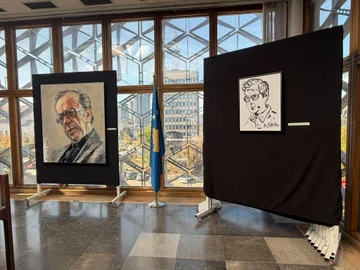
“Kadare’s Kosovo” exhibition opens on the 90th anniversary of the writer’s birth
Arts
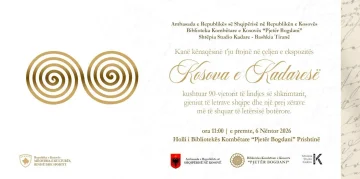
“Kadare’s Kosovo,” an exhibition dedicated to the 90th anniversary of the great writer’s birth





