
The waistcoat of Naim Frashëri, the attire of Ali Pasha of Tepelena or Lord Byron… These are the main orders Buqe Muka, a certified master embroiderer, receives from Albanian emigrants. She lives in the stone city of Gjirokastër, in southern Albania, where craftsmanship has been experiencing a revival for years, despite numerous difficulties. The profession she […]
Craftsmanship Reviving Albania’s Heritage Through Embroidery
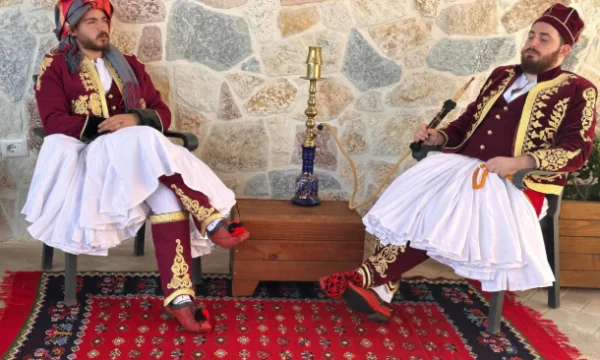
The waistcoat of Naim Frashëri, the attire of Ali Pasha of Tepelena or Lord Byron…
These are the main orders Buqe Muka, a certified master embroiderer, receives from Albanian emigrants.
She lives in the stone city of Gjirokastër, in southern Albania, where craftsmanship has been experiencing a revival for years, despite numerous difficulties.
The profession she practices with great love has its roots in her childhood.
“At that time, there wasn’t a girl who didn’t know how to sew, embroider, or do various kinds of crochet or knitting. I married young, and while taking care of my three children, I began practicing these techniques I had learned as a child, for the benefit of my new family. I worked at home, where I received various orders—initially from local residents, and then from other places around the area,” Buqe tells Radio Free Europe.
As the orders increased and she saw interest in “the old,” she decided to open a small shop in “Qafa e Pazarit,” where she would sell old objects dating from the communist era or earlier.
While selling those items, she also made various handicrafts, which she began selling in the shop as well.
“I made doilies (ed. crochet or embroidered pieces placed in the middle of a table) with symbols of Gjirokastër or Albania, various crocheted jewelry… Seeing that emigrants and foreign tourists were the most interested, I began studying different techniques to increase the variety of products,” says the 47-year-old.
She recalls that the COVID-19 pandemic was a major blow to her efforts to keep this tradition and the business she had started alive.
“History and tradition revived the business during the pandemic”
“It was a time when you had to think about what to do, to reinvent yourself in some way in terms of what you offered, to bring something new that would attract attention as soon as I posted it online. Many thoughts came to mind, and while talking with my husband, I told him my idea was to focus on traditional clothing,” Buqe recalls.
She says she very much wanted to bring back the original traditional garments, but there were many difficulties.
The original garment had to be found, and special techniques had to be used.
She first received help from another local craftswoman, but later realized she had to undertake proper research to achieve the goal she had set for herself.
“In the summer of 2020, I began practicing embroidery on traditional clothing. I started my research, found some materials, and spoke with people who knew the local clothing, but they were uncooperative, distrustful… they wouldn’t give me the information I needed,” says Buqe, who later began searching through books, specifically publications by the Institute of Anthropology.
“I found five series of books on Albanian folk clothing, which also include garments from Albanian territories outside the borders. In fact, thanks to this dedication, I later became part of the team of restorers at the Ethnographic Museum,” the craftswoman says.
Naim Frashëri’s waistcoat, most sought-after by emigrants
In her view, every traditional garment is a book in its own right. She says that while doing research, she came across the attire worn by Albanian Renaissance figure Naim Frashëri in 1900.
“I found it in the book ‘Albanian Clothing Through the Centuries’ by ethnologist Andromaqi Gjergji. It is an outfit that has everything, but above all, it conveys nobility; it has a beautiful cut, elegance, high quality, and is embroidered with gold thread. It was clearly worn by a member of the upper class of that time,” Buqe says.
After making this outfit, she says she presented it to the renowned Albanian ethnographer Afërdita Onuzi.
“I was very happy when she told me it was almost identical to the original—98 percent. The remaining two percent that differed from the original had to do with the material, because we no longer have the shajak cloth. The gold thread used for embroidery at the time was genuine or gold-plated, whereas today it is thread in that color that comes from China or Turkey,” Buqe says.
According to her, one of the most sought-after designs among buyers remains the waistcoat of Naim Frashëri, which is requested mainly by emigrants.
The attire of Ali Pasha of Tepelena
Buqe’s husband is from Tepelena, so she could not overlook the traditional clothing of this area either.
But she says she encountered many difficulties, as it has almost disappeared. She recalls that extensive research was needed, since information is also lacking in ethnographic museums. Once again, by consulting with ethnographers, she managed to create two very important outfits.
“The Municipality of Tepelena asked me to create the outfits of Ali Pasha of Tepelena. The ethnographer Afërdita Onuzi told me the outfits did not exist, apart from pictures on the internet. She again directed me to a book by Anbdromaqi Gjergji; I met historians and visited his museum in Ioannina. I created both outfits based on photographs brought to me from a museum in London, since I myself had no opportunity to visit,” says the embroiderer.
She is pleased to have received praise for work that is very close to the originals.
In all the traditional outfits she has revived—whether those of well-known historical figures or of residents from different areas in the south of the country—she has preserved the colors and motifs, without adding any elements.
During the pandemic, she also created portraits of well-known historical figures, such as Skanderbeg, Ismail Qemali and Isa Boletini, as well as images of various castles in Albania.
“They were mainly requested by Kosovars and emigrants,” Buqe says.
Restoring garments up to 200 years old
Her current work focuses on traditional clothing, but also on restoring old garments to their original state.
“I see that people are becoming more aware; they want the outfit of their area to be authentic. When someone comes and asks for an outfit for a boy or a man, I ask where they’re from, so I can make the clothing of the area they come from. It costs money, but it is a value passed down through generations,” Buqe says.
She says most of her requests come from emigrants—“they are the ones who want the original; they feel nostalgic for their homeland and express it through the orders they place.”
Buqe says that people also bring old garments to her workshop to be restored.
“They are degraded, more than 100 years old. I feel sad when I hold them because they practically crumble, since they have been kept in unsuitable conditions. When I saw them in museums, I felt sorry for them. The more I saw them, the more convinced I became of how much value we lose when no one takes care of them. I work on them with great love,” the embroiderer says.
She says she has just restored a waistcoat from the Berat area, which she says is 200 years old and has been passed down through generations.
Recognition in Albania and abroad
Buqe was certified as a master craftswoman by the National Chamber of Crafts in June 2022.
Later, the women working at the chamber referred her portfolio to “Homo Faber”—a foundation bringing together craftspeople from around the world.
“The portfolio went through the review of three teams, which evaluated my work. I wasn’t alone; there were 12 of us in total, craftspeople from Albania. My profile was also published in July 2024. I insisted strongly on being represented by the outfit of Naim Frashëri, made by me, because they had asked me for something between traditional and modern,” Buqe says.
A case that has stayed in her mind is that of a Hungarian citizen who lived in Sarandë and promoted Albania in his home country.
He had asked Buqe for a traditional outfit to wear during a television appearance in his country.
“One day he came to my workshop and told me he had brought me a gift from his mother. I was very surprised. It was a doily embroidered by his mother. There is a special technique that we refer to as Hungarian embroidery when we use it. I was moved that a woman from Hungary appreciated the work I had done and had been amazed by Albanian clothing,” Buqe says.
Her main collaborator is her son. He studied painting in Gjirokastër and sketches the clothing of various regions.
The 47-year-old then refers to these designs when embroidering traditional garments.
“My family is a great support, because I open the workshop at 7:00 in the morning and close it at 19:00, sacrificing the time I should spend with them. I can’t remember the last time I might have made them a dessert,” says Buqe, who struggles with a lack of workers when orders increase.
She says that women over the age of 65 do embroidery, while the younger generation is not interested.
Although she is focused on traditional clothing, from time to time she has experimented by also creating embroidered jewelry.
She says women from more distant areas, such as Shkodër and Kukës, have responded to her call for collaboration.
Buqe has had to teach them embroidery initially through videos and then, by mail, send them the materials and receive the commissioned work from them.
Although there are many challenges, she says she wants to have a similar workshop in Tepelena, where, in addition to embroidery, she would also focus on “the things that make us special in the eyes of tourists, such as traditional organic products from the area: raki, gliko, honey, etc.”.
To preserve the tradition, Buqe has also taken part in projects with various municipalities to teach embroidery to students. She says she has noticed interest from the students, but not from local leaders in continuing this tradition.
“They send me messages asking when we’ll start again. I say that love for crafts and tradition must be instilled at school. We shouldn’t blame the younger generation… When we were at school, we had ‘home economics’; we learned to sew and attach buttons. I think that subject should still be taught today,” Buqe says.
Although she is aware that handmade work is not valued, she says she will not stop working or trying to pass it on to younger generations.
She says with regret that she has received no support from institutions, other than invitations to take part in fairs with her work. /RFE/
Related
Arts
José Saramago, the writer who challenged the world with the power of words
Arts
‘Star Wars’ and ‘James Bond’ actress found dead
Arts
The National Theatre of Kosovo’s “Romeo and Juliet” to be presented at the “Moisiu” Albanian Theatre Festival in Skopje
Arts
The film “DUA,” Kosovo’s Oscar submission, presented to the public in New York
Arts
“All About Eve,” the drama that revealed the ambition and rivalry behind the glamour of the stage
Arts
Creative Europe Opens New Calls for Artists and Cultural Professionals

Arts
“Sacrifice” fills theaters at premiere, story of five brothers moves audience to tears
Arts
This Is What the Kosovo Opera and Ballet Theatre Is Expected to Look Like
Arts
Blerta Rugova presents her first book, “RUGOVISM – The quiet revolution that begins within us”
Arts
Johnny Depp turned down the role in “Titanic” because he couldn’t read 15 pages of the script: I struggled
Arts
“Kadare’s Kosovo” exhibition opens on the 90th anniversary of the writer’s birth
Arts
“Kadare’s Kosovo,” an exhibition dedicated to the 90th anniversary of the great writer’s birth





