
The work “The Dardanians” by archaeologist Luan Përzhita marks an important leap from the hitherto hypothetical and narrowly framed approach to Dardanian issues to one that identifies them in time and space, bringing the Dardanians as a people and Dardania as a kingdom—historically known from the 4th century BCE until its involvement in imperial structures (Roman and Byzantine)—to light as one of the most important political, social and cultural factors of the Illyrian world in antiquity, if not also as the center of a gravity of determining dimensions for ancient civilization from the Bronze Age through the Iron Age and into later periods. […]
The Dardanians – the epicenter of the Illyrian world in antiquity
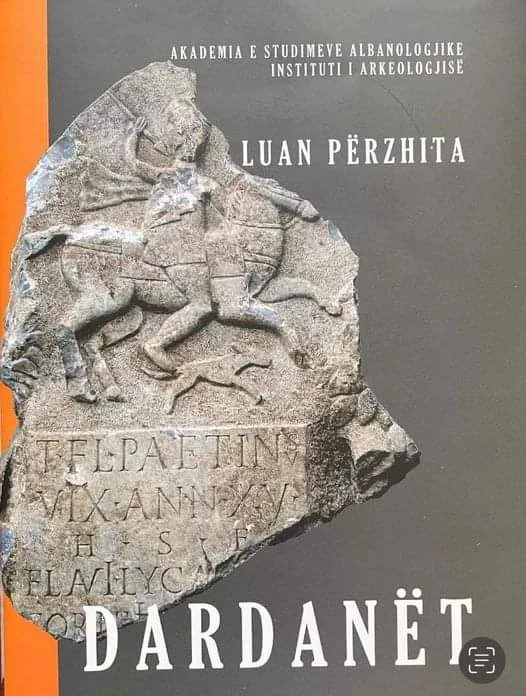
- Luan Përzhita: “THE DARDANIANS”, published by the Academy of Albanological Studies – Institute of Archaeology, Tirana 2022
The work “The Dardanians” by archaeologist Luan Përzhita marks an important leap from the hitherto hypothetical and narrowly framed approach to Dardanian issues to one that identifies them in time and space, bringing the Dardanians as a people and Dardania as a kingdom—historically known from the 4th century BCE until its involvement in imperial structures (Roman and Byzantine)—to light, in the view of the author, as one of the most important political, social and cultural factors of the Illyrian world in antiquity, if not also as the center of a gravity of determining dimensions for ancient civilization from the Bronze Age through the Iron Age and into later periods.
Starting from the archaeological perspective, as one of the main factors that brings to light the foundations of an ethnic structure in a social, cultural and political context, Përzhita concludes that “Illyrian culture was formed on this soil on the basis of the older cultures of the Bronze Age (2100–1200 BCE), from earlier epochs, whereby it is said ‘that they are direct descendants of the ethnic groups that populated this part of Europe as early as the Neolithic period (6000–4000 BCE).’
It is naturally in the assertion that archaeological evidence from the Bronze Age (much of it documented through the author’s diligent, years-long research into the material heritage of these regions) is linked to that of the Neolithic (partly identified through archaeological finds from the ruins of settlements in the form of fortifications and early castles in parts of Kosovo and Macedonia, where the Dardanian kingdom extended) that the value of this study lies. For it marks a very important leap from the view of the Dardanians and Dardania as a periphery of the Pelasgo-Illyrian world in antiquity and the Early Middle Ages, mostly as part of other ethnic groups, to that of an influential center, a view that in some way also emerges from F. Papazoglu’s comprehensive study.
Thus, Përzhita’s study of the Dardanians and Dardania, together with Edi Shkriu’s “Ancient Kosova,” shifts the hitherto fragmentary discourse on the Dardanians and Dardania, from the standpoint of the archaeological knowledge available so far, away from the traditional schools of the last century (the Viennese Slavicist school and the Yugoslav Illyrian school) and toward the option of a determining factor. This creates the possibility of redefining its role and importance at that time, as the renowned archaeologist Neritan Ceka also observes in his study “The Illyrians up to the Albanians,” in which, drawing on the achievements to date of Albanian archaeology and that of the surrounding regions, he presents Dardanian civilization as the center of the Illyrian world in antiquity, from the Neolithic onward.
Përzhita’s study “The Dardanians,” based mainly on the author’s many years of research in Kosovo and Macedonia, also incorporates earlier research by renowned Yugoslav and international archaeologists from the 1950s to the 1980s, among which the work of E. Çeshkov should be singled out. Although spatially fragmentary, these studies help support the conclusions the author presents in this book regarding the overall historical picture of the Dardanians and Dardania across the areas it encompassed (Kosovo, Macedonia, and central and eastern Serbia). In this respect, the map of Dardanian cities from antiquity, as well as the picture of the whole, is missing a good number of them, especially those beyond the state borders of Kosovo, in Serbia, such as the settlements and fortifications known from Damastion (in all likelihood in the Medveđa area), Naisus, in Niš, and other castles in the Raška region, which the renowned philologist Budimir calls “The Last Castles in Illyrian Byzantium.”
Of course, the lack of archaeological research in areas outside the state of Kosovo (in Serbia) deprives the study of a comprehensive view, given their role and importance in antiquity within the social, political, cultural and economic circumstances. Nevertheless, this does not conceptually handicap it, since the incorporation of the extensive research of Yugoslav archaeologists, though indicative, is not at odds with it.
On the contrary, the proper use of their work within the whole that was Dardanian culture and its civilization, including in the circumstances of the Early and Late Middle Ages (Christianity, which appeared in the first century of the Common Era and was made official in the fourth by the Dardanian emperor Constantine the Great), not only supports the thesis put forward by Përzhita, in agreement also with that of N. Ceka in “The Illyrians,” but also strengthens it. It remains for the author, and for Albanian archaeology, within the framework of archaeological research, to find ways to cooperate with the relevant institutions of Serbia to conduct a full examination of the Dardanian cities and sites in this region, from Prokuplje and Raška to Niš, especially to identify Damastion, already located in the area near Medveđa, since the enigma of the cultural and political factors in the triangle between the Dardanians, Paeonians and Macedonians is also found there.
From Niš to the Timok, meanwhile, lie the relations—fraught with much uncertainty—between the Dardanians, Triballi and Thracians, on which speculations about political formations in the Middle Ages are also based, especially those during the Byzantine period, when they came onto the scene, and which Serbian historiography has mostly interpreted with hegemonic aims.
In this respect, Përzhita’s study “The Dardanians” should be valued as extremely important work, which must be continued and strengthened throughout the Dardanian geographical area, so that the current tracks on which the archaeological understanding of the Dardanians and Dardania as the center of the ancient Illyrian world is being set may also be carried over into the broader historical picture.
….
Related

Arts
José Saramago, the writer who challenged the world with the power of words

Arts
‘Star Wars’ and ‘James Bond’ actress found dead
Arts
The National Theatre of Kosovo’s “Romeo and Juliet” to be presented at the “Moisiu” Albanian Theatre Festival in Skopje
Arts
The film “DUA,” Kosovo’s Oscar submission, presented to the public in New York

Arts
“All About Eve,” the drama that revealed the ambition and rivalry behind the glamour of the stage

Arts
Creative Europe Opens New Calls for Artists and Cultural Professionals

Arts
“Sacrifice” fills theaters at premiere, story of five brothers moves audience to tears

Arts
This Is What the Kosovo Opera and Ballet Theatre Is Expected to Look Like

Arts
Blerta Rugova presents her first book, “RUGOVISM – The quiet revolution that begins within us”

Arts
Johnny Depp turned down the role in “Titanic” because he couldn’t read 15 pages of the script: I struggled

Arts
“Kadare’s Kosovo” exhibition opens on the 90th anniversary of the writer’s birth
Arts
“Kadare’s Kosovo,” an exhibition dedicated to the 90th anniversary of the great writer’s birth





