
Canadian Prime Minister Mark Carney met Turkish President Recep Tayyip Erdogan in Turkey today, as part of the first bilateral visit to the country by a Canadian leader. The two NATO allies elevated their relations to the level of a “strategic partnership”, as Ottawa seeks to expand its circle of trading partners and […]
Canada and Turkey sign ‘strategic partnership’ agreement during Prime Minister Carney’s visit to Ankara
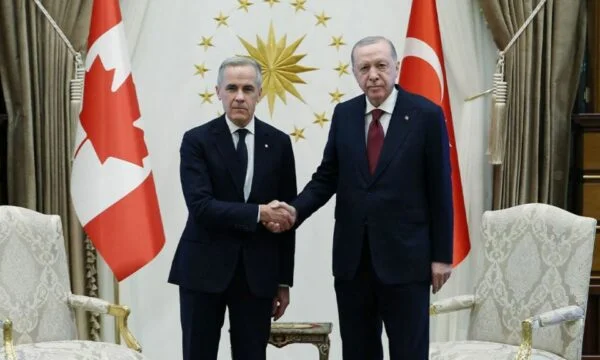
Canadian Prime Minister Mark Carney met Turkish President Recep Tayyip Erdogan in Turkey today, as part of the first bilateral visit to the country by a Canadian leader. The two NATO allies elevated their relations to the level of a “strategic partnership”, as Ottawa seeks to expand its circle of trading partners and reduce its dependence on the United States.
The new partnership will focus on trade and investment, defense and security, energy, and people-to-people relations between the two countries. The aim is to create jobs and expand opportunities for Canadian and Turkish citizens.
During the ceremony, ministers from Canada and Turkey signed cooperation agreements in the fields of energy, defense and air transport.
Carney is holding a series of intensive meetings on the international stage, hoping they will help Canada protect itself from a trade war with the United States, where President Donald Trump has imposed sweeping tariffs and called the sovereignty of its neighbor into question.
Speaking alongside Erdogan at the presidential palace in Ankara, Carney said the strategic partnership would rest on four pillars and include a three-year action plan.
“We have planted the seeds of something new: a strategic partnership that will create new opportunities for our workers and businesses, as well as greater security and prosperity for both our peoples. With care and commitment, this cooperation will develop for generations to come,” Carney said.
Turkey, a NATO member, is seeking new investments and partnerships for its expanding defense industry, new nuclear power plants and mining sector.
Praising Carney as a leader with “sound judgment and foresight” on the global political stage, Erdogan said the two countries had taken a historic step today toward deepening cooperation.
“Today we have bridged the long gap between Turkey and Canada. We are now beginning a new era in relations between the two countries,” Erdogan said, adding that both sides aim to first raise the volume of trade to $5 billion and then to $10 billion, from its current level of $3 billion.
Negotiators from the two NATO allies will meet next month in Ankara to begin the first round of free trade talks, Carney announced. He added that Export Development Canada and Turkey’s Eximbank will sign a new agreement aimed at enabling companies from both countries to work together on projects in third countries.
A Turkish diplomatic source said that the energy ministers of Canada and Turkey would cooperate in areas such as nuclear energy, critical minerals and liquefied natural gas (LNG).
Carney said he would meet with prominent Turkish businesspeople and investors in Istanbul on Friday.
“Geopolitical necessity”
Although trade between Canada and Turkey remains limited, Turkey accounted for less than 0.3% of Canada’s total merchandise trade, worth 4.34 billion Canadian dollars (3.09 billion U.S. dollars). However, bilateral trade has grown by nearly 50% over the past five years.
“This trip is part of the geopolitical necessity of showing the Americans that we’re not just sitting around waiting for them,” said Besma Momani, a professor of political science at the University of Waterloo.
Over the past year, Canada has signed more than 20 trade agreements, as part of Carney’s efforts to double exports to markets outside the United States over the next decade.
In January, he traveled to Beijing to reset strained relations with China, reaching an agreement that significantly reduced tariffs on electric vehicles and canola seeds.
Despite criticism that China poses a security risk, after Canadian authorities had previously found that Beijing had interfered in at least two federal elections, Carney described China as a “more predictable” trading partner than the United States.
Nevertheless, Canada continues to send nearly 70% of its exports to the United States.
The Turkish authorities’ crackdown on the opposition in Ankara during 2024, as well as arrests targeting the LGBTQ+ community, have drawn criticism. However, Carney has paid less attention to human rights issues than his predecessors.
“Carney will have to maintain a very careful balance in Turkey, opening up new economic prospects for Canada while also trying to preserve his country’s role as a middle power in efforts to advance equality,” said Anna Agathangelou, a professor of political science at York University.
Ankara insists that the judiciary is independent and denies that investigations or court proceedings are politically motivated.
At the NATO leaders’ summit in July, Carney and Erdogan launched negotiations for a free trade agreement. As part of this agreement, Turkey also agreed to become a founding member of the Bank of Canada for Defense, Security and Resilience.
Turkey has held talks with Canadian engineering company AtkinsRéalis, as well as South Korean company Korea Electric Power Corporation and Chinese company State Power Investment Corporation, on the possible construction of the country’s planned second and third nuclear power plants.
In 2024, Canada lifted restrictions on arms exports to Turkey, including optical technology used in drones that Turkey exports to dozens of countries.
Canada primarily exports lentils, aircraft and electronic equipment to Turkey, while importing medical equipment, fishing vessels, aircraft engines and jewelry. /Panorama
Related
Globe
16 people lose their lives after an incident at a factory in Turkey
Globe
Peace talks, US official: Russia and Ukraine are showing flexibility on possible territorial exchange
Globe
France raises minimum wage to over €1,500 from December 1
Globe
Ukraine talks in Abu Dhabi, Germany: Russia must be ready to negotiate seriously
Globe
France accuses Iran of cyberattacks on supermarket refrigerators, warns of sanctions at European level
Globe
13 migrants die after boat sinks near Crete in Greece
Globe
CNN: US and Iran are negotiating quietly; both sides have several key demands
Globe
Europe joins Ukraine talks, meeting to be held next week
Globe
Israel on the brink of a post-Netanyahu era? Eisenkot gets mandate to form government
Globe
US strikes cargo ship in the Gulf of Oman: It attempted to break the blockade on Iran
Globe
Incident in Krakow, Poland – Prosecutors launch investigation
Globe
At least 33 killed in Saudi airstrikes in Yemen, including women and children





