
The Secretary General of the Regional Cooperation Council (RCC), Amer Kapetanović, today attended the 9th Istanbul Mediation Conference, organized by the Ministry of Foreign Affairs of Türkiye, where he spoke about the role of regional organizations in preventing conflicts and building sustainable peace. During his visit to Istanbul, […]
Kapetanović at the Istanbul Mediation Conference: Peace Is Built Long After Agreements Are Signed
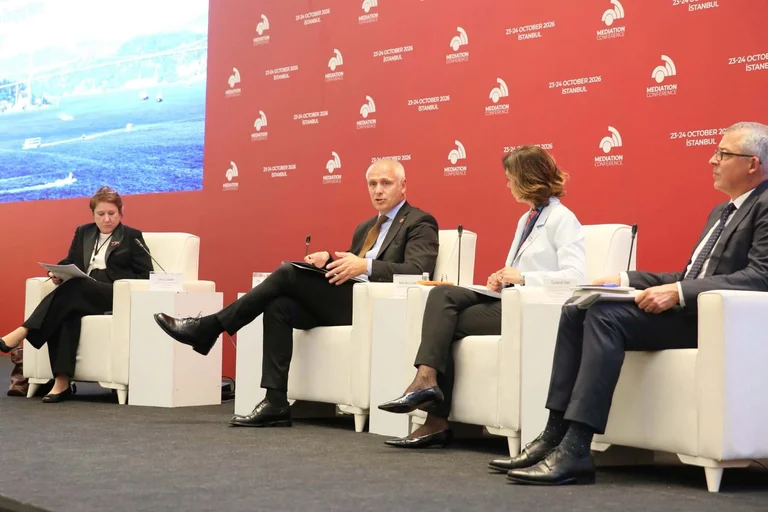
The Secretary General of the Regional Cooperation Council (RCC), Amer Kapetanović, today attended the 9th Istanbul Mediation Conference, organized by the Ministry of Foreign Affairs of Türkiye, where he spoke about the role of regional organizations in preventing conflicts and building sustainable peace. During his visit to Istanbul, Kapetanović also met with Türkiye’s Deputy Minister of Foreign Affairs and Director for EU Affairs, Mehmed Kemal Bozay, to discuss strengthening regional cooperation and connectivity, and implementing shared priorities across Southeast Europe.
Speaking on the panel “Reflections from Regional Organizations: Synchronizing Efforts,” Kapetanović drew on Southeast Europe’s experience with conflict and reconciliation to highlight how sustained dialogue, practical regional cooperation and closer coordination with international partners can help prevent tensions, build trust and achieve sustainable peace.
“Peace is not built only when agreements are signed. A peace agreement stops a war, but it does not finish the job. Peace is built in the years that follow, when institutions continue to engage in dialogue despite disagreements, when people look at their neighbors with a little more trust, when leaders keep the door open even when it brings them few political benefits,” Kapetanović said.
He recalled that the RCC was established as a peace project, rooted in Southeast Europe’s experience with conflict and reconciliation, and that its work continues to demonstrate how practical cooperation contributes to stability. From agreements on mobility and roaming to the recognition of qualifications, the Common Regional Market and initiatives supporting young people and women entrepreneurs, regional cooperation creates shared interests and strengthens ties between people and institutions.
“This is not reconciliation in the abstract sense. This is reconciliation through experience. Interdependence also serves mediation: it does not replace negotiations, but it raises the cost of walking away from the negotiating table,” Kapetanović emphasized. He also welcomed Türkiye’s long-standing commitment to international mediation, including the Balkan Peace Platform, underscoring the importance of linking political dialogue with regional mechanisms that turn cooperation into concrete results.
Held under the theme “New Partnerships and Perspectives for Peace: Mediation in a Changing World,” the Conference brought together senior officials, representatives of international and regional organizations, experts and mediation practitioners to exchange experiences and explore approaches to conflict prevention and peaceful resolution.
During the meeting with Deputy Foreign Minister Bozay, Kapetanović expressed his appreciation for Türkiye’s constructive role in regional cooperation and its continued support for the Southeast Europe 2030 Strategy (SEE2030), including its additional voluntary contribution to the implementation of the Strategy.
The two discussed opportunities to strengthen cooperation between Türkiye and the Western Balkans Six, particularly through the Common Regional Market and the Green Agenda for the Western Balkans, as well as closer policy coordination within the framework of SEE2030. Kapetanović emphasized the importance of turning regional priorities into tangible benefits for citizens and businesses, with a focus on sustainable economic growth, trade, investment, digital transformation and connectivity. The meeting also discussed opportunities to improve connectivity between Southeast Europe and neighboring regions, including new European Union initiatives under the Global Gateway strategy. Kapetanović highlighted the potential of closer coordination in transport, investment and development financing to strengthen the region’s competitiveness and resilience to challenges.
Bozay expressed his support for the Regional Cooperation Council (RCC) and its efforts to advance regional cooperation in Southeast Europe. The two also exchanged views on the current situation in the region and ongoing regional developments.
Related
Globe
16 people lose their lives after an incident at a factory in Turkey
Globe
Peace talks, US official: Russia and Ukraine are showing flexibility on possible territorial exchange

Globe
France raises minimum wage to over €1,500 from December 1
Globe
Ukraine talks in Abu Dhabi, Germany: Russia must be ready to negotiate seriously
Globe
France accuses Iran of cyberattacks on supermarket refrigerators, warns of sanctions at European level
Globe
13 migrants die after boat sinks near Crete in Greece
Globe
CNN: US and Iran are negotiating quietly; both sides have several key demands
Globe
Europe joins Ukraine talks, meeting to be held next week
Globe
Israel on the brink of a post-Netanyahu era? Eisenkot gets mandate to form government
Globe
US strikes cargo ship in the Gulf of Oman: It attempted to break the blockade on Iran
Globe
Incident in Krakow, Poland – Prosecutors launch investigation
Globe
At least 33 killed in Saudi airstrikes in Yemen, including women and children





