
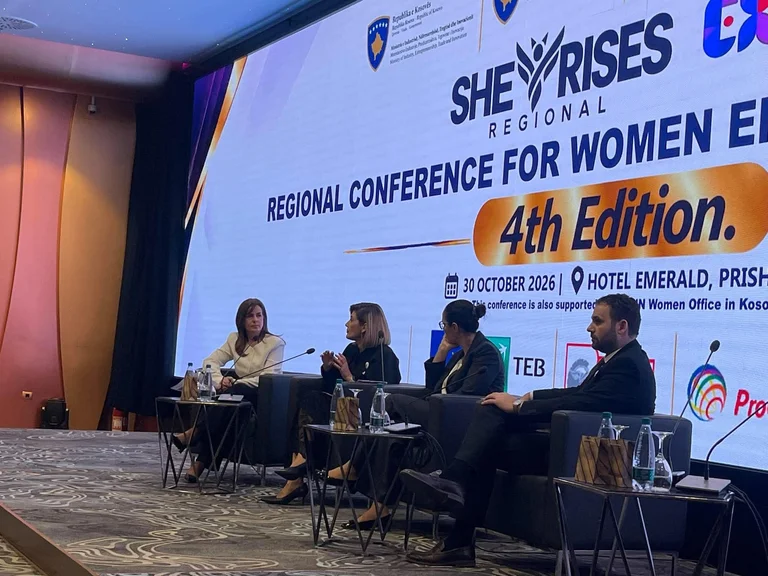
The Regional Conference for Women Entrepreneurs and B2B Meetings – 4th Edition, “SHE RISES REGIONAL 2026”, brought together institutional representatives from Kosovo, Albania and North Macedonia, focusing on women’s economic empowerment, the development of entrepreneurship and the deepening of regional economic cooperation. As part of the conference, a ministerial dialogue was held on the topic “Women’s entrepreneurship within the framework of regional economic cooperation”, where the ministers of economy and industry presented policies, support programs and the challenges women face in their businesses, reports Ekonomia Online. […]
“SHE RISES REGIONAL 2026” focuses on women’s economic empowerment and regional cooperation
The Regional Conference for Women Entrepreneurs and B2B Meetings – 4th Edition, “SHE RISES REGIONAL 2026”, brought together institutional representatives from Kosovo, Albania and North Macedonia, focusing on women’s economic empowerment, the development of entrepreneurship and the deepening of regional economic cooperation. As part of the conference, a ministerial dialogue was held on the topic “Women’s entrepreneurship within the framework of regional economic cooperation”, where the ministers of economy and industry presented policies, support programs and the challenges women face in their businesses, reports Ekonomia Online.
Kosovo’s Minister of Industry, Entrepreneurship and Trade (MIET), Mimoza Kusari-Lila, stressed that financial support, access to markets, innovation and continuous education are among the main pillars for increasing women’s participation in entrepreneurship.
She said that the Ministry of Industry, Entrepreneurship and Trade had allocated special support schemes for women-owned businesses, highlighting grants worth 200,000 euros.
“Therefore, the schemes already prepared by the Ministry of Industry, Entrepreneurship and Trade for this year aim to address these challenges. The first is access to finance. We started this year with grant schemes, setting aside special support schemes for women in business. The value of the scheme we established was 200,000 euros for women-owned businesses, and it has now closed,” Kusari-Lila said.
She also announced the launch of a new grant scheme for innovation, worth one million euros, noting that, for the first time, direct support for women in this sector had been provided.
“I am happy to say that we have a new grant scheme for innovation, a sector that has seen continuous growth in the Republic of Kosovo. The grant application scheme, worth one million euros, is open until November 30. For the first time, at this scale and with this amount, we have launched direct support for women,” she said.
According to the minister, businesses with women as owners or co-owners are also given priority in other ministry schemes, including support for machinery, product certification, and the information and communications technology (ICT) sector.
“We still have a low number or percentage. Only 15 percent of all businesses registered in Kosovo are women-owned. Therefore, this percentage must change not only through incentives, but also through continuous education, knowledge and the role of entrepreneurship in the country’s economic empowerment,” the minister stressed.
Presenting the results of institutional support, she said that in 2024 and 2025, a total of 103 women-led businesses had received support: 70 in 2024 and 33 in 2025.
“In 2024 and 2025, we supported 103 women-led businesses, providing assistance for machinery, digitalization, product certification, innovation, startups and the ICT sector, as well as the refined products industry. Alongside this financial support, we also have a mechanism to support presentations and participation at international trade fairs,” Kusari-Lila said.
She said that 22 businesses had been supported at the women in business fair, while ten other women-owned businesses from Kosovo had received support to participate in a fair organized in Switzerland, where Kosovo has a significant diaspora presence.
“The ministry I lead, together with the new Agency for Innovation and Entrepreneurship, now has a division for women in business within its structure. This division is responsible for providing all information, from business registration through to its transfer. The aim is to collect data and use data intelligence to monitor developments in entrepreneurship on a quarterly, semiannual and annual basis, covering small businesses, startups and large businesses,” she said.
Albania’s Minister of Economy and Innovation, Delina Ibrahimaj, presented Albania’s experience in financing startups, emphasizing that policies favoring women and girls in grant schemes had helped increase their representation in the sector.
“In Albania, we have been providing funds to finance startups for four years, with the aim of encouraging the startup ecosystem. I am very proud to say that this kind of policy we have adopted—giving extra points to women and girls—has meant that 42 percent of startup funding last year was dedicated to women and girls, and went to businesses led by women and girls,” Ibrahimaj said.
She acknowledged that this percentage might not fully reflect the reality of business ownership and management, noting the possibility that some businesses had been registered with women as administrators or owners in order to receive extra points in support schemes.
“Is this figure 100 percent accurate? I am convinced it is not 100 percent accurate. I am convinced that this figure also includes businesses registered with women as administrators or owners solely so they could receive those extra points. But even that, in the end, is not a bad thing, because once a woman is legally an owner or administrator, it means she will continue to be involved in that business. So even if there are such cases, it is still very positive,” the Albanian minister stressed.
Ibrahimaj noted that the increase in grants received by women was the result of policies implemented in recent years, saying that the share of funds dedicated to them had risen from around 28–30 percent to over 40 percent.
“We come from a culture in which women have participated in the labor market. If you look at the statistics, Albania ranks first in the percentage of women and girls participating in the labor market and in employment. We were at 62 percent, because we come from a culture where women went to work and worked just like men. This has undoubtedly stayed with us,” she said.
However, the minister stressed that women’s representation in business management and ownership positions had remained almost unchanged over the years.
“But while we have many women in employment and a high percentage, women make up 31 to 31.5 percent of administrators, depending on the year, as owners or administrators. So, we are at a level close to the European Union average, but for many years, as I have followed this indicator with great interest, this level has not risen. Regardless of the policies, and regardless of what I just said about startups, this means either that we have not done enough to encourage their participation in business and entrepreneurship, or that we need to do more in this area,” Ibrahimaj said.
North Macedonia’s Minister of Economy and Labor, Besar Durmishi, said women’s economic empowerment should be viewed not only as a matter of equal opportunities, but also as an important factor in economic development, competitiveness and the use of human potential.
He stressed that the Ministry of Economy and Labor implements concrete measures to provide financial support to entrepreneurs, modernize technology, boost productivity, create new jobs and develop exports.
“For us, women’s economic empowerment is not only a matter of the equal opportunities they should have, but also a matter of economic development, domestic economic competitiveness and making better use of human potential. We must be able to use all the capacities and resources we have,” Durmishi said.
Presenting the programs for 2026, he said that around two million denars, or approximately 100,000 euros, had been allocated through the program for the development of entrepreneurship and competitiveness to support micro, small and medium-sized enterprises, as well as artisans.
According to him, under this measure the state co-finances up to 40 percent of an investment, up to a maximum of 200,000 denars, or around 3,500 euros, for each investment.
“In 2026, through the program for the development of entrepreneurship and competitiveness, we have allocated nearly two million denars, or 100,000 euros, to support micro, small and medium-sized enterprises, as well as artisans. Through this measure, we co-financed up to 40 percent of the investment they made, but no more than 200,000 denars, or 3,500 euros, for each investment, whether to increase companies’ production capacity,” Durmishi said.
He also announced the allocation of a further two million denars to implement international standards and certify products, with the aim of boosting companies’ competitiveness and easing their access to international markets.
“We have also allocated two million denars for the implementation of international standards and certification in industry, so that companies can be more competitive and enter the international market more easily. Through the Ministry of Economy and Labor, we have offered co-financing of around 70 percent, so that companies applying for a specific certification in the manufacturing industry, in order to sell their products in international markets, can receive the necessary support. Companies owned or led by women also benefit from these instruments we have established for 2026,” he said.
Durmishi also spoke about cooperation with international labor organizations, through which an operational plan to promote employment and entrepreneurship is implemented every year, with a particular focus on young women and men.
He said that the value of this plan for 2026 was around 2.4 million denars, or 40,000 euros, while financial support for establishing new businesses was up to 7,000 euros for people over the age of 29 and up to 10,000 euros for young women and men.
“In parallel, in cooperation with international labor organizations, we have an operational plan in our country that we implement every year. This year as well, the value of that plan is around 2.4 million denars, or 40,000 euros, with a focus on young women and men starting startups or establishing their own companies. The value of this support is up to 7,000 euros for those over the age of 29, and up to 10,000 euros for young women and men, for any business idea they have and wish to put into action,” Durmishi stressed.
According to him, the scheme also aims to support people who already have an economic activity but operate in the informal economy, encouraging them through financial support to formalize their businesses.
“Even if they are operating or have a business of their own, but it is in the informal economy and has not been formalized, instead of carrying out inspections, we provide support. We also encourage them to formalize their businesses,” the minister said.
Durmishi highlighted a challenge identified during the implementation of the operational plan, namely women’s low participation in applications for financial support.
“One detail I want to mention here is that during the implementation of the operational plan, after carrying it out and conducting the analyses, we still found in the end that women were not included, or that the number of their applications was very small compared with applications from men,” Durmishi said.
Related
Economy
Ymeri: Government measures on electricity will not solve the situation
Economy
GAP: 87% of Kosovo’s budget expenditures contributed to the Sustainable Development Goals during 2021–2025
Economy
Government links payroll and human resources systems; €8.9 million from the EU expected to be released
Economy
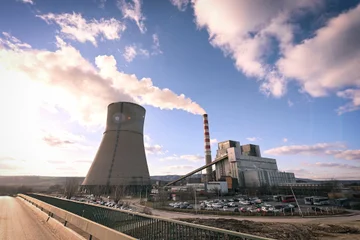
Government says electricity supply is also at risk due to the failure to complete work on Unit B1 on time; project funded by the EU

Economy
Oil prices fall again on international exchanges; in Kosovo, the decrease is being reflected slowly
Economy
Shahini: Investors are becoming more cautious, while Albania risks postponing new investments
Economy
Hoti: The government has apparently stopped electricity imports from Serbia – can something be stopped that, according to government officials, did not exist?
Economy
Tahiri to the Government: Even after 6 years, do you have a plan to start building a new power plant?
Economy
Hoti: During VV’s government, economic growth was lower and inflation higher
Economy
Kraki slams the Government: So we’ve bought electricity from Serbia and still ended up without power — failure twice over
Economy
Rizvanolli explains reasons for decision to ban energy trading with Serbian companies
Economy
Ramadani: The Government admitted it plundered the budget through electricity trading with Serbia





