
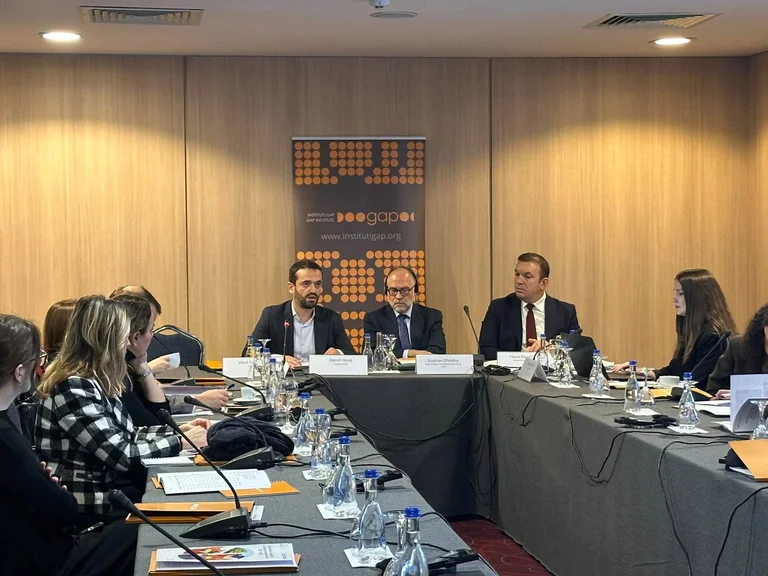
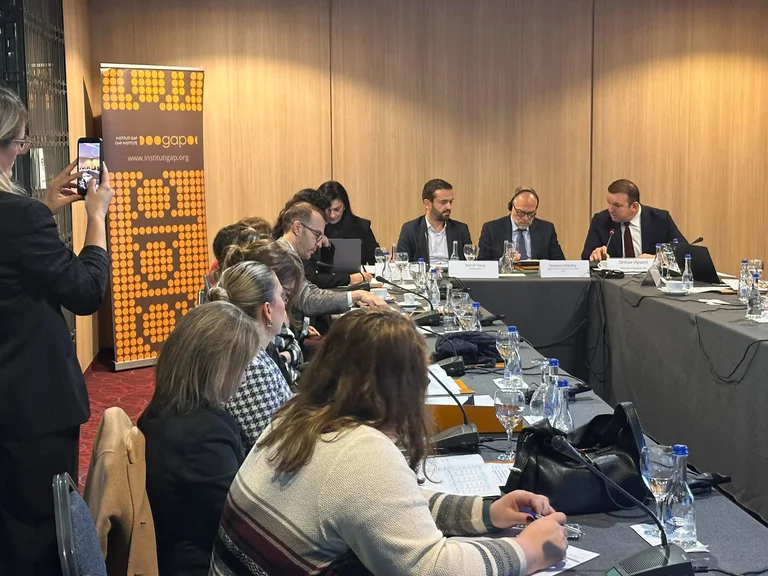
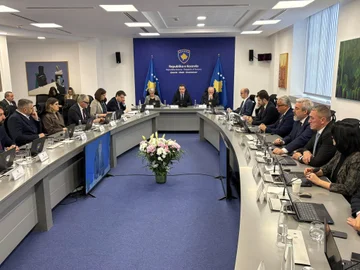
The GAP Institute organized a discussion roundtable where it presented the report “Alignment of Kosovo’s Budget with the Sustainable Development Goals (2021–2025),” reports Ekonomia Online.
GAP: 87% of Kosovo’s budget expenditures contributed to the Sustainable Development Goals during 2021–2025
This report analyzes Kosovo’s budget expenditures over the past five years and how they contribute to achieving the 17 Sustainable Development Goals.
The executive director of the GAP Institute, Blendi Hasaj, said the report was produced with the support of the Office of the United Nations Coordinator for Development in Kosovo, with the aim of analyzing the distribution of budget expenditures within the framework of these goals.
“Through this report, we have tried to compare the extent to which budget expenditures reflect the SDGs and which of these goals receive a greater share of Kosovo’s annual budget. As you will also see during the presentation of the analysis and findings by our colleague Rona, there are very interesting issues that merit broader discussion at today’s roundtable, as well as going forward. For example, the report finds that around 87% of the annual budget is distributed, or allocated, across several SDGs. However, it is then important to see how concentrated or distributed the expenditures are across all the SDGs, because our findings show a concentration mainly in three or four SDGs, as we will learn later. On the other hand, some very important SDGs relating, for instance, to gender equality or environmental protection and investment are not reflected as much in budget expenditures or in the relevant SDGs,” Hasaj said.
“These findings naturally lead us to raise a question about how issues are prioritized through the budget, but also about the goals we are targeting through our policy—in this case, our fiscal policy and budget spending. This becomes particularly important at a time when environmental challenges and climate change make it much more important for these issues to receive the right priority, if our aim is to have sustainable economic development, and not merely economic development in and of itself. Fortunately, the SDGs prioritize precisely these issues that ensure sustainable development, and it remains for us to align our budgetary direction, as well as our institutional efforts, with this,” he stated.
Meanwhile, the United Nations Development Coordinator in Kosovo, Stephen O’Malley, said the budget is the clearest reflection of the priorities of a government and society, emphasizing that Kosovo must ensure its financial resources are aligned with its commitments to achieve the Sustainable Development Goals by 2030.
“As you all know, the budget is the clearest statement of the priorities set by a government and a society. Strategies tell us what institutions intend to do, while budgets tell us what they are doing and what they have done. Kosovo has made a conscious choice to commit to the Sustainable Development Goals. The Assembly did so through a resolution in 2018, while the National Development Strategy 2030 is also aligned with these goals. We have four years left until 2030, and the question is whether financial resources are following through on this commitment. So far, I think it has been difficult to answer this question through the figures. One of the greatest strengths of this report is that it represents the first comprehensive effort to do so,” he said.
“Before the presentation of the report begins, I would highlight three main findings. The first finding is, I think, quite encouraging. In the 2021–2025 period, around 87 percent of budget expenditures, or approximately 13.4 billion euros, were allocated to activities that contributed to achieving the goals. Most of these funds were directed toward social protection, public institutions, the rule of law, educational infrastructure and healthcare. These are investments in people and in the institutions that serve them. I think Kosovo deserves a great deal of credit for this. The second finding is that expenditures are concentrated. Five goals receive 82 percent of the funds allocated for these purposes, while six goals receive less than one percent. Among them are some of the key Sustainable Development Goals, such as gender equality, reducing inequalities, climate and nature protection. I think the authors are right, and I am convinced they will discuss this issue in more detail, that some of these findings need to be interpreted carefully. A low budget allocation does not automatically mean a lack of investment. For example, some expenditures benefiting women or the environment may be included in other budget categories, where they are not as visible,” O’Malley added.
“But this is precisely the issue facing the report’s authors: when expenditures are not identifiable in the budget, it becomes difficult to plan, monitor and also protect these funds, especially at a time when financial resources are limited. These are, of course, fundamental issues. Women’s participation in the economy, cleaner energy, resilience to floods and forest fires, and the inclusion of all communities will largely determine Kosovo’s prosperity and reflect the European path it has chosen. The third finding I would highlight is that money is not the same thing as results. For example, the category with the largest budget allocation, the one related to poverty reduction and social protection, achieves the best results when funds are allocated to those who need them most. And this is precisely what is meant by the principle of leaving no one behind,” O’Malley said.
Meanwhile, GAP Institute researcher Rona Zhuri said during the presentation of the report that the analysis covers the 2021–2025 period and aims to comprehensively present the contribution of budget expenditures to achieving the Sustainable Development Goals.
She emphasized that although Kosovo has expressed its commitment to achieving these goals through the 2018 Assembly resolution and the National Development Strategy 2030, there is still no specific mechanism for measuring progress in this regard.
“So, this report aims to provide a comprehensive overview of the extent to which Kosovo’s budget expenditures contribute to achieving the Sustainable Development Goals, or SDGs. It does so by classifying budget expenditures and allocating them across the SDGs. For the purposes of this presentation, I will refer to the ‘SDGs’ rather than the ‘Sustainable Development Goals,’ as it is shorter. This analysis covers a five-year period, from 2021 to 2025. First, as the previous speakers also mentioned, in 2015 an agreement was signed among the member states of the United Nations, establishing the 2030 Agenda and defining the 17 Sustainable Development Goals. In this regard, Kosovo has demonstrated its willingness to fulfill the SDGs by adopting a resolution in the Assembly in 2018, with the aim of engaging parliamentary committees and the government in implementing the SDGs. One strategic document in which Kosovo has also incorporated the SDGs is the National Development Strategy 2030, which defines the links between the strategic objectives and the SDGs. However, although there are regular reports on the implementation of the strategy’s objectives, there is no specific mechanism to measure Kosovo’s progress toward achieving the SDGs,” she said.
“First, I will briefly discuss the context of Kosovo’s economy, since we also mentioned it in the report. In 2022–2025, average growth was 4%. Unemployment fell steadily, from 22.5% in 2021 to 10.8% in 2024. Budget expenditures increased from 2.3 billion euros in 2021 to 3.6 billion euros in 2025. Similarly, budget revenues increased from 2.2 billion euros in 2021 to 3.3 billion euros over the same period. Public debt remains low, averaging 18% of GDP. And if we analyze expenditures by functional classification, the largest budget expenditures in 2025 were on social protection, followed by economic affairs, general public services, education and healthcare,” she said.
“I will now continue with the main findings of the paper. The results show that Kosovo allocated a total of 13.4 billion euros in budget funds to categories that contribute to achieving the SDGs over a five-year period. On average, around 2.7 billion euros per year were allocated to SDG financing. So, around 87% of total budget expenditures were classified under the SDGs. During this period, in 2025 alone, around 3.1 billion euros of the budget were allocated across the SDGs. The results show that around 82% of the budget allocated across the SDGs was concentrated in just five goals. These are Goal 1: SDG 1 (No Poverty), SDG 16 (Peace, Justice and Strong Institutions), SDG 4 (Education), SDG 9 (Industry, Innovation and Infrastructure) and SDG 3 (Good Health and Well-being). For SDG 1, the budget was 642 million euros in 2021 and increased to 906 million euros in 2025. This category includes expenditures such as pension schemes and social assistance programs for older people, families in need, as well as other categories such as mothers and children. Social housing programs and similar expenditures aimed at reducing extreme poverty are also included. A total of 2 billion euros was allocated to SDG 16 (Peace, Justice and Strong Institutions) over a five-year period. This includes expenditures on strengthening public administration, justice institutions, tax and customs systems, civil registration services and digital governance systems. SDG 4 was the third SDG to receive the most funding. This includes education and education-related expenditures, with a total of 1.9 billion euros allocated over a five-year period. It mainly includes expenditures on the construction and renovation of school and childcare facilities, investment in university infrastructure, and the funding of educational institutions,” Zhuri said.
On the other hand, Deputy Minister of Environment and Spatial Planning Driton Hyseni said that donations and funds allocated by Kosovo’s international partners should also be included in the report, since, according to him, they constitute an important part of the support for achieving the Sustainable Development Goals.
He also mentioned several projects in the water and social housing sectors, financed by international institutions.
“To be honest, I think it is necessary—I heard Rona say that the donations component, the funds provided by our allies and our country’s partners, was not included in the presentation. I think that each ministry could enrich the report in this regard with the revenues received from donors, because they represent an extremely large part, a substantial share of the support that different countries and different institutions provide to Kosovo, which is directly linked to achieving these Sustainable Development Goals. Particularly with regard to the water sector, we have the Floës project, a loan from the World Bank, worth 25 million euros, which addresses water security, water quality and the expansion of the water supply network. In this regard, I also think it is necessary to mention the assistance provided to Kosovo—I am now referring to the ministry I represent here today—in terms of adequate social housing: we have 25 million allocated by the Council of Europe Development Bank. This fund is dedicated to creating better living conditions for many residents of Kosovo who live in poor conditions, whether in their current houses or apartments, which need to be renovated or modified, but also through the construction of new housing units, whether houses or apartment buildings, with the aim of eliminating this need, or, better put, addressing the situation of those categories of people who currently do not live in adequate housing conditions. I’ll put it that way, taking both their situation and their needs into consideration,” he said.
“I think it is very important to say something: alongside the growth of gross domestic product and the state budget, you know that a budget of 4.3 billion is planned for next year, and this year gross domestic product is reaching 12 billion euros. We are continuously making progress and developing, but at the same time standards are rising, and the need for major financing and investment in these sectors linked to the Sustainable Development Goals is also growing. However, I think it is very important to say something at this roundtable that was also emphasized by Rona and by the rest of you: 87% of the current budget of the Republic of Kosovo is dedicated to these pillars of the Sustainable Development Goals. And I think that, as far as the level of distribution is concerned, we are doing very well,” Hyseni said.
Related
Economy
Ymeri: Government measures on electricity will not solve the situation
Economy
Government links payroll and human resources systems; €8.9 million from the EU expected to be released
Economy
Government says electricity supply is also at risk due to the failure to complete work on Unit B1 on time; project funded by the EU
Economy
Oil prices fall again on international exchanges; in Kosovo, the decrease is being reflected slowly
Economy
Shahini: Investors are becoming more cautious, while Albania risks postponing new investments
Economy
Hoti: The government has apparently stopped electricity imports from Serbia – can something be stopped that, according to government officials, did not exist?

Economy
Tahiri to the Government: Even after 6 years, do you have a plan to start building a new power plant?
Economy
Hoti: During VV’s government, economic growth was lower and inflation higher
Economy
Kraki slams the Government: So we’ve bought electricity from Serbia and still ended up without power — failure twice over
Economy
Rizvanolli explains reasons for decision to ban energy trading with Serbian companies
Economy
Ramadani: The Government admitted it plundered the budget through electricity trading with Serbia
Economy
Government approves decision, electricity trading with companies from Serbia halted





