
A United States-mediated ceasefire aimed at enabling the delivery of humanitarian aid to the city of Oleshky in southern Ukraine took effect in the early hours of October 27, shortly after Russia attacked Kyiv, striking a university dormitory and other civilian facilities and killing at least one person. […]
Russia strikes Kyiv as ceasefire begins in Oleshky
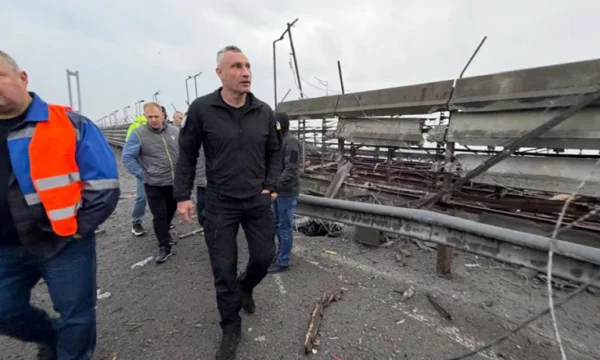
A United States-mediated ceasefire aimed at enabling the delivery of humanitarian aid to the city of Oleshky in southern Ukraine took effect in the early hours of October 27, shortly after Russia attacked Kyiv, striking a university dormitory and other civilian facilities and killing at least one person.
This ceasefire was mediated last week by Melania Trump, the wife of U.S. President Donald Trump, and was confirmed by Moscow and Kyiv. It was necessary because conditions in Oleshky are extremely dire. The frontline city is on the brink of catastrophe, while the people still there are mostly elderly and in urgent need of medical care, medicine, food, and drinking water.
“The ceasefire has begun, and the Ukrainian side is fulfilling its commitments,” Dmytro Lubinets, Ukraine’s Parliamentary Commissioner for Human Rights, wrote on Telegram on October 27.
“Today, at 3:00 a.m. Kyiv time and 4:00 a.m. Moscow time, a ceasefire was established in certain areas related to the humanitarian mission,” he added.
Russia’s Defense Ministry said it had halted attacks in the direction of Kherson and had established a “ceasefire regime” ahead of a planned humanitarian operation in Oleshky.
Petro Andryushchenko, a former adviser to the mayor of Mariupol who now heads the Center for the Study of the Occupation, told Current Time that operations to clear mines from areas near Oleshky were expected to begin on October 27. A humanitarian convoy and an evacuation operation are then planned for October 30. However, restrictions imposed by Russia were hindering the broader evacuation of civilians.
“Yesterday we saw that the Russians had brought in an engineering unit, which is supposed to carry out this work. So, we hope the process will indeed begin today,” Andryushchenko said.
“The evacuation vehicles are expected to arrive directly at the hospital building in Oleshky. That is exactly where the evacuation should begin,” he added.
Oleshky is on the Russian-occupied bank of the Dnipro River, opposite Kherson, the capital of the region of the same name. Before Russia launched its full-scale invasion of Ukraine in February 2022, the city had around 24,000 residents.
Melania Trump’s office estimates that between 1,700 and 2,000 people remain in the city, including around 50 children. Most are believed to be elderly people who were unable or unwilling to leave. No official demographic census has been conducted since 2022.
The city has endured years of fighting, population displacement, and isolation. The destruction of the nearby Kakhovka Dam in June 2023 made the situation even worse, as an estimated 90 percent of Oleshky’s territory was flooded.
Russian attacks hit Kyiv as Zelensky calls for air defense
Russia attacked Kyiv late on October 26, striking a university dormitory and other civilian facilities and killing at least one person. Ukrainian President Volodymyr Zelensky urged Ukraine’s partners to provide the country with “the right tools” to defend itself.
Russian forces launched 16 ballistic missiles and 280 drones at Ukraine overnight, Zelensky said on October 27. Ukraine’s Air Force said that Ukrainian air defenses had shot down two ballistic missiles and 255 drones.
“Russia is constantly taking new steps toward escalation,” the Ukrainian leader said.
Kyiv Mayor Vitali Klitschko said at least 14 people were injured in the attacks, “most of them students at a university dormitory.”
Klitschko also said that a Russian attack had damaged a key bridge over the Dnipro River in Kyiv.
“Experts are assessing the extent of the damage to the Southern Bridge. Traffic across the bridge is currently closed,” he wrote on Telegram.
“It is precisely in circumstances like these, when the threat is constant, when attacks can happen at any moment and directly strike cities and villages, that artificial delays in supplying Ukraine with air defense systems serve terror,” Zelensky said in a social media post.
“It is important that our partners understand that Ukraine needs the right tools to destroy Russia’s ballistic missile launchers. That would be the most effective way to save lives. It is important that the world see that Russia is showing nothing but a desire to kill and continue the war,” he added.
In its latest report, published on October 26, the United Nations Independent International Commission of Inquiry on Ukraine said Russian authorities had committed war crimes and crimes against humanity, including by attacking civilians and critical energy infrastructure.
U.S. lawmakers are opposing President Donald Trump’s decision to ease restrictions on imports of Russian energy and are seeking assurances that Kyiv will continue to have access to critical U.S. military and intelligence support.
Through a series of legislative initiatives, congressional investigations, and appeals to the administration, Republicans and Democrats have warned that decisions benefiting Moscow or weakening Ukraine’s combat capabilities could undermine U.S. national security, weaken Congress’s authority, and prolong Russia’s war.
The objections come after the U.S. administration authorized transactions involving Russian diesel, at a time when reports said Ukraine’s access to SpaceX’s Starlink satellite system and the military-grade satellite communications system Starshield had been restricted.
Ukrainian officials say the disruptions have affected military operations, although in recent days they have said that satellite connection speeds have been restored. However, it is still unclear who imposed the restrictions.
Despite extensive evidence to the contrary, Russian officials deny targeting civilian infrastructure in the conflict, which has continued since the Kremlin launched its full-scale invasion of the neighboring country in February 2022.
The university struck during the attack was identified as the State University of Trade and Economics (SUTE), one of Kyiv’s largest higher education institutions, with more than 15,000 students.
Nordic leaders speak with Putin and Zelensky
Zelensky said on October 27 that he had spoken with Finnish President Alexander Stubb and Norwegian Prime Minister Jonas Gahr Store, following their phone calls with Russian President Vladimir Putin.
“We discussed preparations for the trilateral meeting planned for November, at the level of Ukrainian, American, and Russian teams,” Zelensky wrote in a post on X after the conversation.
“Finland and Norway, as countries that border Russia, have a particular interest in stable and reliable security agreements,” he added.
The Nordic leaders said their talks with Putin focused on diplomatic efforts to end Russia’s war against Ukraine, ahead of upcoming meetings in Abu Dhabi.
The Kremlin confirmed the conversation, saying Putin had insisted that peace was possible only if Russia’s interests were fully taken into account.
The Kremlin also said the Russian president had blamed the policies of the European Union and NATO for prolonging the war in Ukraine, and had informed the leaders about the launch of a humanitarian operation in Oleshky./RFE/RL/
Related
Globe
16 people lose their lives after an incident at a factory in Turkey
Globe
Peace talks, US official: Russia and Ukraine are showing flexibility on possible territorial exchange

Globe
France raises minimum wage to over €1,500 from December 1
Globe
Ukraine talks in Abu Dhabi, Germany: Russia must be ready to negotiate seriously

Globe
France accuses Iran of cyberattacks on supermarket refrigerators, warns of sanctions at European level

Globe
13 migrants die after boat sinks near Crete in Greece

Globe
CNN: US and Iran are negotiating quietly; both sides have several key demands

Globe
Europe joins Ukraine talks, meeting to be held next week

Globe
Israel on the brink of a post-Netanyahu era? Eisenkot gets mandate to form government

Globe
US strikes cargo ship in the Gulf of Oman: It attempted to break the blockade on Iran
Globe
Incident in Krakow, Poland – Prosecutors launch investigation
Globe
At least 33 killed in Saudi airstrikes in Yemen, including women and children





