
UN Secretary-General Antonio Guterres has made clear the position of the United Nations regarding maritime agreements that run counter to international law, in a statement made after a question about the Turkish-Libyan memorandum. Asked by a journalist in Cairo about the UN’s position on countries that violate […]
Turkish-Libyan memorandum, Guterres: Violations of international law are unacceptable
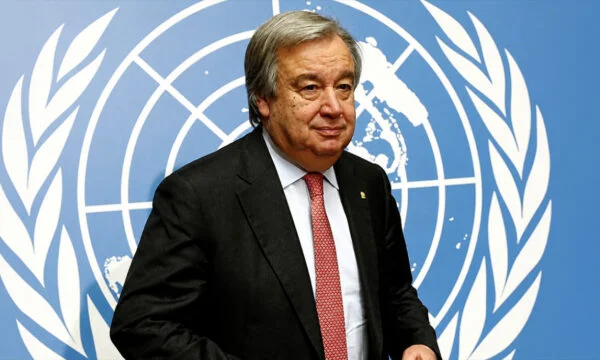
UN Secretary-General Antonio Guterres has made clear the position of the United Nations regarding maritime agreements that run counter to international law, in a statement made after a question about the Turkish-Libyan memorandum.
Asked by a journalist in Cairo about the UN’s position on countries that violate international law in relation to maritime agreements, Guterres stressed that “violations of international law are unacceptable”.
Without directly naming any state, the UN chief referred to the United Nations Convention on the Law of the Sea.
“As regards the situation at sea, there is the UN Convention on the Law of the Sea. Anything that is not in accordance with this convention should neither be respected nor accepted,” he said.
Guterres added that, regarding other violations of international law as well, the UN’s position has always been clear: it must be ensured that the rule of law prevails over the law of force.
“This applies to each of the situations you mentioned,” he said.-
During his statements in Cairo, the UN Secretary-General also spoke about major international developments, highlighting Egypt’s role as a pillar of multilateral cooperation and an important factor of stability in the Middle East.
He devoted a special part of his statement to the conflict in Gaza, where he emphasized the need to lift restrictions on humanitarian aid, protect civilians and implement the relevant UN Security Council resolutions.
He also expressed concern over the expansion of Israeli settlements, the displacement of Palestinians and the escalation of violence in the occupied West Bank.
Guterres reiterated that the two-state solution remains the only viable prospect for lasting peace, in which Israel and Palestine coexist in peace and security, in accordance with international law and UN resolutions.
The UN chief also stressed that freedom of navigation in the Strait of Hormuz and Bab el-Mandeb must be fully restored, in accordance with international law.
He warned that developments in the Red Sea and the Black Sea, as well as the crisis in the Strait of Hormuz, are weighing on international trade, driving up energy costs and affecting the global economy.
Regarding tensions between Iran and the Gulf countries, Guterres stressed that any further military escalation must be avoided, as the consequences could be unpredictable and extend beyond the region.
He called on all parties to exercise restraint and seek diplomatic solutions.
Regarding Sudan, the UN Secretary-General called for an immediate cessation of hostilities, the protection of civilians and an end to the supply of weapons used against them.
As for Libya, he stressed the need to unify institutions and hold national elections, in order to end the prolonged period of transition.
In conclusion, Guterres called for increased international support for developing countries and countries hosting refugees, such as Egypt.
He also underscored the need for fundamental reforms in international financial institutions and the UN Security Council, in order to strengthen the participation and influence of developing countries in decision-making processes. /Panorama
Related

Globe
16 people lose their lives after an incident at a factory in Turkey
Globe
Peace talks, US official: Russia and Ukraine are showing flexibility on possible territorial exchange

Globe
France raises minimum wage to over €1,500 from December 1
Globe
Ukraine talks in Abu Dhabi, Germany: Russia must be ready to negotiate seriously

Globe
France accuses Iran of cyberattacks on supermarket refrigerators, warns of sanctions at European level
Globe
13 migrants die after boat sinks near Crete in Greece
Globe
CNN: US and Iran are negotiating quietly; both sides have several key demands
Globe
Europe joins Ukraine talks, meeting to be held next week

Globe
Israel on the brink of a post-Netanyahu era? Eisenkot gets mandate to form government
Globe
US strikes cargo ship in the Gulf of Oman: It attempted to break the blockade on Iran

Globe
Incident in Krakow, Poland – Prosecutors launch investigation

Globe
At least 33 killed in Saudi airstrikes in Yemen, including women and children





