
The fourth edition of the Regional Conference for Women Entrepreneurs and B2B Meetings, SHE RISES REGIONAL 2026, was held in Pristina, organized by the Kosovo Women’s Economic Chamber (G7), with the participation of more than 400 businesses owned or led by women, government representatives, financial institutions and international partners, reports Ekonomia Online. The President […]
Women entrepreneurs from the region come together in Pristina for new business opportunities
The fourth edition of the Regional Conference for Women Entrepreneurs and B2B Meetings, SHE RISES REGIONAL 2026, was held in Pristina, organized by the Kosovo Women’s Economic Chamber (G7), with the participation of more than 400 businesses owned or led by women, government representatives, financial institutions and international partners, reports Ekonomia Online.
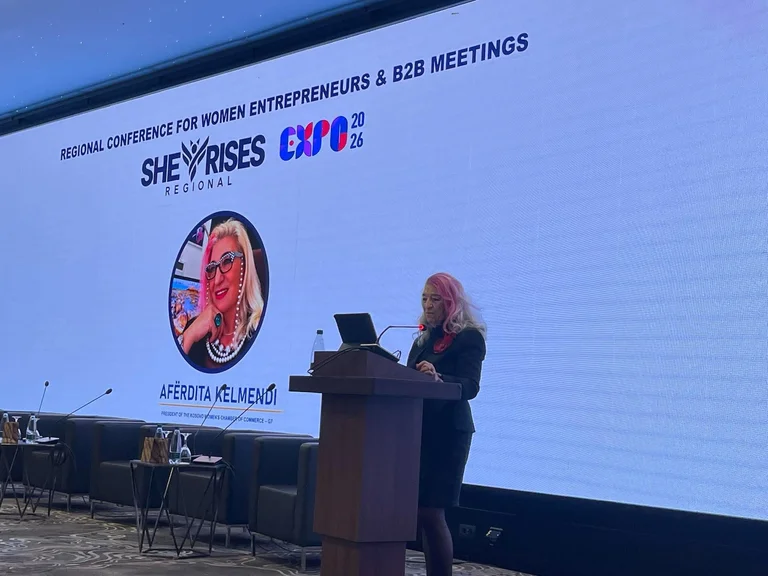
In her opening remarks, the President of the Kosovo Women’s Economic Chamber, Aferdita Kelmendi, first referred to the case of the murder of Arlinda Zekaj, stressing that women’s safety and dignity are fundamental prerequisites for their empowerment.
“After the minute of silence that united us in grief and reflection, it is impossible to talk about women’s empowerment without considering its true meaning. Arlinda’s tragedy reminds us that a society cannot claim to be empowering women if it cannot guarantee them the most fundamental right to live safely, freely and with dignity,” she stressed.
Speaking about the importance of women’s economic empowerment, Kelmendi emphasized that their contribution to society is not determined solely by their professional position or success in business.
“But a woman’s empowerment does not begin or end with a professional position, a successful business or a high-ranking state office. The woman who cares for her family, the one who works in a factory, the teacher who educates generations, the professional who builds a career, the entrepreneur who creates jobs, the minister or president who makes decisions for the country—each, in her own way, is part of the foundation on which society stands and develops. A woman’s work does not begin when she enters the labor market, and her worth is not determined by the position she holds. Therefore, when we talk about women’s economic empowerment, we are not talking only about more businesses owned by women; we are talking about a society that recognizes women’s contributions, respects their freedom and creates real opportunities for their economic independence. Because economic independence is not only the opportunity to earn; it is also the freedom to choose, to decide and to build one’s life. And this is precisely the spirit that brings us together today,” she said.
“On behalf of the Kosovo Women’s Economic Chamber, G7, I am pleased and honored to welcome you to the fourth edition of the Regional Conference for Women Entrepreneurs and B2B Meetings. Today, more than 400 businesses owned or led by women have joined us in this hall, along with representatives of governments, financial institutions and international partners. We are here to create new economic opportunities. This conference invites us to turn meetings into partnerships and ideas into concrete business opportunities. The global economy is changing rapidly. Technology, artificial intelligence, the digital and green transitions, and market uncertainty are changing how we work and compete. Women entrepreneurs are part of this transformation, but they often face additional barriers: more difficult access to financing, more limited investment opportunities and less representation in sectors with high economic value. It is not enough to have more women starting businesses; we need more women growing them, exporting and competing beyond the domestic market. Kosovo, Albania, North Macedonia and Montenegro, considered separately, have relatively small markets, but together they create a much larger space of opportunities. Our borders must not be the limits of our economic ambitions. An entrepreneur from Pristina should see Tirana, Skopje or Podgorica as natural opportunities to expand her business. By exchanging expertise and developing joint products, we can enter new markets. The diaspora is an important bridge to capital and technology,” she said.
Meanwhile, the Head of the European Union Office in Kosovo, Dirk Schuebel, focused in his remarks on the challenges women entrepreneurs face, particularly in accessing finance and markets, emphasizing the importance of regional cooperation.
“However, many women entrepreneurs still face difficulties accessing finance, business networks and markets, as well as opportunities to participate in decision-making. These challenges are especially significant in smaller economies, where business growth often depends on reaching customers and partners beyond domestic markets. Regional cooperation offers an opportunity to change this. Through CEFTA and other regional initiatives, the Western Balkans is working to remove trade barriers and create a more integrated regional market. This must translate into concrete benefits for women-led businesses: easier access to neighboring markets, new customers and stronger business partnerships. Women entrepreneurs themselves have an important role to play. By connecting across borders, they can exchange experiences, identify shared challenges and jointly advocate for policies that address their needs,” he said.
“Women’s economic empowerment is at the heart of the region’s economic and trade agenda. Advancing equality strengthens competitiveness, innovation and economic growth. This is equally important for Kosovo’s integration into the European Union. Alongside legislative and institutional reforms, Kosovo needs a competitive and inclusive economy in which women and men have equal opportunities to contribute and succeed. The European Union supports Kosovo in building precisely such an economy. As Kosovo’s strongest and most reliable partner and the largest provider of financial assistance, the EU supports entrepreneurship, innovation, skills development and access to finance, including for women-led businesses,” he said.
Meanwhile, the Head of the European Bank for Reconstruction and Development (EBRD) Office in Kosovo, Sergiy Maslichenko, spoke about the financial programs and business advice the institution offers to small and medium-sized enterprises, particularly those led by women.
“The EBRD is well known for providing finance. As you know, we are very active in financing small and medium-sized enterprises (SMEs), particularly women-led SMEs. We implement a range of programs, and I am very pleased that just two days ago we signed a new program with TEB Bank, which is a partner here. In fact, TEB was the first; it launched this program 12 years ago, and now we are proud to see the results. I am very proud to see in this hall entrepreneurs and companies we have supported, such as Digital School, Ancors Up, Grand Decor, Xeho, Academia Evolucion, Barza Cake and others. These businesses represent very different sectors, from IT to wood manufacturing, fashion and food, but they share an important characteristic: the ambition to grow. And as you know, the EBRD is not just about finance; we also provide business advice. It is important to us that women entrepreneurs build stronger businesses, connect across borders and gain access to new markets. And that is why today’s B2B session is so important. I encourage you to use it not simply to exchange contacts, but to start real conversations and discuss business ideas. The EBRD is proud to be part of this journey and continues to support entrepreneurs with finance, expertise and access to networks and markets,” he stressed.
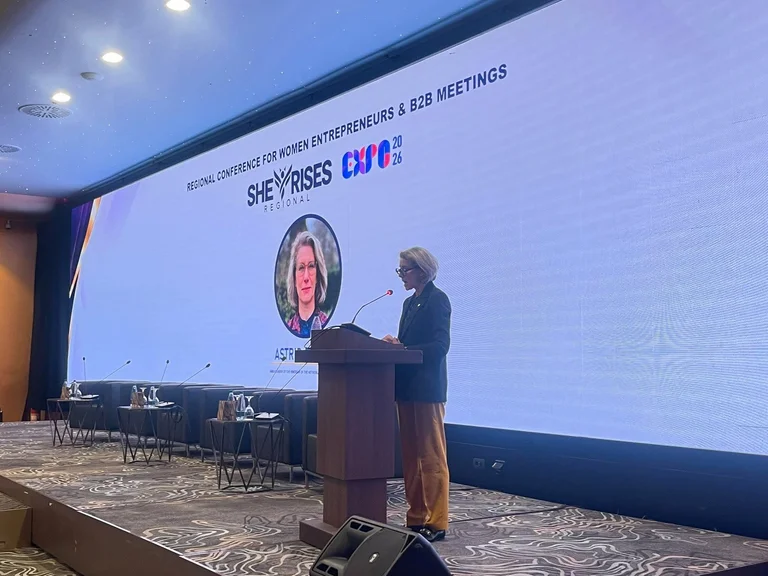
The Ambassador of the Kingdom of the Netherlands to the Republic of Kosovo, Astrid de Vries, presented the Dutch experience in supporting women entrepreneurs, highlighting the importance of creating mechanisms that enable them to access finance and business networks more easily.
“I would like to share some practical lessons from the Netherlands on how we support women entrepreneurs and what we still need to improve. In the Netherlands, entrepreneurs can receive advice from the Chamber of Commerce and its government services. They can also apply for public schemes that help businesses obtain loans, including when they do not have sufficient collateral. There are mentoring programs and regional business networks that can help them meet advisers, experts and potential investors. But experience shows that support which is open to everyone does not always reach everyone equally. And in the Netherlands, it was recognized that an additional effort was needed to reach and support women entrepreneurs. That is why public and private organizations in the Netherlands joined together and created what is called Code V. V stands for women—vrouwen in Dutch. It brings together more than 130 organizations, including government bodies, banks and business groups, and they really work together to improve women’s access to finance, knowledge and networks. They also gather information and connect women entrepreneurs with potential financiers. And why was this necessary? Well, a Dutch government study found that women who needed financing were less likely than men to apply for it. 47% of women did so, compared with 59% of men. But, also surprisingly to me, when women applied, their approval rate was almost equal to that of men. 89% of women and 90% of men had their proposals approved. This suggests that an important step is helping women find financing, find the right funds and also be ready to apply,” she said.
Related
Economy
Ymeri: Government measures on electricity will not solve the situation
Economy
GAP: 87% of Kosovo’s budget expenditures contributed to the Sustainable Development Goals during 2021–2025
Economy
Government links payroll and human resources systems; €8.9 million from the EU expected to be released
Economy
Government says electricity supply is also at risk due to the failure to complete work on Unit B1 on time; project funded by the EU

Economy
Oil prices fall again on international exchanges; in Kosovo, the decrease is being reflected slowly
Economy
Shahini: Investors are becoming more cautious, while Albania risks postponing new investments
Economy
Hoti: The government has apparently stopped electricity imports from Serbia – can something be stopped that, according to government officials, did not exist?
Economy
Tahiri to the Government: Even after 6 years, do you have a plan to start building a new power plant?
Economy
Hoti: During VV’s government, economic growth was lower and inflation higher
Economy
Kraki slams the Government: So we’ve bought electricity from Serbia and still ended up without power — failure twice over
Economy
Rizvanolli explains reasons for decision to ban energy trading with Serbian companies
Economy
Ramadani: The Government admitted it plundered the budget through electricity trading with Serbia





