
Within a few years, the European Union’s (EU) external borders could become Kosovo’s borders with Albania and Montenegro.
If Albania and Montenegro join the EU, how will this affect citizens and businesses in Kosovo?
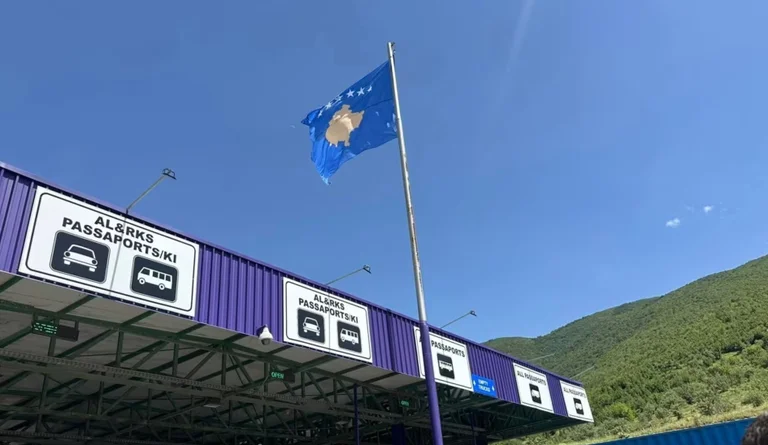
This prospect is becoming more concrete as both countries make progress in the accession process, while Kosovo is lagging on its path toward European integration.
Montenegro has provisionally closed 23 of the 33 negotiating chapters, and the European Commission estimates it could close them all by the end of 2026. Albania, meanwhile, has closed 4 of the 33 chapters and opened the final cluster of chapters. It aims to complete negotiations by the end of 2027.
Kosovo, on the other hand, applied for EU membership on December 15, 2022, and is still waiting to receive candidate-country status.
The European Commission’s latest report highlights stalled reforms in Kosovo amid a prolonged institutional crisis. The crisis was marked by difficulties in constituting the Assembly and forming institutions, while the country held three rounds of parliamentary elections within about a year.
Experts on European integration, the economy and security believe Kosovo should prepare for the eventual accession of Montenegro and Albania to the EU.
According to them, these developments could affect the movement of people and goods, create new conditions for Kosovan businesses and change regional security cooperation.
The gap with neighbours in integration and security
Albania and Montenegro’s progress toward EU membership could widen Kosovo’s political distance from its neighbours, but also create differences in regional security cooperation.
Tefta Kelmendi, a researcher at the European Jacques Delors Institute, believes Kosovo has already fallen behind its neighbouring countries as a result of the political crisis and a lack of progress in the dialogue with Serbia.
“Given the progress neighbouring states have made over the past four years and, in comparison, Kosovo’s stagnation as a result of the political crisis in the country and the lack of progress in the dialogue with Serbia—which has affected both the European integration process and diplomatic relations with EU institutions and member states—a considerable distance has emerged that will be difficult to overcome in the near future,” Kelmendi tells Radio Free Europe.
In her view, if Montenegro and Albania join the EU within four years, Kosovo could face greater domestic pressure to accelerate European integration.
This development, however, Kelmendi believes, could also have a positive impact by restoring citizens’ and political representatives’ confidence in the European perspective.
According to her, Pristina should commit to accelerating domestic reforms, particularly in the rule of law and diplomacy, and to overcoming political obstacles on its path to EU integration.
“A wise strategic approach would be for Kosovo to engage as soon as possible and intensively in removing the political obstacles to its progress in the integration process, including the issue of non-recognition by five EU member states, which would enable the unblocking of its candidacy in the Council of Europe,” Kelmendi tells RFE/RL.
According to Kelmendi, Kosovo should intensify its diplomatic engagement with EU institutions and member states to unblock its candidacy. In parallel, it should advance the reforms that would enable it to integrate into the EU’s single market.
The gap with neighbours is not limited to the political integration process.
Jeta Loshaj of the Kosovo Centre for Security Studies (KCSS) believes the gap with neighbours could also widen in the field of security, where Kosovo already has a less favourable position in terms of access to European cooperation mechanisms.
Currently, Kosovo is the only country in the region without an operational agreement with Europol. The current working arrangement, from 2020, does not allow the exchange of personal data, although practical cooperation has increased.
“Once our neighbours are inside the EU, this asymmetry will deepen,” Loshaj tells RFE/RL.
According to her, Kosovo’s unequal position relative to its neighbours inside the EU could make it more difficult to combat organised crime and other cross-border threats.
She says criminal groups treat the region as a single space and exploit countries where controls and information-sharing are weaker.
“If our neighbours are fully integrated (into the EU) and Kosovo is not, a grey zone could emerge that is exploited for trafficking, smuggling and irregular migration,” Loshaj says.
She also says that Montenegro and Albania’s eventual accession to the EU would bring the bloc’s rules and standards to border management, stricter controls and greater involvement by the European Border and Coast Guard Agency (Frontex).
Kelmendi adds that Montenegro and Albania’s eventual accession to the EU would affect their relations with Kosovo through the bloc’s additional requirements for the free movement of citizens.
“To cross the border and access their personal property or visit relatives in these two countries, citizens of Kosovo would need to travel with a valid passport, pay special insurance for vehicles entering the EU, and face limits on the length of their stay,” Kelmendi says.
This would particularly affect how citizens of Kosovo and those of Albania and Montenegro cross into each other’s territories. Currently, this is possible using biometric identity cards.
Loshaj explains that existing regional agreements on travel with identity cards do not automatically cease to apply when Albania and Montenegro join the EU. In her view, the greatest impact on the movement of people would be felt if these two countries also joined the Schengen Area, since this does not happen at the same time as EU accession and usually takes several more years.
After that, she says, a number of practical questions would remain.
“What will happen to the joint border crossing points, and how long will the queues be in the summer? Visa liberalisation has greatly reduced this risk, but Kosovo needs to address these issues now, so that the border does not become an obstacle for people,” Loshaj says.
From CEFTA to the EU market: a challenge for Kosovan exporters
If Albania and Montenegro join the European Union before Kosovo, their trade relations with Kosovo will operate within a new framework of rules.
Gazmend Qorraj, an economics professor at the University of Pristina, believes this change would bring a structural transformation in trade relations between these countries.
“In practical terms, upon joining the EU, Albania and Montenegro will be required to apply the EU’s Common Commercial Policy and will automatically withdraw from the Central European Free Trade Agreement (CEFTA),” Qorraj tells RFE/RL.
According to him, trade with Kosovo would be governed by the Stabilisation and Association Agreement (SAA), which has been in force in Kosovo since 2016.
Qorraj believes one of the main challenges for Kosovan exporters will be non-tariff barriers related to European market standards and requirements.
“Exporters who already have experience trading with EU countries will find it easier to adapt, while for those without this experience, the transition will pose a new challenge because of the EU market’s stricter requirements and regulations compared with the regional Western Balkan market,” he tells RFE/RL.
Adapting to the requirements of the EU market would be particularly difficult for small and medium-sized businesses, believes Lulzim Rafuna, president of the Kosovo Chamber of Commerce.
“Although a small number of large exporting companies (especially in the wood processing, plastics and IT sectors) have managed to obtain certification for the EU market, the vast majority of small and medium-sized enterprises do not have the financial and technical capacity to make this transition within a short time,” he tells RFE/RL.
Rafuna warns that if Albania and Montenegro join the EU, Kosovan exporters will face strict phytosanitary and veterinary requirements, as well as EU quality standards. In his view, a lack of information and Kosovo’s limited laboratory capacity for product testing could make it harder for businesses to meet these requirements and weaken their competitiveness in both markets.
“Among the sectors most exposed are agribusiness and food processing, manufacturers of construction materials, as well as the transport and logistics sector,” Rafuna says.
Rafuna adds that additional customs checks and procedures at the border could cause delays and increase costs for Kosovan transport operators.
How should Kosovo prepare?
Radio Free Europe approached the Government of Kosovo to obtain its position on the possible political, economic and security consequences of Albania and Montenegro potentially joining the EU, including the impact on citizens’ movement, cross-border cooperation and trade relations.
RFE/RL also asked what specific measures the Government is planning to protect Kosovo’s interests and advance the country’s European integration. By the time this article was published, the Government had not responded to the questions.
All of RFE/RL’s interviewees, from different perspectives, emphasise the need for Kosovo to prepare for the changes that Albania and Montenegro’s accession to the EU could bring.
They call for greater institutional engagement, agreements with the two neighbouring countries and measures to help Kosovan businesses adapt to the new requirements.
Kelmendi says that to make up for the time lost because of the political crisis and problems in the dialogue with Serbia, Kosovo needs to step up efforts to unblock its EU membership candidacy.
Meanwhile, to advance the domestic reforms that would enable it to integrate into the European single market, Kosovo can, in her view, make use of EU financial support.
“The EU has already established a framework to help candidate countries make progress in this direction, through the Growth and Reform Plan and the financial instruments that support it. What remains is for the Government of Kosovo to engage politically in this process and put it on its list of top priorities,” Kelmendi tells RFE/RL.
In the field of security, Loshaj believes Pristina should negotiate bilateral agreements on security and border control with Tirana and Podgorica before they join the EU.
“These agreements should include joint patrols, joint contact centres, joint border crossing points and information-sharing. They should be drafted in line with EU standards so that they remain valid after accession,” Loshaj tells RFE/RL.
According to her, Kosovo can deepen cooperation with Europol in fighting crime, with Frontex in border management, and with Eurojust on judicial cooperation in criminal matters, without raising the issue of its status.
Loshaj adds that Kosovo should strengthen data protection, the integrity of border controls and the capacities of the Kosovo Police. In her view, tangible results in these areas would demonstrate Kosovo’s readiness to cooperate and help it seek gradual inclusion in EU security operations.
To prepare businesses, Qorraj calls for the advance engagement of public institutions and business associations.
“Public institutions and business associations should prepare domestic businesses in advance through information and training focused on EU standards,” Qorraj says.
In addition to information and training, Qorraj believes institutions and business associations should pay particular attention to exporters who lack experience with the EU market, so they can prepare for its stricter requirements and regulations.
Rafuna believes the Government of Kosovo should take concrete measures, including subsidising product certification and standardisation, investing in local laboratories and negotiating special trade protocols with Albania and Montenegro.
“Work should be done toward a transitional agreement with Albania and Montenegro: the Government should negotiate special trade protocols or transitional ‘green corridors’ now for the period after their accession, with the aim of facilitating customs procedures for products originating in Kosovo,” Rafuna says.
He also suggests that the Government create a fund to cover up to 70 per cent of product certification costs. According to Rafuna, financial support would help businesses, particularly small and medium-sized enterprises, meet the standards required for the European market.
Related
Economy
Ymeri: Government measures on electricity will not solve the situation
Economy
GAP: 87% of Kosovo’s budget expenditures contributed to the Sustainable Development Goals during 2021–2025
Economy
Government links payroll and human resources systems; €8.9 million from the EU expected to be released
Economy
Government says electricity supply is also at risk due to the failure to complete work on Unit B1 on time; project funded by the EU
Economy
Oil prices fall again on international exchanges; in Kosovo, the decrease is being reflected slowly
Economy
Shahini: Investors are becoming more cautious, while Albania risks postponing new investments
Economy
Hoti: The government has apparently stopped electricity imports from Serbia – can something be stopped that, according to government officials, did not exist?
Economy
Tahiri to the Government: Even after 6 years, do you have a plan to start building a new power plant?
Economy
Hoti: During VV’s government, economic growth was lower and inflation higher
Economy
Kraki slams the Government: So we’ve bought electricity from Serbia and still ended up without power — failure twice over
Economy
Rizvanolli explains reasons for decision to ban energy trading with Serbian companies
Economy
Ramadani: The Government admitted it plundered the budget through electricity trading with Serbia





