
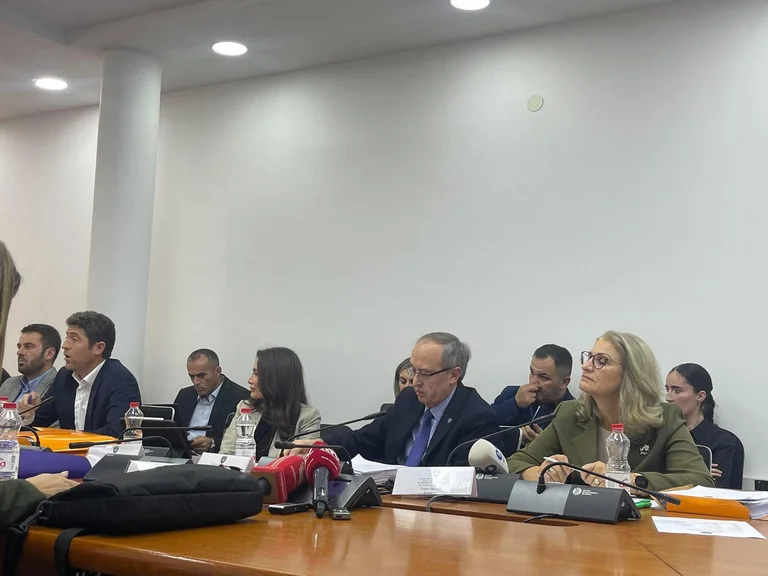
During the first reading of the Draft Law on Budget Allocations for the Budget of the Republic of Kosovo for 2027, Avdullah Hoti, a member of the committee from the Democratic League of Kosovo (LDK), addressed a series of criticisms and questions to Finance Minister Hekuran Murati, questioning the budget’s strategic direction and its alignment with the Government’s pledges, reports Ekonomia Online.
“Whatever you say, you distort it”: Clash between Hoti and Murati over the 2027 Draft Budget
Hoti said the budget should not be viewed only as a financial document, but as a strategic instrument that sets the direction for the country’s economic development.
“The budget is not an accounting plan; it is a strategic document. I, too, have tried to look at the textual analysis section at the end of this large document, to see how the government has planned this 2027 budget document and the following years from a strategic perspective, because the government takes around one third of national income from citizens and businesses. It will be around 32% next year. So, it is one third of national income that we take—the state takes—and invests, spends in various ways. It is precisely through the budget that we give the economy direction, or should give it direction, because we take one third of the flow of economic activity and bring it into the state,” Hoti said.
He stressed that these funds should be returned to the economy through spending that produces concrete effects, warning that otherwise a large share of economic activity could be channeled into unproductive spending.
“And we have to put it back into circulation so that income increases, rather than diverting one third of all economic activity and then channeling it into activities and spending that produce no effect,” he said.
Speaking about the division of the budget into current and capital expenditures, Hoti said the Government should take a clearer approach to wages, pensions, social assistance, and spending on goods and services.
“The two main budget allocations are these: current expenditure and capital expenditure. What do we do with current expenditure? Wages, pensions, and goods. What should be the focus? First, preserving purchasing power, including for wages, and especially for pensions, social assistance, and various schemes. I do not see in this budget, in the textual section and then reflected in the tables, how the allocation of wages, pensions, social assistance, and various schemes has focused on preserving purchasing power,” Hoti said.
He also raised the issue of spending on goods and services, asking how these funds would contribute to improving citizens’ quality of life.
“As for spending on goods, how do we ensure that we improve the quality of life? Goods that you buy, from medicines and educational materials to materials used within institutions and other institutions,” he said.
Hoti devoted part of his criticism to the health sector, asking for greater clarity on health insurance and the financial burden citizens continue to bear out of pocket.
“And then, as for sectoral spending, what do we want to do with healthcare? We can talk about large figures, but the reality is completely different, and I will show what we want to do with this health insurance. What do we want to do to ensure that people do not pay 40% of total healthcare expenses out of their own pockets? We can say all we want that healthcare in our public hospitals is free, but families pay out of pocket for 40% of the healthcare expenses they have on average,” Hoti said.
Hoti also questioned infrastructure investment planning, criticizing the Government for not completing major road projects and for lacking a clear concept for railways.
“Or what is your strategic plan for infrastructure? We cannot go on for a whole decade—one, two, three years under previous governments and six years under your government—without completing a single one of the main arterial roads. I’m not getting into individual projects. What is the concept for infrastructure? When will you complete these roads? What is your concept for railways now? What is happening with that railway to Durrës? So, what is the overall budget for investments in the infrastructure section?” Hoti asked.
He also addressed the energy sector, saying the country lacked a concrete plan to increase generation capacity.
“What should we do about energy? Look, we are going into winter and once again we are facing basic electricity cuts. And there is no concept, no concept at all, for how we will increase energy capacity in the future. That is the strategic planning that needs to happen in the budget,” he said.
Hoti said these were issues that, in his view, should be addressed in the budget document and accompanied by measurable objectives for the coming years.
Hoti then compared the budget document with the Government’s pledges made when it presented its governing program to the Assembly on September 13, 2026.
He stressed that the budget covers the 2027–2029 period and that, consequently, a large part of the Government’s term should be reflected in it.
“These are my ideas, based on how I tried, when I was in office, to the extent I was able, to prepare the budget and present it to the MPs. Now, let’s leave that aside. I’ll start by comparing this budget document with your promises. What did you promise? What I want as an opposition member is one thing, but what did you promise? What did the person designated as prime minister of the country promise on September 13, 2026, when the Government was voted in by the Assembly? You presented a program—you did not bring it to the Assembly—but in the opening speech by the person designated as prime minister, when he took on the mandate to govern for the next four years, he listed the Government’s objectives and, in most cases, specific projects in various fields,” Hoti said.
He called for the pledges presented to the Assembly to be reflected in the budget document.
“And now, because the budget is for three years: 2027, 2029—and as you presented it, you should plan all the projects through 2029. So almost your entire term is included in this plan, which means the promises made on September 13, 2026, at the Assembly session should be 99% reflected in this document. But what are they?” he asked.
In his response, Finance Minister Hekuran Murati said not all the Government’s pledges could be included in the 2027–2029 budget allocations, since the Government’s term also includes 2030.
“As for the budget allocations, I cannot say all of them, but most of them, because this budget does not run through to the end of the term; 2030 is also part of our term. So not all of them can be planned for. A large part of what is planned for implementation does not involve budget allocations. For example, the €1 billion program in guarantees for investment in production is not a budgetary issue; you will soon have the draft law on issuing a sovereign guarantee,” Murati said.
He added that possible legislative changes could also be accompanied by a budget review if the impact on revenues were significant, but, he said, such initiatives were not expected to negatively affect state revenues.
“Whenever a law is amended, the law also provides that if the impact on revenues is large enough, there can be a budget review. However, we do not consider that this will reduce revenues; on the contrary, it may increase investment,” the minister said.
Murati also mentioned projects that, in his view, do not necessarily require an allocation from the state budget, citing Brezovica and Pristina Airport as examples.
“Then there are issues such as Brezovica; for example, the airport was not in the budget when it was given under concession, because the state did not invest there,” he said.
Murati went on to refer to an earlier debate with Hoti about child allowances, claiming that in 2021, during the review of the budget for the following year, Hoti had questioned whether the allowances would be implemented because they were not included in the document.
“I remember that in 2021, when I brought in the budget for the following year, one of MP Hoti’s comments, one of his objections, was that child allowances were not included in the budget at all. His conclusion was therefore that they would not happen, if I can quote him accurately,” Murati said.
After this statement, Hoti interjected, objecting to the way the minister was attributing his earlier remarks to him.
“You can never quote me. Whatever you say, you distort it,” Hoti responded.
Murati, meanwhile, said that issues related to specific projects and individual initiatives should be discussed in the relevant parliamentary committees with the ministers responsible for each sector.
“So, as for individual issues and individual projects, I invite you to go to the relevant line committees to discuss them with the ministers, because the budget is also reviewed in those committees. So go to those committees; you can ask your questions there. I can talk about the budget as a whole, overall policies, and the budget framework, but as for projects and individual initiatives, you can discuss them with each minister, because they are more competent and know the area better. They know the area covered by their field much better. I cannot answer for other fields,” Murati said.
During the discussion, Minister Murati also spoke about the Northern Development Fund, saying it stemmed from the 2013 agreement reached in Brussels and ratified by the Assembly of Kosovo.
“The Northern Development Fund is the result of an agreement in Brussels in 2013, and that agreement was ratified. Perhaps—I do not know whether you were an MP and voted for its ratification—but it was also ratified with votes from LDK MPs. Kosovo cannot unilaterally undo it,” Murati added.
Related
Economy
Ymeri: Government measures on electricity will not solve the situation
Economy
GAP: 87% of Kosovo’s budget expenditures contributed to the Sustainable Development Goals during 2021–2025
Economy
Government links payroll and human resources systems; €8.9 million from the EU expected to be released
Economy
Government says electricity supply is also at risk due to the failure to complete work on Unit B1 on time; project funded by the EU
Economy
Oil prices fall again on international exchanges; in Kosovo, the decrease is being reflected slowly
Economy
Shahini: Investors are becoming more cautious, while Albania risks postponing new investments
Economy
Hoti: The government has apparently stopped electricity imports from Serbia – can something be stopped that, according to government officials, did not exist?
Economy
Tahiri to the Government: Even after 6 years, do you have a plan to start building a new power plant?
Economy
Hoti: During VV’s government, economic growth was lower and inflation higher
Economy
Kraki slams the Government: So we’ve bought electricity from Serbia and still ended up without power — failure twice over
Economy
Rizvanolli explains reasons for decision to ban energy trading with Serbian companies
Economy
Ramadani: The Government admitted it plundered the budget through electricity trading with Serbia





