
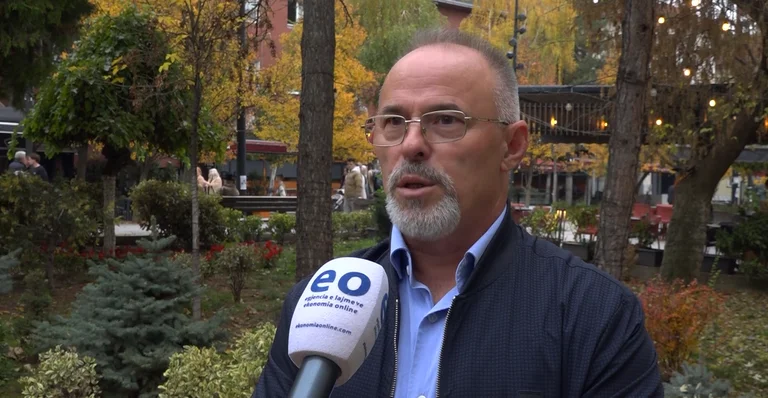
The chair of the Public Administration Trade Union, Ali Gashi, has described the planned increase in the value of the salary coefficient from 110 to 120 euros as unacceptable, saying that such an increase does not reflect the actual economic situation, rising prices of essential goods and inflation.
Gashi opposes raising the coefficient from 110 to 120: It is unacceptable and does not reflect rising prices
In an interview with Ekonomia Online, Gashi said that since the Salary Law came into force, the coefficient has been worth 110 euros, while according to the Government's plans, its value is set to rise to 120 euros as part of the draft budget for 2027.
He said that for the federation and union he represents, this increase is extremely unacceptable, as it does not correspond to the actual rise in the cost of living.
“For us, as a federation and as a union, it is extremely unacceptable. The reason is that such an increase absolutely does not reflect the actual situation and prices. I would rather say that, even when inflation is taken into account, this is extremely unacceptable,” Gashi said.
He stressed that increasing the coefficient by 10 euros does not mean a sufficient improvement in civil servants' salaries, given the impact this increase has on gross pay.
“Yes, a public official with a coefficient of five gets a 50-euro increase, and that increase is gross. That means that the absolute majority of the increase for public officials—for around 82 public officials, exclusively civil servants at the central and local levels—could average somewhere around 65 euros,” he said.
Gashi described this increase as laughable and absurd, adding that the union's ongoing demand to the Government of Kosovo and the prime minister has been for salary increases to reflect the rise in the prices of essential goods.
“Honestly, this is a laughable increase, an absurdity, because we did not believe in or expect such an increase. Our ongoing demand, addressed to the Government of the Republic of Kosovo and the prime minister himself, has been for the increase to reflect the rise in the prices of essential goods,” Gashi said.
According to him, the union has not asked for anything more than a calculation of the price increases for essential goods and for the coefficient's value to be set based on the average increase.
“Look, we have asked for nothing more and nothing less than for the increase in the prices of essential goods to be calculated and an average to be determined. The value of the coefficient should be set based on that average. And citizens, civil servants, and the Government of the Republic of Kosovo should understand this: if the average increase in the prices of essential goods is somewhere around 50%, then salaries should also reflect that increase,” he said.
Gashi argued that when the prices of essential goods have risen by 50 to 60 percent, an increase of just 10 euros in the value of the coefficient is unreasonable.
“Because if the price of a product has risen by 50–60% and you increase the salary by only 10 euros through the coefficient, then that is absurd. Therefore, it is unacceptable, and we call on the Government of the Republic of Kosovo to respond, because we are employees of this government, we are public administration employees, but above all we are citizens of the Republic of Kosovo. We have families, and we must support our families with our salaries,” Gashi said.
The head of the Public Administration Trade Union also raised concerns about employees leaving the public administration and the lack of interest in working in public institutions, particularly in positions requiring professional and engineering qualifications.
According to him, unworthy salaries are directly contributing to civil servants leaving their jobs, after which they move to the private sector or leave the country.
“Look, there are now two phenomena affecting public officials, particularly civil service employees. There is the departure—undoubtedly, people are leaving their positions because the salaries they receive are not worthy, and, to be honest, most of those who leave this service either move to the private sector or go abroad,” he said.
Another problem, according to Gashi, is the lack of interest among professionals with various engineering qualifications in working in the public sector, due to the large pay gap with the private sector.
He said that an engineer in public institutions might be paid between 700 and 800 euros, while in the private sector they could earn at least 1,500 euros.
“But we also have another phenomenon: a lack of interest, and we need to understand one detail: it is somewhat difficult to persuade people with all engineering qualifications to work in the public sector. The reason is that an engineer of any specialization might be paid between 700 and 800 euros, whereas if they move to the private sector, the minimum salary is 1,500 euros. That is why they do not see themselves in public institutions, and this then causes a chain reaction that greatly harms the public sector and public administration. It would be an enormous loss, because a strong state also depends on a strong and professional administration,” Gashi concluded.
With a budget of 4.27 billion euros for next year, the Government has planned a 13th-month salary for public employees, an increase in the salary coefficient starting in July, and a doubling of child benefits by 2030.
Related
Economy
Ymeri: Government measures on electricity will not solve the situation
Economy
GAP: 87% of Kosovo’s budget expenditures contributed to the Sustainable Development Goals during 2021–2025
Economy
Government links payroll and human resources systems; €8.9 million from the EU expected to be released

Economy
Government says electricity supply is also at risk due to the failure to complete work on Unit B1 on time; project funded by the EU

Economy
Oil prices fall again on international exchanges; in Kosovo, the decrease is being reflected slowly
Economy
Shahini: Investors are becoming more cautious, while Albania risks postponing new investments
Economy
Hoti: The government has apparently stopped electricity imports from Serbia – can something be stopped that, according to government officials, did not exist?
Economy
Tahiri to the Government: Even after 6 years, do you have a plan to start building a new power plant?
Economy
Hoti: During VV’s government, economic growth was lower and inflation higher
Economy
Kraki slams the Government: So we’ve bought electricity from Serbia and still ended up without power — failure twice over
Economy
Rizvanolli explains reasons for decision to ban energy trading with Serbian companies
Economy
Ramadani: The Government admitted it plundered the budget through electricity trading with Serbia





