
The Ministry of Industry, Entrepreneurship, Trade and Innovation (MINTI) and the World Bank have signed a Cooperation Agreement for the development of Eco-Industrial Parks in Kosovo, with the aim of transforming industrial zones into sustainable spaces for production, innovation and economic development, Ekonomia Online reports. The Minister of Industry, Entrepreneurship, Trade and Innovation, Mimoza Kusari-Lila, said that development […]
MINTI and the World Bank Sign Agreement on the Development of Eco-Industrial Parks in Kosovo
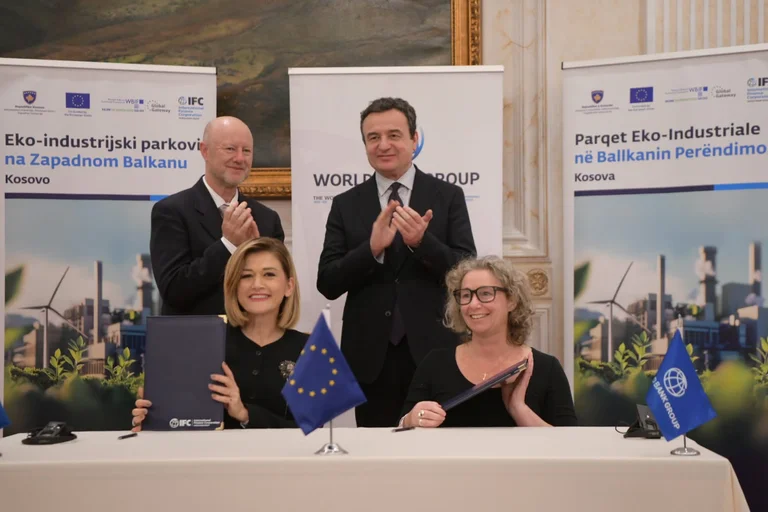
The Ministry of Industry, Entrepreneurship, Trade and Innovation (MINTI) and the World Bank have signed a Cooperation Agreement for the development of Eco-Industrial Parks in Kosovo, with the aim of transforming industrial zones into sustainable spaces for production, innovation and economic development, Ekonomia Online reports.
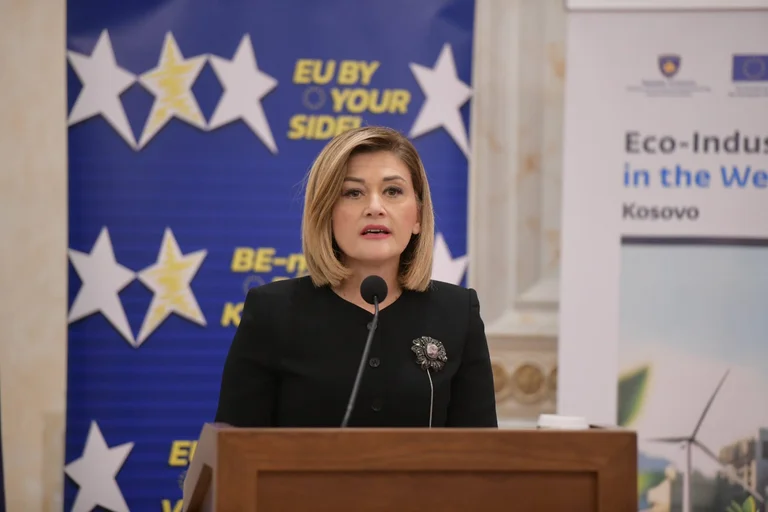
The Minister of Industry, Entrepreneurship, Trade and Innovation, Mimoza Kusari-Lila, said that industrial development should not be measured only by production capacity, but also by how resources and energy are used and how waste is managed.
“The industry of the future is measured not only by how much it produces, but also by how it produces, specifically in terms of energy use, waste and its management. Placing the environmental component at the center of industrial development is not only a guiding principle of our development policies, but also a necessity for businesses’ competitiveness and integration into European markets,” Kusari-Lila said.
She stressed that in recent years the Government of Kosovo has invested in developing industrial parks, infrastructure and creating spaces for businesses to advance, while the new agreement aims to take this process to another stage.
“In recent years, the Government of the Republic of Kosovo has invested in developing industrial parks, infrastructure and creating spaces for businesses to advance and for our progress. We now aim to take this process one step further, transforming these spaces into centers of sustainable production, innovation, and economic and social development,” the minister said.
Kusari-Lila said that this vision also aligns with the economic potential identified in the recently published Country Private Sector Diagnosis report by IFC and the World Bank.
According to her, the report estimates that, through targeted reforms in the renewable energy, business services and construction components manufacturing sectors, Kosovo has the potential to mobilize private investment worth between $1.2 billion and $1.5 billion and create between 61,000 and 87,000 new direct and indirect jobs in the medium term.
The minister stressed that Eco-Industrial Parks will provide businesses with modern, integrated infrastructure, more reliable access to energy, water, transport and shared services, as well as opportunities to use energy and renewable resources more efficiently.
According to her, one of the key elements of this transformation is the circular economy and industrial symbiosis, through which enterprises can cooperate by using one another’s waste and resources.
“The circular economy is particularly important in this transformation. We aim to move from a linear model of production and consumption to one in which materials and resources are kept in use for as long as possible, renewed and recycled. Through industrial symbiosis, enterprises within a zone can cooperate and benefit from one another’s capacities. The waste of one enterprise can become the raw material for another. This means less waste, less pollution, lower costs and more added value for our economy,” Kusari-Lila stressed.
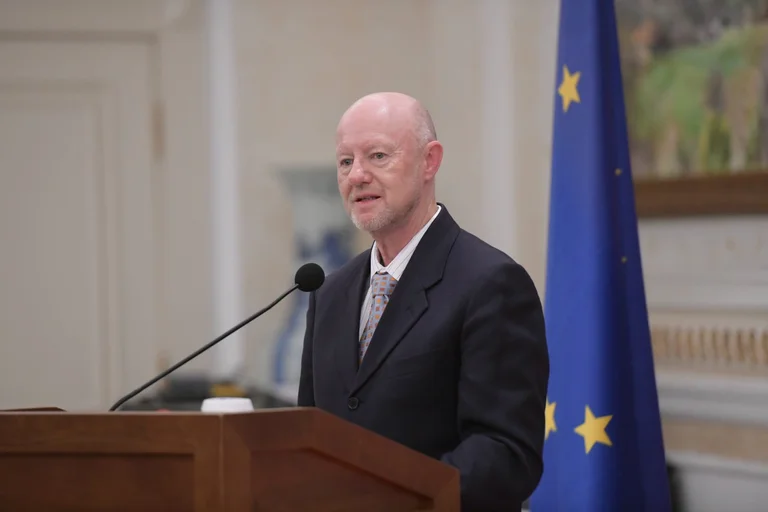
Meanwhile, the European Union Ambassador to Kosovo, Dirk Schuebel, highlighted the importance of developing Eco-Industrial Parks, stressing that they are directly linked to the competitiveness of Kosovo’s economy and opportunities for access to the European single market.
He recalled that the European Union’s Growth Plan for the Western Balkans provides for six billion euros in additional support for the region, of which 882 million euros is for Kosovo, but emphasized that the main purpose of this initiative is to create opportunities for greater economic integration and access to the EU single market.
“A few years ago, the European Union presented what is called the Growth Plan, through which we added not only six billion euros in additional resources for the Western Balkans, including 882 million euros for Kosovo, but also an underlying idea: access to the European Union’s single market. This is the driving force behind how growth can truly be generated, beyond the fiscal space that we can provide to facilitate the growth of the Republic of Kosovo,” Schuebel said.
According to the ambassador, access to the European market is not automatic and should not be understood as an opportunity offered to countries without conditions, since it requires a high level of competitiveness and the ability to meet market standards.
“Access to the EU single market is not something that is handed to you on a silver platter, as if to say that this is now a protected region and you have access to it. On the contrary, it requires a high level of competitiveness, because otherwise there may be the opposite effect when you no longer have protected markets and then find it more difficult to access European Union markets,” he said.
Schuebel stressed that, ultimately, it is the market itself that determines whether a country is able to attract investors, export products and develop domestic production, replacing some imports.
“It is the market that decides whether you are able to attract investors, whether you are able to export goods and whether you are able to produce goods for the Kosovo market domestically instead of importing them. Therefore, I think the importance of eco-industrial parks is tremendous, because they truly allow you to make a shared commitment to a competitive economic future that is resource-efficient and sustainable. These components have to come together,” the ambassador said.
He added that developing eco-industrial parks is not only an approach that the European Union recommends for Kosovo, but also a model being promoted and implemented within EU member states themselves.
“This is an approach that is being heavily promoted within the European Union right now. So we are not preaching something here that we think is a good approach only for Kosovo, but it is the same approach we are trying to implement, often with difficulty, I must admit, in my own country, Austria, for example. This is not easy, because it is always about trying to compete with other countries and other markets, which may not prioritize environmental standards and may have a comparative advantage when it comes to costs,” Schuebel added.
Related
Economy
Ymeri: Government measures on electricity will not solve the situation
Economy
GAP: 87% of Kosovo’s budget expenditures contributed to the Sustainable Development Goals during 2021–2025
Economy
Government links payroll and human resources systems; €8.9 million from the EU expected to be released
Economy
Government says electricity supply is also at risk due to the failure to complete work on Unit B1 on time; project funded by the EU
Economy
Oil prices fall again on international exchanges; in Kosovo, the decrease is being reflected slowly
Economy
Shahini: Investors are becoming more cautious, while Albania risks postponing new investments
Economy
Hoti: The government has apparently stopped electricity imports from Serbia – can something be stopped that, according to government officials, did not exist?
Economy
Tahiri to the Government: Even after 6 years, do you have a plan to start building a new power plant?
Economy
Hoti: During VV’s government, economic growth was lower and inflation higher
Economy
Kraki slams the Government: So we’ve bought electricity from Serbia and still ended up without power — failure twice over
Economy
Rizvanolli explains reasons for decision to ban energy trading with Serbian companies
Economy
Ramadani: The Government admitted it plundered the budget through electricity trading with Serbia





