
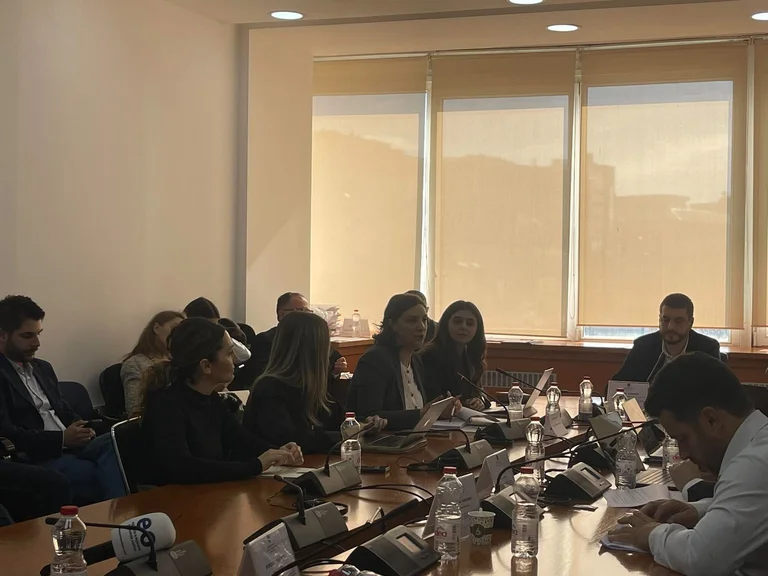
Minister of Economy Artane Rizvanolli reported to the Committee on Economy on the Draft Law on Energy Efficiency at a meeting attended by none of the committee members from the ranks of the PDK, LDK and the Alliance, Ekonomia Online reports.
Rizvanolli presents the Draft Law on Energy Efficiency to the Committee on Economy, without opposition participation
During the presentation of the draft law, Rizvanolli said the initiative aims to advance legislation on the efficient use of energy in the Republic of Kosovo, adapting it to developments in European legislation and the needs of the country's energy sector.
She said that the draft law aligns a significant part of Directive 2012/27/EU, as amended by Directive 2018/2002 and adapted for the Energy Community, as well as Directive 2023/1791.
“The Draft Law on Energy Efficiency advances this legislation on the efficient use of energy in the Republic of Kosovo. It builds on the existing law, but is being expanded to include requirements that reflect developments in European legislation and the needs of the country's energy sector,” Rizvanolli said.
The minister discussed some of the draft law's main innovations, highlighting the establishment of national objectives and mechanisms for achieving energy savings.
According to her, these objectives will be set through the National Energy and Climate Plan and other strategic sector documents, with the aim of creating a more coordinated approach between planning and implementation of measures.
“To achieve these objectives, annual savings of 0.8 percent of average final energy consumption over the previous three years are envisaged, starting from the first full calendar year after the law enters into force. This is in line with what we have already put into practice and with the investments already being made in energy efficiency in the Republic of Kosovo,” she said.
Another issue Rizvanolli described as important is the renovation of public buildings and the inclusion of energy performance criteria in public procurement.
The draft law envisages the annual renovation of at least 3 percent of the total useful floor area of buildings that are heated or cooled, are owned by public institutions and have an area of more than 250 square meters.
“The annual renovation of at least 3 percent of the total useful floor area of buildings that are heated or cooled, are owned by public institutions and have an area of more than 250 square meters is envisaged. At the same time, the draft law requires the inclusion of high energy performance in public procurement, so that we do not have such a great need to address efficiency and make additional investments after buildings are constructed, but instead these are provided for at the procurement stage,” the minister said.
She added that institutions had worked in this direction during previous terms as well, and that an international agreement, approved by the Assembly a few months ago, was now also in place to continue these activities.
Rizvanolli stressed that the measures envisaged in the draft law are not merely theoretical objectives, but concrete policies for which, she said, institutions have already built capacity and secured part of the funding.
“So, what we are discussing and proposing is not simply something distant and abstract in theory, but interventions and policies for which we already have both institutional capacity and funding for some of them, while funding still needs to be secured for others, as well as the institutions' experience in carrying them out,” Rizvanolli said.
The minister also highlighted the inclusion of energy poverty in support policies and programs, describing it as one of the draft law's innovations compared with the current Law on Energy Efficiency.
According to her, this approach is in line with the provisions of the Law on Energy, which has already been approved in principle by the Committee and is between its two readings.
“The inclusion of energy poverty in support policies and programs is something new in this law compared with the previous energy efficiency law. This is also in line with what is provided for in the Law on Energy, which you have already approved in principle as a committee and which is between its two readings,” she said.
Rizvanolli added that the two laws may eventually be aligned during the review phase between the two readings, but stressed that the principle remains the same: greater focus on energy poverty and the protection of vulnerable consumers.
“The principle is the same: energy poverty and vulnerable consumers have a greater role; more precisely, this package of laws places greater focus on them,” the minister said.
Another innovation in the draft law relates to energy labelling and informing citizens when they purchase electrical appliances.
“Energy labelling and information when purchasing appliances are also something that has already become standard practice through the efficiency measures we have implemented in the past, and citizens are now much more aware. However, from now on, traders will be required to ensure that, at the time of sale, products also have efficiency labels in the official languages of the Republic of Kosovo,” Rizvanolli said.
According to her, this will enable citizens and businesses to be better informed about the energy consumption of the products they buy and to make more suitable choices.
Rizvanolli stressed that the draft law goes a step further by creating the legal basis for ecodesign and setting minimum energy performance requirements for appliances.
“In fact, this law goes a step further, because it also defines ecodesign, or the legal basis for ecodesign, and minimum requirements for the performance of appliances. What does this mean? Whereas until now we have been able to inform citizens or subsidize the purchase of efficient appliances, as compared with inefficient ones, we have not had a mechanism to ban the sale of inefficient products on the market,” the minister said.
To illustrate this change, she used lighting as an example, comparing LED bulbs with inefficient ones, which consume significantly more energy.
“For example, if we start with the most basic and easiest things, inefficient lighting consumes many times more than efficient LED lighting. Meanwhile, the price difference between an LED bulb and an inefficient bulb is very small. So, this is something that does not and will not entail a major cost for citizens,” Rizvanolli stressed.
Meanwhile, following the report, the committee members voted on the draft law.
Related
Economy
Ymeri: Government measures on electricity will not solve the situation
Economy
GAP: 87% of Kosovo’s budget expenditures contributed to the Sustainable Development Goals during 2021–2025
Economy
Government links payroll and human resources systems; €8.9 million from the EU expected to be released
Economy
Government says electricity supply is also at risk due to the failure to complete work on Unit B1 on time; project funded by the EU
Economy
Oil prices fall again on international exchanges; in Kosovo, the decrease is being reflected slowly
Economy
Shahini: Investors are becoming more cautious, while Albania risks postponing new investments
Economy
Hoti: The government has apparently stopped electricity imports from Serbia – can something be stopped that, according to government officials, did not exist?
Economy
Tahiri to the Government: Even after 6 years, do you have a plan to start building a new power plant?
Economy
Hoti: During VV’s government, economic growth was lower and inflation higher
Economy
Kraki slams the Government: So we’ve bought electricity from Serbia and still ended up without power — failure twice over
Economy
Rizvanolli explains reasons for decision to ban energy trading with Serbian companies
Economy
Ramadani: The Government admitted it plundered the budget through electricity trading with Serbia





