
The Women’s Economic Forum in Kosovo (WEF) has assessed that the Labor Law, which has been in force since 2012, has contributed to discrimination against women in employment, and has called for its reform and for responsibility for paying maternity leave to be transferred from the private sector to the Government. The coordinator of this Forum, […]
WEF: Labor Law is discriminating against women; the private sector should be freed from the burden of maternity leave payments
The Women’s Economic Forum in Kosovo (WEF) has assessed that the Labor Law, which has been in force since 2012, has contributed to discrimination against women in employment, and has called for its reform and for responsibility for paying maternity leave to be transferred from the private sector to the Government.
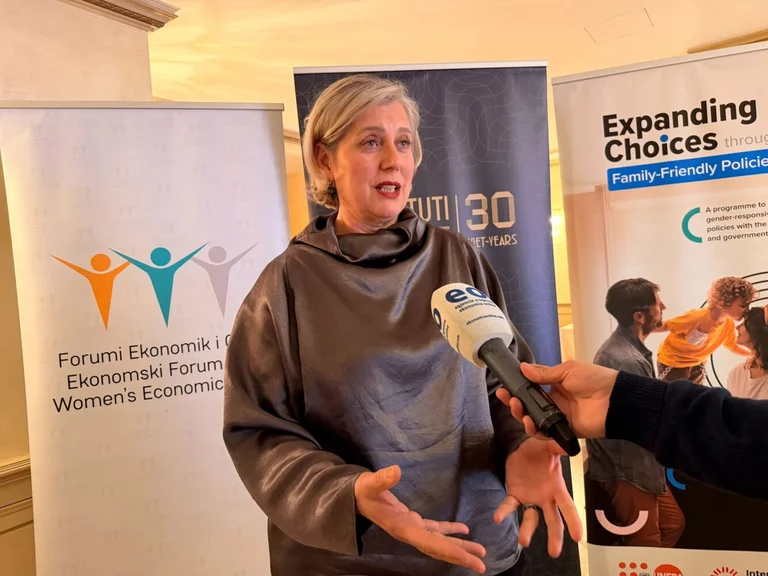
The coordinator of this Forum, Saxhide Mustafa, said in an interview with Ekonomia Online that the current maternity leave payment model places a burden on businesses and may affect women’s employment and career advancement, particularly in the private sector.
She said that women face discrimination from the hiring process onward, including questions about family planning during job interviews, while after returning from maternity leave they are often treated as less committed to their work.
“The Labor Law, in force since 2012, this current Labor Law, has been discriminatory in the employment of women. For this reason, Kosovo is one of the countries with the lowest employment rate in Europe. This fact tells us that, regardless of their education or the policies the government has adopted to educate girls and women, when they enter the labor market in Kosovo, the labor market has had no policies, meaning policies that encouraged them to enter the labor market and keep their jobs,” she said.
Mustafa also mentioned the discriminatory questions that, she said, young women are asked during job interviews about plans to start a family and have children.
“One of the discriminatory practices faced by young women, especially young women and young girls of childbearing age, has been the question in job interviews about how they plan their family? In other words, ‘Are you going to have children, or when are you going to?’ Therefore, for over a decade, this has consistently emerged as one of the most frequently asked questions, and as a discriminatory question. After they had a child, when they returned to work, they were seen as useless in the workplace, because their concentration was not 100% on the job, but on their children. And this has meant they have not advanced to managerial or higher positions, and have mainly been discriminated against in terms of pay. They could do the same work as a man, but were paid less, because they were seen as not being 100% committed to their workplace,” she said.
Regarding the financing of maternity leave, Mustafa said that the Women’s Economic Forum proposes transferring the current payments, which are covered by the private sector, to the Government, arguing that this would create a fairer distribution of the financial burden.
“At the same time, we have also discussed how maternity leave payments have burdened the private sector. We are calling for the private sector to be freed from this burden. The Women’s Economic Forum has proposed a model to transfer to the government the payments currently made by the private sector, and has examined the cost options. Currently, under Measure 3.5, Kosovo pays—and has the highest cost of payments for women who do not work. We are not absolutely opposed to this, since it is a policy to encourage the birth rate, but it is a burden on working taxpayers, and the payments to them are lower. It should be the other way around, because the more women we have in employment, the more the state treasury benefits. We are calling for reform; this law needs to be reformed, and the burden of reforms should not fall on just one institution, nor only on the government, but should be shared by the private sector and employees,” she said.
Mustafa assessed that women’s employment has remained at low levels over the past decade, and called for government measures to promote employment to be evidence-based and analyzed before implementation.
“If we look at the past decade, women’s employment has been in the single digits; we cannot say there has been a great deal of employment. So, naturally, we say that in recent years the government has taken some measures, such as wage subsidies or Superpuna, which has been accompanied by numerous problems; employers or employees have not benefited from Superpuna. In other words, there are problems in that respect too, but I hope the government has analyzed everything and will be more careful with future measures, because our call is always that the policies adopted by the government must be evidence-based. Policies that are not evidence-based are not sustainable. And we, as a society, cannot afford to adopt rushed, unsustainable policies 26 years after the war. We need a stable market in order to keep workers in the country, meaning to prevent workers from leaving,” she said.
She called for wage increases and the creation of policies that would enable a more equal sharing of family responsibilities between women and men, including the advancement of parental leave.
“We need to raise wages and create policies, improved leave; adults today are asking for parental leave, they have a different, more democratic mindset, because they live independently and want family responsibilities between men and women to be more balanced. That is why the model of the Women’s Economic Forum is focused on precisely this tendency, based on the research we have conducted as an organization,” she said.
Related
Economy
Ymeri: Government measures on electricity will not solve the situation
Economy
GAP: 87% of Kosovo’s budget expenditures contributed to the Sustainable Development Goals during 2021–2025
Economy
Government links payroll and human resources systems; €8.9 million from the EU expected to be released
Economy
Government says electricity supply is also at risk due to the failure to complete work on Unit B1 on time; project funded by the EU

Economy
Oil prices fall again on international exchanges; in Kosovo, the decrease is being reflected slowly
Economy
Shahini: Investors are becoming more cautious, while Albania risks postponing new investments
Economy
Hoti: The government has apparently stopped electricity imports from Serbia – can something be stopped that, according to government officials, did not exist?

Economy
Tahiri to the Government: Even after 6 years, do you have a plan to start building a new power plant?
Economy
Hoti: During VV’s government, economic growth was lower and inflation higher
Economy
Kraki slams the Government: So we’ve bought electricity from Serbia and still ended up without power — failure twice over
Economy
Rizvanolli explains reasons for decision to ban energy trading with Serbian companies
Economy
Ramadani: The Government admitted it plundered the budget through electricity trading with Serbia





