
From “Accords of Kosovo” to festivals that today attract tourists and shape the image of cities, a new monograph seeks to give one of Kosovo’s most important cultural phenomena the recognition it deserves. For more than half a century, festivals have been part of Kosovo’s cultural life. Yet, despite their number and influence […]
146 Festivals in One Book: The Half-Century History of a Celebrating Kosovo Is Promoted
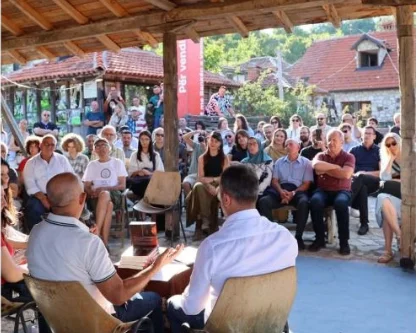
From “Accords of Kosovo” to festivals that today attract tourists and shape the image of cities, a new monograph seeks to give one of Kosovo’s most important cultural phenomena the recognition it deserves.
For more than half a century, festivals have been part of Kosovo’s cultural life. Yet, despite their number and influence, for a long time they remained events to be experienced rather than phenomena to be studied.
The monograph “Festivals of Kosovo – A Half-Century History, A Geographic-Tourism Monographic Study,” by Dr. Fitim Humolli, a professor of geography and tourism at the University of Pristina, addresses this gap.

Professor Humolli has emphasized that among all influential festivals, Sunny Hill Festival holds the leading position.
The journey of this study began in late 2020 and early 2021, first as a master’s thesis and then grew into a multi-year research project. Through interviews, fieldwork, archival sources, statistics, and scientific analyses, the authors documented 146 festivals held in Kosovo up to 2024.
But the book is not simply a list of festivals.
It shows where they take place, how they began and developed, which have survived, and which have managed to influence tourism, culture, the economy, and the lives of local communities.

The story begins much earlier. In 1969, with “Accords of Kosovo,” followed by the “Theatre Festival” in Ferizaj in 1970 and “Kosovarja Këndon” in 1972. Since then, numerous festivals have emerged, disappeared, been revived, and some have become well-known brands beyond Kosovo.
One example of how a festival can change a place’s image is Etno Fest in Kukaj, which transformed a rural area into a well-known cultural and tourist destination.
This is precisely one of the monograph’s main messages: a festival is not just entertainment. It can mean economy, tourism, identity, promotion, and local development.
The book’s reviewer, Prof. Dr. Dhimitër Doka, described the work as an important contribution to the study of tourism geography and cultural heritage, highlighting the multi-year fieldwork and scientific approach to a field that has until now been little explored.
The study, however, does not shy away from criticism either. According to the author, the large number of festivals does not necessarily mean quality. The lack of sustainable funding, organizational weaknesses, and the absence of long-term strategies remain some of the main challenges.
For the author, this book is not the end of the research, but its beginning.
“Our studies of festivals are not part of completing the mosaic, but the beginning of building it,” is one of his messages.
With 146 festivals documented, it seems the material for this history was never lacking. What was missing was someone to gather it into a book.
Related
Arts
José Saramago, the writer who challenged the world with the power of words
Arts
‘Star Wars’ and ‘James Bond’ actress found dead
Arts
The National Theatre of Kosovo’s “Romeo and Juliet” to be presented at the “Moisiu” Albanian Theatre Festival in Skopje
Arts
The film “DUA,” Kosovo’s Oscar submission, presented to the public in New York
Arts
“All About Eve,” the drama that revealed the ambition and rivalry behind the glamour of the stage
Arts
Creative Europe Opens New Calls for Artists and Cultural Professionals

Arts
“Sacrifice” fills theaters at premiere, story of five brothers moves audience to tears

Arts
This Is What the Kosovo Opera and Ballet Theatre Is Expected to Look Like

Arts
Blerta Rugova presents her first book, “RUGOVISM – The quiet revolution that begins within us”

Arts
Johnny Depp turned down the role in “Titanic” because he couldn’t read 15 pages of the script: I struggled
Arts
“Kadare’s Kosovo” exhibition opens on the 90th anniversary of the writer’s birth
Arts
“Kadare’s Kosovo,” an exhibition dedicated to the 90th anniversary of the great writer’s birth





