
“I Give You My Silence”, the final novel by Peruvian Nobel laureate Mario Vargas Llosa, is an unusual work, full of humor, nostalgia and love for the culture of his country. When the book was published in Spanish in 2023, Vargas Llosa had rightly predicted that it would be his last novel. […]
Mario Vargas Llosa’s final novel, a love letter to Peru and its music
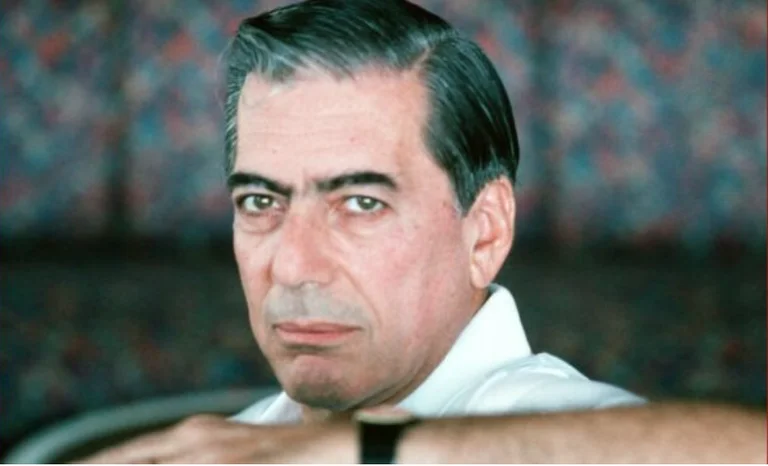
“I Give You My Silence”, the final novel by Peruvian Nobel laureate Mario Vargas Llosa, is an unusual work, full of humor, nostalgia and love for the culture of his country.
When the book was published in Spanish in 2023, Vargas Llosa had rightly predicted that it would be his last novel. The writer died last year at the age of 89.
Although the book may have been written with the awareness that the end of life was approaching, there is almost nothing gloomy or morbid in it.
On the contrary, “I Give You My Silence” is an eccentric love letter to Peru and, in particular, to its music.
A poor journalist obsessed with Peruvian music
The novel’s quixotic hero is Toño Azpilcueta, a music journalist and fanatic of Peruvian culture.
Toño had always dreamed of becoming a professor of Peruvian music, but at the beginning of the novel he barely makes a living teaching at a girls’ school and writing articles for specialist magazines.
Financially, he relies on his patient wife, Matilde.
Toño is an easily recognizable type of character: the poor intellectual, obsessed with a cultural field that most people do not understand.
If he were British, he might be obsessed with free jazz or some forgotten Delta blues musician.
But Toño is Peruvian, and his passion is the “vals”, a Peruvian musical style that combines the European waltz with African and Indigenous Latin American traditions.
The encounter that changes everything
One evening, Toño is invited to hear an unknown guitarist named Lalo Molfino.
The musician’s virtuosity amazes him.
But before he can fully process what he has heard, Toño learns that Molfino has died suddenly.
With the help of a small sum of money given to him by a friend, he decides to write the guitarist’s biography.
The book would be a tribute to Molfino’s talent, but also something far more ambitious.
Toño finally wants to put down on paper the theories he has developed over the years about the Peruvian vals.
The big idea: music will save Peru
Toño has a grand theory.
He believes the vals can save Peru – and perhaps humanity, too.
In his view, the mixed origins of this music offer a way to overcome the traumas that colonialism, racism, dictatorship and terrorism have inflicted on the country.
To write the book, Toño embarks on a quest involving research, interviews and travels along the Pacific coast to Molfino’s birthplace.
But he must also confront his personal demons, including a deep fear of rats.
Two books within a novel
One of the most interesting features of “I Give You My Silence” is its structure.
Essentially, the book contains two works nested inside one another.
The odd-numbered chapters recount in the third person Toño’s efforts to research and write the biography.
Most of the even-numbered chapters, meanwhile, are excerpts from the book Toño is writing, which bears the same title: “I Give You My Silence”.
These passages gradually become a kind of unusual guide to Peruvian music and culture.
They include histories of the vals, biographies of the musicians who created it, reflections on the “cajón” – Peru’s distinctive percussion instrument – as well as discussions of the Spanish language and the country’s cultural identity.
The novel also features Cecilia Barraza, a well-known Peruvian singer in real life.
For a reader unfamiliar with Peru’s musical culture, her appearance might be compared to the sudden appearance of someone like Patti Smith in a novel.
What is “huachafería”?
Another central concept in the book is “huachafería”.
Translator Adrian Nathan West explains in the afterword that dictionaries usually define the term as a kind of pretentiousness or exaggerated taste.
But for Toño, its meaning is much broader.
According to him, “huachafería” can be brilliant, but rarely intelligent; it is intuitive, drawn-out, solemn, melodic, imaginative and, above all, sentimental.
In a way, this is also a perfect description of the book Toño is writing.
He goes so far as to claim that his work will be the beginning of a revolution that will lift Peru out of poverty and sorrow, restore its glory and creativity, and put an end to divisions among the country’s people.
It is an impossible and grandiose claim.
But that is precisely what makes Toño endearing.
A slightly mad idealist
Toño’s mission is clearly absurd.
Nevertheless, he pursues it with such great dedication that the reader gradually begins to root for him.
The novel’s form allows Vargas Llosa to do two things at once.
On the one hand, he gives Toño room to develop his theories down to the finest detail.
On the other, the writer has fun showing just how exaggerated these theories are.
In one chapter, Toño recounts the love story of Toni Lagarde and Lala Solórzano.
He is a white man from a middle-class neighborhood, while she is a poor woman of color from a much rougher area.
They come together through their shared love of music, fall in love and get married.
For Toño, this is proof of the vals’s power to overcome racial and class divisions.
But Toni and Lala are not so eager to become symbols of his theory.
“You’re the only ones who are free. And music opened your eyes,” Toño tells them.
“You have a theory there, but there are lots of theories,” Toni replies diplomatically.
Not everyone takes the book seriously
In another episode, a psychiatrist helping Toño with his fear of rats is much more brutal.
He describes the book as “a meaningless and incoherent mass of undeveloped ideas”.
But Vargas Llosa himself takes a much gentler view of the protagonist.
He regards Toño with irony, but also with affection.
Because, in a way, the author shares his character’s idealism.
Vargas Llosa and the dream of changing Peru
The novel is set in the early 1990s.
During that same period, Vargas Llosa himself had undertaken a grand and unsuccessful mission to change his country: he ran for president of Peru.
In this sense, Toño is not entirely unlike his author.
One believes that music can save Peru.
The other had believed that politics could do so.
Vargas Llosa seems to see something heroic in impractical dreamers like Toño.
They may not manage to change the world in the grand way they imagine, but that does not mean they have no impact on it at all.
A book that makes you look for Peru on the map
And perhaps this is where the novel’s success lies.
By the end of the book, its reviewer admits to having followed Toño’s journey along the Pacific coast on Google Maps.
They had searched for the small settlement of Puerto Etén.
They had looked up Lala’s quince marmalade recipe online.
They had created a playlist of Peruvian valses on Spotify.
They had even checked the prices of plane tickets to Lima.
Few books make a reader want not only to understand a country, but also to visit it.
“I Give You My Silence” does exactly that.
Mario Vargas Llosa’s final novel may be eccentric, often comic and deliberately over-the-top, but in the end it is a warm tribute to Peru, its music, culture and people who continue to believe that art can change the world./GazetaExpress/
Related
Arts
José Saramago, the writer who challenged the world with the power of words
Arts
‘Star Wars’ and ‘James Bond’ actress found dead
Arts
The National Theatre of Kosovo’s “Romeo and Juliet” to be presented at the “Moisiu” Albanian Theatre Festival in Skopje
Arts
The film “DUA,” Kosovo’s Oscar submission, presented to the public in New York
Arts
“All About Eve,” the drama that revealed the ambition and rivalry behind the glamour of the stage
Arts
Creative Europe Opens New Calls for Artists and Cultural Professionals

Arts
“Sacrifice” fills theaters at premiere, story of five brothers moves audience to tears

Arts
This Is What the Kosovo Opera and Ballet Theatre Is Expected to Look Like

Arts
Blerta Rugova presents her first book, “RUGOVISM – The quiet revolution that begins within us”
Arts
Johnny Depp turned down the role in “Titanic” because he couldn’t read 15 pages of the script: I struggled
Arts
“Kadare’s Kosovo” exhibition opens on the 90th anniversary of the writer’s birth
Arts
“Kadare’s Kosovo,” an exhibition dedicated to the 90th anniversary of the great writer’s birth





