
At 101, Ce Roser continues to paint, remember and tell the story of a generation of women who challenged the American art system when gallery and museum doors remained closed to them. The American artist was one of the co-founders of the “Women in the Arts Foundation,” an organization that in the early 1970s […]
Ce Roser, the 101-year-old who challenged the art world: “We made a noise, we shut down the streets”
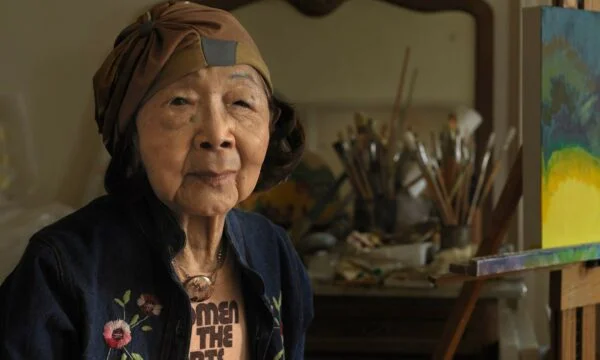
At 101, Ce Roser continues to paint, remember and tell the story of a generation of women who challenged the American art system when gallery and museum doors remained closed to them.
The American artist was one of the co-founders of the “Women in the Arts Foundation,” an organization that in the early 1970s began direct-action protests in New York to demand more space, exhibitions and recognition for women artists.
Today, more than half a century later, Roser is writing another remarkable chapter in her career, making her European debut at the age of 101, with an exhibition at the VeneKlasen gallery in London.
“No one could build a career”
In the early 1970s, the issue of women’s exclusion from the art world was becoming increasingly visible.
During the same period, the famous essay “Why Have There Been No Great Women Artists?” raised a question that shook the art establishment.

For Roser, however, the problem was not theoretical.
“My older friends couldn’t get exhibitions, even though they had had brilliant careers before,” she recalls.
“The same thing was happening to my poet and writer friends. No one seemed able to establish themselves as a professional artist. So we got together, complained, and I decided we needed to hold a serious meeting.”
The first meeting was held at her home in New York, and that is where the “Women in the Arts Foundation” was born.
Protest outside MoMA
At first, the group was small.
But at the third meeting, artist Elaine de Kooning offered her studio as a meeting place.
And word spread quickly.
“A lot of people came because they wanted to see Elaine’s studio,” Roser recalls. “And there we decided that we would protest.”
The father of one of the artists was a policeman, and he told them he could help the group shut down 53rd Street, in front of the Museum of Modern Art, MoMA.
“We seized the opportunity. We decided to hold a joyful protest. We didn’t want to act like men, to be harsh and aggressive. Of course we were aggressive, but not ferocious.”
Artists who are now considered part of art history took part in the protest.
Joan Mitchell arrived from France.
Louise Bourgeois stood in front of MoMA holding a large sign bearing the word “NO”.
Pat Passlof held a sign that read: “MoMA loves Papa”.
“We made a lot of noise. We danced in the street. We shut down the whole street,” Roser recalls.
The victory of 1973
Two years later, the protest began to yield results.
In 1973, the New York Cultural Center offered space for an exhibition curated by women and featuring only women artists.
Roser was one of the seven selectors.

Instead of the traditional curatorial system, they created a more democratic model in which the artists nominated one another.
The exhibition “Women Choose Women” included 111 artists and was considered a great success.
It not only gave women more space, but also showed that more democratic forms of curating could work effectively.
From wartime Shanghai to postwar Berlin
When the protests began, Roser was in her 40s and had lived an unusual life.
She was the wife of an American diplomat and had lived in different parts of the world.
The family returned to the United States when her son was due to start school.
“He spoke Urdu, Tagalog and German, but not enough English to become an American,” she says with a laugh.
Roser herself was a third-generation American, with parents of Chinese descent.
Her grandparents had immigrated from China to California, and one of them had a farm.
Her parents had met at university. Her father studied law, while her mother studied mathematics and history.
Roser was the second of six children.
“I didn’t feel Chinese, because I grew up in a culture where there were very few Chinese people,” she says.
“My parents ate American food for breakfast, and you can learn a lot about people from what they eat for breakfast.”
A childhood of poetry and paint
Her mother introduced her to art at an early age.
She gave the children five cents for every poem they memorized and, to keep them occupied, sat them at a table with crayons, watercolors and paper.
Still, Roser did not think that art would become her profession.
At 19, she worked in the information department at the American embassy, where she also met her future husband.
At 21, she married and began her life abroad as a diplomat’s wife.
As a diplomat’s wife, she faced many restrictions on what she was allowed to do professionally.
But during a stay in Manila, a friend gave her a painting set.
“I painted something from a photograph, and when my husband went to have it framed, someone wanted to buy it. That’s when I thought it might be good,” she recalls.
Art school in Berlin
In the late 1940s, the couple was sent to Berlin.
Roser enrolled at the Berlin Academy of Art and studied with the German sculptor and Holocaust survivor Hans Uhlmann.
When asked whether postwar Germany was shocking, she replies that she had seen worse things.
As a teenager, during a visit to her uncle in wartime China, her family became stranded in Shanghai.
“We traveled for 40 days in a freight car. It was my mother, my grandmother, my brothers and sisters, and four cousins. No men.”

“So I was accustomed to places devastated by war and bombing.”
Uhlmann taught her a new way of thinking about art.
“He would ask us to draw something from reality and then turn it into abstraction, or take an abstraction and turn it into reality on paper.”
One of his pieces of advice has stayed with Roser throughout her life:
“When you paint, be very decisive. Don’t hesitate. Just do it.”
The studio that became her artistic home
After returning to New York, Roser found a studio overlooking the Hudson River.
She has worked there for more than 70 years.
“When I first walked into the studio, I felt like a hand slipping into a glove,” she recalls.
“Everything domestic disappeared. I didn’t cook, I didn’t clean. I was there only to paint.”
She also limited her reading to topics related to creativity.
“I read only art criticism, art history or poetry. Nothing else.”
Poetry and calligraphy in her paintings
Roser’s abstract paintings are characterized by bright colors, rhythm and a kind of calligraphic energy.
She studied calligraphy with the Japanese master Nankoku Hidai.
He taught her to use broad strokes and “the arms, not just the wrists.”
Poetry remains another important source of inspiration.
“Give me a line and I see a painting,” she says.
At 101, she still paints every day
Although her name is not as well known today as it once was, Ce Roser continues to work in her studio on the Hudson River.
On good days, she can produce two or even three paintings.
And there is a lovely irony in her whole story.
Roser’s works are now held precisely by the New York institutions she once protested against.
After more than a century of life and over seven decades of creativity, she continues to paint with the same determination she learned in Berlin:
Without hesitation.
Just do it. /GazetaExpress/
Related
Arts
José Saramago, the writer who challenged the world with the power of words
Arts
‘Star Wars’ and ‘James Bond’ actress found dead
Arts
The National Theatre of Kosovo’s “Romeo and Juliet” to be presented at the “Moisiu” Albanian Theatre Festival in Skopje
Arts
The film “DUA,” Kosovo’s Oscar submission, presented to the public in New York
Arts
“All About Eve,” the drama that revealed the ambition and rivalry behind the glamour of the stage

Arts
Creative Europe Opens New Calls for Artists and Cultural Professionals

Arts
“Sacrifice” fills theaters at premiere, story of five brothers moves audience to tears

Arts
This Is What the Kosovo Opera and Ballet Theatre Is Expected to Look Like

Arts
Blerta Rugova presents her first book, “RUGOVISM – The quiet revolution that begins within us”

Arts
Johnny Depp turned down the role in “Titanic” because he couldn’t read 15 pages of the script: I struggled
Arts
“Kadare’s Kosovo” exhibition opens on the 90th anniversary of the writer’s birth
Arts
“Kadare’s Kosovo,” an exhibition dedicated to the 90th anniversary of the great writer’s birth





