
Maggie Gyllenhaal has said that the film industry faces a “systemic problem”, speaking about the fact that only two films made by women directors are competing for the top prize at the Venice Film Festival this year. The actress and director, who heads the jury of the festival’s 83rd edition, the oldest film festival in the world […]
Maggie Gyllenhaal: The film industry has a systemic problem with discrimination against women
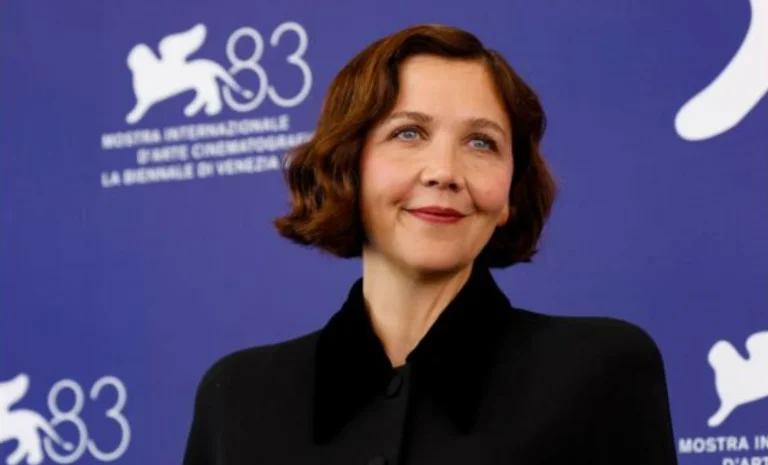
Maggie Gyllenhaal has said that the film industry faces a “systemic problem”, speaking about the fact that only two films made by women directors are competing for the top prize at the Venice Film Festival this year.
The actress and director, who heads the jury of the 83rd edition of the world’s oldest film festival, said that women continue to face greater difficulties when seeking funding for their projects.
“It is harder for women to secure funding for films,” Gyllenhaal said.
She also raised the question of whether the subjects women choose to explore in cinema are valued in the same way by the industry.
“Is it possible that the things women want to make films about, drawing on a different experience of life in this world, are not always considered high art?” she asked.
“Who decides what is good? Who decides what has value?”
Only two women directors in the main competition
The artistic directors of the Venice Film Festival have faced criticism since the initial programme was announced.
In the first lineup, only one of the 20 films competing for the Golden Lion was made by a woman: “Woman Unknown” by Danish-Egyptian director May el-Toukhy.
The new documentary “NAZA”, directed by Yuval Abraham and Rachel Szor, was subsequently added to the main competition.
They are part of the creative team behind the Oscar-winning film “No Other Land”.
Gyllenhaal heads the Venice jury
Gyllenhaal heads a seven-member jury.
Its members also include Tunisian director Kaouther Ben Hania, the creator of “The Voice of Hind Rajab”; Hong Kong director Johnnie To; Afghan director Shahrbanoo Sadat; French filmmaker Xavier Giannoli; British composer Daniel Blumberg; and Italian film scholar Francesco Casetti.
Before the festival began, there had been uncertainty about whether the jury would appear before the media at all on opening day, officially because of a “scheduling conflict”.
But this year’s programme features an unusual number of films that touch on highly sensitive political and social issues.
They include films addressing the Israel-Palestine conflict, the Russia-Ukraine war, a feature film about Rupert Murdoch, and a documentary about Elon Musk.
This had also increased interest in the views that jury members might express publicly.
Should cinema be political?
The debate over the relationship between film and politics has become increasingly prominent at international festivals.
At the Berlin Film Festival, jury president Wim Wenders faced criticism after saying that filmmakers should “stay out of politics” while answering questions about Israel and Palestine.
When Gyllenhaal was asked in Venice whether directors should take part in political debates, she offered a different perspective.
In her view, cinema’s very ability to create empathy makes it inevitably political.
Indeed, this empathy can extend even to the most corrupt or morally dark characters.
“I think that if films are truly an honest look at other people’s experiences, then they are inherently and inevitably political, among many other things they can be,” Gyllenhaal said.
From Venice winner to jury president
Gyllenhaal has a significant history with the Venice Film Festival.
Her directorial debut, “The Lost Daughter”, won the award for best screenplay at the festival in 2021.
This time she returns not only as jury president, but also with the Marilyn Monroe-inspired short film “Flesh Impact”, which will screen out of competition.
Amid debate over women’s representation and films addressing some of the most sensitive political issues of the moment, Gyllenhaal made clear at the festival’s opening that, in her view, the industry’s problems cannot be explained solely by a lack of individual talent.
For her, inequality in funding opportunities and in how women’s stories are valued is a much deeper and more systemic issue. /GazetaExpress/
Related
Arts
José Saramago, the writer who challenged the world with the power of words
Arts
‘Star Wars’ and ‘James Bond’ actress found dead
Arts
The National Theatre of Kosovo’s “Romeo and Juliet” to be presented at the “Moisiu” Albanian Theatre Festival in Skopje
Arts
The film “DUA,” Kosovo’s Oscar submission, presented to the public in New York
Arts
“All About Eve,” the drama that revealed the ambition and rivalry behind the glamour of the stage
Arts
Creative Europe Opens New Calls for Artists and Cultural Professionals
Arts
“Sacrifice” fills theaters at premiere, story of five brothers moves audience to tears

Arts
This Is What the Kosovo Opera and Ballet Theatre Is Expected to Look Like

Arts
Blerta Rugova presents her first book, “RUGOVISM – The quiet revolution that begins within us”
Arts
Johnny Depp turned down the role in “Titanic” because he couldn’t read 15 pages of the script: I struggled
Arts
“Kadare’s Kosovo” exhibition opens on the 90th anniversary of the writer’s birth
Arts
“Kadare’s Kosovo,” an exhibition dedicated to the 90th anniversary of the great writer’s birth





