
American artist Peter Max, known for his colorful works and psychedelic style that became a symbol of the 1960s “flower power” movement, has died at the age of 88. Max died on Monday, and the news was confirmed by his son, Adam Max, in a statement released on Wednesday. The cause of death was not […]
Peter Max, Icon of American Psychedelic Art, Dies
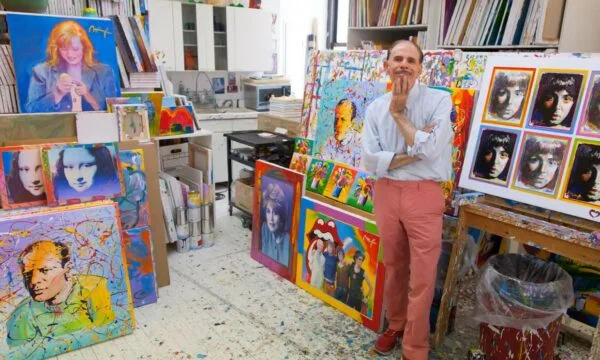
American artist Peter Max, known for his colorful works and psychedelic style that became a symbol of the 1960s “flower power” movement, has died at the age of 88.
Max died on Monday, and the news was confirmed by his son, Adam Max, in a statement released on Wednesday. The cause of death was not disclosed.
“We will remember him for his extraordinary creativity, warmth, curiosity, and the way he saw beauty and possibility everywhere,” Adam Max wrote.
“His art became part of American culture, but the man behind that art—the father we knew and loved—is the one we will miss most.”
A style that defined an era
Peter Max began his career in graphic design in the 1960s and soon became known for his distinctive figures, bold colors, and undulating forms that embodied the optimism and spirit of “flower power.”

Thanks to his direct and accessible style, Max’s works remained popular and in demand many decades later.
He himself described his art as always oriented toward peace.
“I don’t deal with negative things in my paintings. I don’t dwell on them, either in my mind or on canvas,” Max had said.
From the Olympics to the Super Bowl and World Cup
During his career, Max served as the official artist for several of the world’s biggest sporting events, including the Olympic Games, the Super Bowl, the Indianapolis 500, the World Cup, and the World Series.
His art was also used on a Boeing 777 aircraft and on a Norwegian Cruise Line ship.
He created portraits of many public figures, from American presidents to Taylor Swift.
At the height of his fame, in the late 1960s and early 1970s, his works featuring flowers, cosmic motifs, and stylized figures, rendered in bold colors such as turquoise, orange, and neon green, could be found almost everywhere.
His posters covered the walls of students’ rooms, while his designs appeared on clocks, bedspreads, clothing, and various household items.
He even created covers for the “Manhattan Yellow Pages,” and in 1969 appeared on the cover of “Life” magazine.
From Berlin to New York
Peter Max was born Peter Max Finkelstein in 1937 in Berlin, to a Jewish family.
When he was still an infant, his family fled Nazi Germany and settled in Shanghai. They later lived in Tibet, Israel, and Paris before eventually moving to New York when Max was 16.
By then, he was already passionate about American culture—comics, films, and jazz music.
In the 1960s, his unique style caught the attention of advertising agencies, magazines, corporations, and the pop culture industry, turning his art into a major commercial success as well.
“My work, I can say, was almost exploited,” he had said. “It was on cups, sheets, dresses, silk, scarves, and ties—in around 70 product lines.”
In the early 1970s, Max temporarily closed his business to return to artistic creativity.
Portraits of the Statue of Liberty
One of the best-known projects after his return to public life was his series of portraits of the Statue of Liberty.
In 1981, at the invitation of First Lady Nancy Reagan, he worked on the project at the White House as well.
Legal and family troubles
Max’s long career was not without controversy.
In 1997, he pleaded guilty to tax fraud after U.S. authorities alleged that he had concealed more than one million dollars in income from his art.
He was initially sentenced to two months in prison, but was later allowed to serve his sentence through a work program. He also paid back taxes and a $30,000 fine, and completed 800 hours of community service teaching art in Harlem schools.
In 2015, the artist’s family life became part of the tabloid media because of a conflict between his second wife, Mary, and his son, Adam.
The parties accused one another of financial mismanagement, isolation, and ownership of the artworks. Mary Max died in 2019.

Ties to the Beatles and Eastern spirituality
The art for the Beatles’ film and album “Yellow Submarine” has often been wrongly attributed to Peter Max.
In fact, the official design of the work belongs to artist Heinz Edelmann.
Nevertheless, Max was friends with the Beatles and many other well-known figures in pop culture.
He also had a deep interest in Eastern spirituality and played a role in bringing “Swami” Satchidananda Saraswati to the U.S., helping popularize yoga in the country.
Max’s first marriage, to Elizabeth Nance, ended in divorce.
He is survived by his son Adam and daughter Libra. /GazetaExpress/
Related
Arts
José Saramago, the writer who challenged the world with the power of words
Arts
‘Star Wars’ and ‘James Bond’ actress found dead
Arts
The National Theatre of Kosovo’s “Romeo and Juliet” to be presented at the “Moisiu” Albanian Theatre Festival in Skopje
Arts
The film “DUA,” Kosovo’s Oscar submission, presented to the public in New York
Arts
“All About Eve,” the drama that revealed the ambition and rivalry behind the glamour of the stage
Arts
Creative Europe Opens New Calls for Artists and Cultural Professionals

Arts
“Sacrifice” fills theaters at premiere, story of five brothers moves audience to tears

Arts
This Is What the Kosovo Opera and Ballet Theatre Is Expected to Look Like

Arts
Blerta Rugova presents her first book, “RUGOVISM – The quiet revolution that begins within us”
Arts
Johnny Depp turned down the role in “Titanic” because he couldn’t read 15 pages of the script: I struggled
Arts
“Kadare’s Kosovo” exhibition opens on the 90th anniversary of the writer’s birth
Arts
“Kadare’s Kosovo,” an exhibition dedicated to the 90th anniversary of the great writer’s birth





