
“Prima Facie”, Suzie Miller’s award-winning work, arrives on the big screen with Cynthia Erivo in the role Jodie Comer made famous on stage. But what worked powerfully as a one-woman show loses much of its intensity in the film version. The 2019 drama […]
“Prima Facie” – a powerful stage drama that loses its force on the big screen
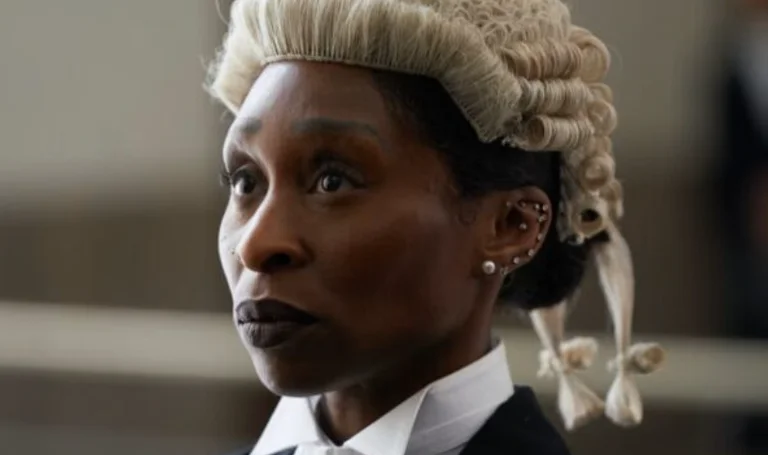
“Prima Facie”, Suzie Miller’s award-winning work, arrives on the big screen with Cynthia Erivo in the role Jodie Comer made famous on stage. But what worked powerfully as a one-woman show loses much of its intensity in the film version.
The 2019 drama uses a familiar premise: a successful London lawyer, accustomed to winning difficult criminal cases, suddenly finds herself on the other side of the legal system.
Not as the accused, but as the complainant in a rape case.
The idea of a powerful figure confronting the mechanisms of the same system she once used herself is not new, but “Prima Facie” stood out in the theater because the entire burden of the story fell on a single actress.
And that was precisely where its magic lay.
From the power of the monologue to a more conventional film
On stage, Jodie Comer delivered an extraordinary and exhausting performance, in London as well as in New York.
The strength of “Prima Facie” lay not only in its story or message, but in the physical and emotional effort of the actress, who alone carried almost the entire weight of the show.
But how can a traditional film work for nearly two hours with only one person speaking?
Director Susanna White and Miller herself have chosen to expand the world of the story, giving Cynthia Erivo other characters around her and turning into real scenes events that were only recounted in the theater.
The problem is that this very expansion strips the film of much of its power.
What remains is a much more conventional drama about a serious and widespread social problem.
Cynthia Erivo as Tessa
Erivo plays Tessa, a criminal lawyer who is quickly building a strong reputation around the Old Bailey thanks to her intelligence and ability to defend her clients.
She often takes on sexual assault cases, partly because, as one colleague cynically explains, it looks better for an accused rapist to be defended by a female lawyer.
Tessa does not seem to see this as a problem.
To her, everyone has the right to a defense, and morality should not enter the equation.
She is ambitious and determined also because she comes from a modest family.
Her mother, June, played by Noma Dumezweni, works as a cleaner, while her younger brother Johnny, played by Toheeb Jimoh, works in construction.
Tessa won a scholarship to study at Cambridge and now lives a successful life in London.
But everything falls apart when she is raped by her colleague and partner, Julian, played by Daniel Ings.
The incident takes place after what had until then been a romantic evening and a discussion about the possibility of their relationship becoming more serious.
From lawyer to victim within the same system
Tessa reports the case to the police, beginning a journey toward a trial in which she is now the one who must face questions, doubts and attacks on her character.
She knows better than most how the system works.
She knows her motives will be analyzed, her behavior will be questioned, and that the accused could realistically be found not guilty.
Nevertheless, she decides to continue, seeking a form of justice after what happened to her.
In the theatrical version, Tessa had plenty of time to explain her love of the law, her strategies for cross-examining witnesses and the intellectual satisfaction she found in courtroom confrontations.
At the same time, the audience entered deep into her mind: into the doubt, anger, fear and confusion she experiences when she realizes that she has now become precisely the kind of person she once mercilessly tore apart in court.
The film tries to preserve some of this inner monologue, but only sporadically.
As a result, Tessa is not explored as deeply as she is on stage, and her story becomes more generic.
An overly cold film style
The way the film is shot does not help it much either.
Susanna White handles the material in a fairly visually flat way, with only a few sporadic attempts to give it more texture.
Erivo plays the role with discipline and intensity, but the script does not always give her enough material to develop the character’s transformation.
One of the biggest problems is that the film makes a three-year leap from the report to the police to the trial.
This means the audience does not spend time with the long-term effects of the trauma and does not see how Tessa gradually changes as she processes what she has experienced.
Instead, the film becomes increasingly procedural and even stops to recount events we have already seen.
A drama that won major awards in the theater ends up, at times, resembling a very ordinary episode of “Law & Order”.
The message remains important, but the approach loses its force
Of course, the film’s themes are extremely important.
“Prima Facie” addresses the shocking prevalence of sexual violence and the major difficulties victims face when trying to obtain justice.
But the film presents these themes in an overly direct way.
It lacks the dark and compelling journey the stage production offered, its emotional peaks, devastating moments and sharp humor that brought the material to life.
In trying to expand the story beyond one woman and her personal testimony, the film paradoxically becomes less universal.
“Prima Facie” remains an important story, with a strong protagonist and a subject that deserves attention, but the film version fails to preserve the fire and power that made the original work so special on stage. /GazetaExpress/
Related
Arts
José Saramago, the writer who challenged the world with the power of words

Arts
‘Star Wars’ and ‘James Bond’ actress found dead
Arts
The National Theatre of Kosovo’s “Romeo and Juliet” to be presented at the “Moisiu” Albanian Theatre Festival in Skopje
Arts
The film “DUA,” Kosovo’s Oscar submission, presented to the public in New York
Arts
“All About Eve,” the drama that revealed the ambition and rivalry behind the glamour of the stage
Arts
Creative Europe Opens New Calls for Artists and Cultural Professionals
Arts
“Sacrifice” fills theaters at premiere, story of five brothers moves audience to tears

Arts
This Is What the Kosovo Opera and Ballet Theatre Is Expected to Look Like

Arts
Blerta Rugova presents her first book, “RUGOVISM – The quiet revolution that begins within us”

Arts
Johnny Depp turned down the role in “Titanic” because he couldn’t read 15 pages of the script: I struggled
Arts
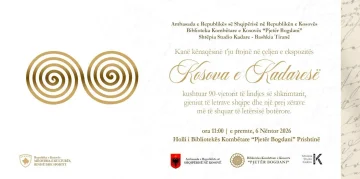
“Kadare’s Kosovo” exhibition opens on the 90th anniversary of the writer’s birth
Arts
“Kadare’s Kosovo,” an exhibition dedicated to the 90th anniversary of the great writer’s birth





