
For centuries, music scholars have tried to answer a difficult question: what makes one composer’s music more distinctive than another’s? The entire history of music analysis and musicology has grappled with such a dilemma: can it be demonstrably proven that Mozart, […]
The secret to Mozart’s genius? An 18-year-old discovers why his music always sounds unpredictable
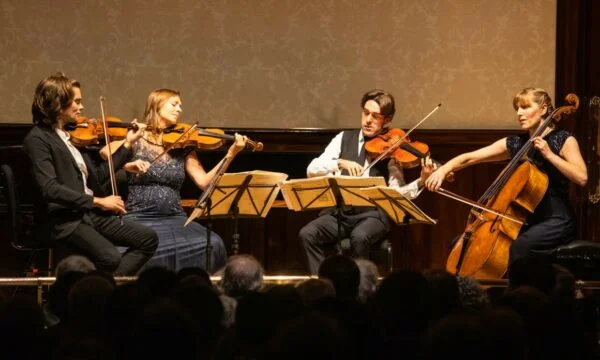
For centuries, music scholars have tried to answer a difficult question: what makes one composer’s music more distinctive than another’s?
The entire history of music analysis and musicology has grappled with such a dilemma: can it be demonstrably proven that Mozart, for example, was “better” or more original than other composers?
The magic of his music is instinctively felt. But explaining why Mozart’s works remain fresh even after countless listens, and why they continue to surprise us even when we know them in detail, is one of musicology’s greatest questions.
Now, an American student just 18 years old claims to have found a new way to measure this.
An analysis of 600 musical movements
Linus Chen-Plotkin, a student from Philadelphia, analyzed the music of four great composers: Mozart, Haydn, Beethoven and Schubert.
In his study, he included 600 movements from these composers’ piano sonatas and string quartets.

Using a program he developed, based on Markov chains and other statistical and mathematical methods, Chen-Plotkin analyzed how melodies develop from one note to the next.
The result was interesting: Mozart’s melodies turned out to have a shorter “memory” than those of the other composers.
In practice, this means that his music is less predictable.
Mozart creates patterns that lead the listener to expect a certain development, but then often breaks those expectations and takes the melody in a different direction.
Musical surprise heard from the very first notes
This feature can be heard in many of Mozart’s string quartets.
In the opening of the Quartet in E-flat major, K428, the music begins to move away from what the listener might expect from as early as the third note.
Even more famous is the “Dissonance” Quartet, K465, whose introduction is built as a series of melodic and harmonic surprises that continually challenge expectations.
According to Chen-Plotkin’s analysis, this very element of immediate unpredictability may be one of the reasons Mozart’s music remains so lively and intriguing even after more than two centuries.
But the study does not say that mathematics “proves” Mozart is the best
Chen-Plotkin himself is cautious about drawing conclusions.
He acknowledges that statistical analysis has limitations and cannot simply be used to declare one composer “better” than another.
In fact, his findings reinforce something musicologists have long said: Mozart’s music is extraordinarily rich in the way it moves from note to note and from phrase to phrase.
But that does not mean he was always more unpredictable in the large-scale structures of his works.
If the analysis focused on the architecture of an entire piece rather than just individual melodies, the results could be quite different. In such a comparison, Haydn or Beethoven might prove more radical in the way they constructed large musical forms.
Statistics as a tool for understanding creativity
Chen-Plotkin does not argue that mathematics should replace musicology.
Rather, his aim is to show that statistical analysis can help uncover the patterns hidden behind human creativity.
He is also opposed to using generative artificial intelligence to create art, seeing technology more as a tool for analysis than as a replacement for human creativity.
And his work has only just begun.
Chen-Plotkin starts university this fall and has already begun another project, this time computationally analyzing the work and language of Geoffrey Chaucer.
Royal Philharmonic Orchestra turns 80
Meanwhile, the Royal Philharmonic Orchestra celebrates its 80th anniversary this week, a milestone that brings renewed attention to the orchestra’s remarkable and often contradictory history.
Its legacy includes some of the most important recordings of Sibelius’s music, made during the 1950s and ’60s.

Under the direction of its founder, Thomas Beecham, the orchestra gave performances that pushed the boundaries of orchestral sound, while in the 1960s and early 1970s, under Rudolf Kempe, it had a powerful influence on London’s musical life.
Important recordings were also made during this period, including Janáček’s “Glagolitic Mass.”
A history of contradictions
Nevertheless, the orchestra’s history also has its problematic aspects.
Beecham insisted that the orchestra be all-male throughout his tenure, until his death in 1961.
The Royal Philharmonic Orchestra welcomed its first female musician only more than a decade later: clarinettist Prudence Whittaker.
Over the years, the orchestra has also moved from its highest artistic achievements to far more commercial projects.
In the 1980s it became part of the “Hooked on Classics” phenomenon, in the 1990s it recorded the Champions League theme, and in the 2020s it also performed at the coronation of King Charles.
This summer, the orchestra also performed with Mandle Cheung, who paid an undisclosed sum for the opportunity to conduct Mahler’s Symphony No. 2, “Resurrection.”
Over the decades, the Royal Philharmonic Orchestra has ranged from the most sublime art to the most unusual projects and has survived many financial crises.
Under the musical direction of Vasily Petrenko, in place since 2021, the hope is that the next chapter in its history will remain focused on the finest side of this legacy. /GazetaExpress/
Related
Arts
José Saramago, the writer who challenged the world with the power of words
Arts
‘Star Wars’ and ‘James Bond’ actress found dead

Arts
The National Theatre of Kosovo’s “Romeo and Juliet” to be presented at the “Moisiu” Albanian Theatre Festival in Skopje
Arts
The film “DUA,” Kosovo’s Oscar submission, presented to the public in New York
Arts
“All About Eve,” the drama that revealed the ambition and rivalry behind the glamour of the stage

Arts
Creative Europe Opens New Calls for Artists and Cultural Professionals

Arts
“Sacrifice” fills theaters at premiere, story of five brothers moves audience to tears

Arts
This Is What the Kosovo Opera and Ballet Theatre Is Expected to Look Like

Arts
Blerta Rugova presents her first book, “RUGOVISM – The quiet revolution that begins within us”

Arts
Johnny Depp turned down the role in “Titanic” because he couldn’t read 15 pages of the script: I struggled
Arts
“Kadare’s Kosovo” exhibition opens on the 90th anniversary of the writer’s birth
Arts
“Kadare’s Kosovo,” an exhibition dedicated to the 90th anniversary of the great writer’s birth





