
ITV’s landmark documentary series, “7 Up”, has entered its final chapter after a full 63 years. The project began in 1964, when cameras started following the lives of 10 boys and four girls in England, all just seven years old. Since then, the documentary has returned every seven years to see how their lives, dreams, relationships and challenges have changed […]
“I find myself in tears after almost every scene”: How the legendary series “7 Up” changed viewers’ lives
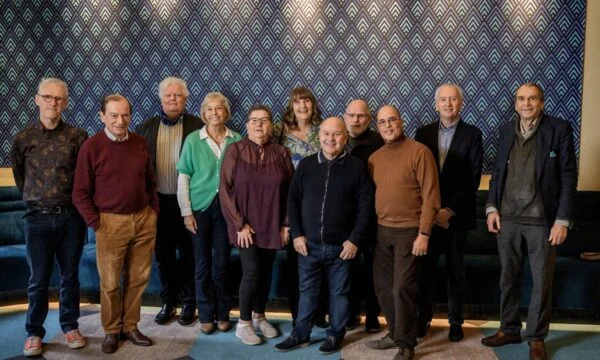
ITV’s landmark documentary series, “7 Up”, has entered its final chapter after a full 63 years.
The project began in 1964, when cameras started following the lives of 10 boys and four girls in England, all just seven years old. Since then, the documentary has returned every seven years to see how their lives, dreams, relationships and challenges have changed.
As “70 Up” comes to an end, seven viewers have told “The Guardian” what the series has meant to them and how it has helped them reflect on their own lives.
“Life is the sum of experiences”


Judith Barton, 69, from Surrey, says one of the most memorable moments for her was seeing a sad Suzy as a teenager and then watching her become calmer and more self-confident.
Bruce was equally impressive, finding meaning through teaching, as was Neil, whose life was marked by many hardships.
“It has been a privilege to compare myself with the participants and see my own journey. The series made me understand that life, whether you are rich or poor, is a sum of experiences, even when they seem completely ordinary,” she says.
According to Barton, it is not necessarily education or privilege that makes life interesting, but how a person uses the opportunities that come their way.
“Deeply moving”


Sheila Lambe, 63, from Scotland, particularly remembers Neil, whom she describes as a sweet, imaginative seven-year-old.
The fact that he later experienced mental health crises affected her deeply.
“His difficulties could have happened to anyone, regardless of social class or background,” she says.
Lambe also mentions Nick, who achieved a great deal in life despite his humble beginnings, but said that the most important moment of his life was the birth of his son.
“Over the years, it seemed that the true measure of success was not academic or material achievements, but family love and finding peace with yourself.”
“The series changed my life”


Martin Forsey, 65, from Fremantle, Australia, says he identified most with Bruce.
“His character and his search for meaning really resonated with me,” he recalls.
Forsey discovered “7 Up” during a sociology of education course while working as a science teacher.
“I came from a working-class family, and when I left school I didn’t even know what sociology was. ‘Up’ sparked my sociological imagination,” he says.
He later retrained and became a sociologist and anthropologist.
“The series helped me understand myself, but also the wider world I lived in.”
“The greatest television series of all time”


Shirley, 68, from London, has watched the entire series and says she felt very close to it, since she is roughly the same age as the participants.
She notes that in the early episodes, women were often portrayed more in the roles of wives and mothers than in their careers.
“I experienced something similar myself,” she says.
In her view, the teenage years particularly reveal a great deal of insecurity among girls who were trying to seem more grown-up.
“I believe it is the greatest television series of all time. It shows how society has changed from the ’60s to today and, at the same time, how a person evolves throughout their life.”
“70 Up shook me emotionally”


Lyle Jackson, 72, from Nashville, says “70 Up” affected him more than he had expected.
“I find myself crying after almost every scene,” he says.
Over the past three years, Jackson has lost several close friends and family members, so the theme of loss has become very personal to him.
“The series doesn’t just remind you of the years that have passed, but also of what you have lost, what remains and what you have learned along the way.”
He began watching the series in 1975, at a time when documentaries were almost entirely absent from American commercial television.
“This series was intimate, patient and honest about ordinary lives. It showed that a person’s story can unfold slowly, with disappointments, contradictions, resilience and surprises.”
This experience directly influenced his career.
Jackson became a documentary photographer and producer and won 18 regional Emmy awards.
“I will always be grateful to ‘7 Up’ because it taught me that ordinary lives are never truly ordinary if someone has the patience and compassion to observe them.”
“The older I get, the more I find myself in the characters”


Khalid Dajani, 54, from Dubai, says he identifies most with Paul, who is first seen in a children’s home and later starts a family of his own in Australia.
“He remained sensitive, gentle and intelligent, just as he was when we first saw him in 1964,” says Dajani.
He discovered the series about eight years ago through a book by critic Roger Ebert, who had called it the best documentary he had ever seen.
He then watched all the episodes in two weeks.
“It was extraordinary to see the children grow into middle-aged people.”
Dajani says that over the years he has felt increasingly close to the participants.
“Our lives are very different, but fundamentally we have the same desire: to make the best possible use of the limited time we have.”
“7 Up set the gold standard for documentary filmmaking”


Alan Reich, 63, from London, saw the first film when he was just seven years old.
At the time, he was at a Jewish summer camp with his brother and remembers crying during the first nights because he missed home.
“The film was shown on a noisy projector, and I was captivated by these seven-year-olds who came from a world completely different from my sheltered religious bubble.”
He continued to seek out every subsequent film, wherever he lived.
“The participants became like friends who were always seven years ahead of me on my life’s journey.”
Reich became a documentary filmmaker in his 20s and says “7 Up” set a gold standard for him.
“The series taught me to form a deeper connection with interviewees and, when possible, to maintain that relationship afterwards.”
In 2018, at the Sheffield Documentary Festival, he met director Michael Apted and told him that “7 Up” had inspired him to go into documentary filmmaking.
Apted asked him: “And how’s it going?”
At the time, Reich’s film career had begun to fade, and he had retrained as a psychotherapist.
“Today I am 63, and I continue to seek deep connections with people, helping them understand how our past continues to live on in our adult lives.”
After more than six decades, “7 Up” is coming to a close as one of the most unusual and powerful documentary experiments in television history – a series that showed not only how people change over time, but also how much of childhood remains within us. /GazetaExpress/
Related
Arts
José Saramago, the writer who challenged the world with the power of words
Arts
‘Star Wars’ and ‘James Bond’ actress found dead

Arts
The National Theatre of Kosovo’s “Romeo and Juliet” to be presented at the “Moisiu” Albanian Theatre Festival in Skopje

Arts
The film “DUA,” Kosovo’s Oscar submission, presented to the public in New York
Arts
“All About Eve,” the drama that revealed the ambition and rivalry behind the glamour of the stage

Arts
Creative Europe Opens New Calls for Artists and Cultural Professionals

Arts
“Sacrifice” fills theaters at premiere, story of five brothers moves audience to tears

Arts
This Is What the Kosovo Opera and Ballet Theatre Is Expected to Look Like

Arts
Blerta Rugova presents her first book, “RUGOVISM – The quiet revolution that begins within us”

Arts
Johnny Depp turned down the role in “Titanic” because he couldn’t read 15 pages of the script: I struggled
Arts
“Kadare’s Kosovo” exhibition opens on the 90th anniversary of the writer’s birth
Arts
“Kadare’s Kosovo,” an exhibition dedicated to the 90th anniversary of the great writer’s birth





