
After 28 years on an extraordinary journey on foot, British adventurer Karl Bushby has returned to his hometown, completing a trek of around 50,000 kilometers from Chile, across four continents, without using any form of transport to make progress toward his destination. The former British Army paratrooper was welcomed on Monday in the center of […]
After 28 years and 50,000 kilometers, British adventurer Karl Bushby returns home
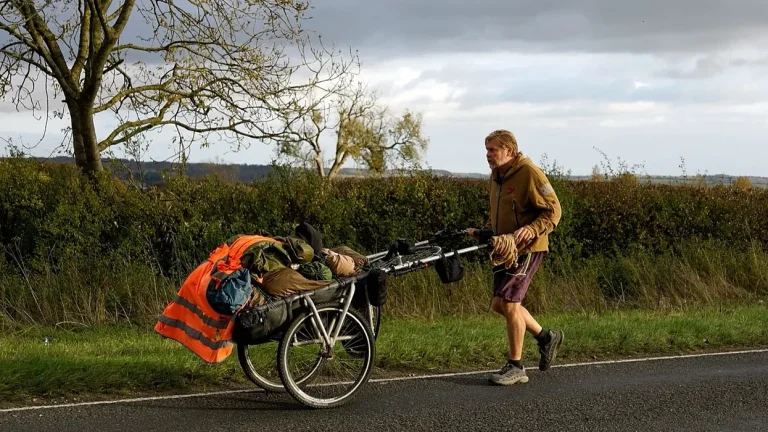
After 28 years on an extraordinary journey on foot, British adventurer Karl Bushby has returned to his hometown, completing a trek of around 50,000 kilometers from Chile, across four continents, without using any form of transport to make progress toward his destination.
The former British Army paratrooper was welcomed on Monday in the center of Hull, in northeast England, by a crowd of up to 1,000 people, who greeted him with cheers. Bushby thanked everyone who had supported him during the journey, emphasizing that the achievement was not his alone.
“I didn’t do this alone,” he said, describing the expedition as a global effort. He added that during the trek he had received help from many people in overcoming extraordinary obstacles, including difficulties with government authorities.
The day before, Bushby had also been applauded as he crossed the famous Humber Bridge, near Hull, in dense fog. From there, he continued toward the city center and then to his mother’s home.
The journey, which he has called the “Goliath Expedition,” was originally expected to take 12 years, but ultimately became a 28-year adventure. Dense jungles, scorching deserts, frozen regions and bureaucratic obstacles repeatedly slowed him down.
The idea for the expedition came in the mid-1990s, after a birthday card from his father, Keith, himself an army veteran. It mentioned a debate among special forces members about the possibility of walking from London to New York via the Bering land bridge, which, according to some scientists, was used by early humans to travel from Asia to America when sea levels were lower.
Bushby drew an uninterrupted route on a map through Europe and Asia to North America, but decided to continue even farther, to the southern tip of Chile.
“And that was it. Once the idea got into my head, there was no going back,” he said, Telegrafi reports.
To complete the mission, Bushby set two strict rules: he could not use transportation to make progress on the trek, and he had to return home on foot. He set off with just $500 and soon faced powerful winds on the Patagonian steppes.
In 2001, he managed to avoid the dangers of the conflict in the Darien Gap, a challenging, roadless area connecting South America with Central America. However, after crossing a restricted border area in Panama, he was arrested and spent 18 days in jail.
One of the most dangerous moments came in 2006, when Bushby and American adventurer Dimitry Kieffer attempted to cross the Bering Strait, a distance of around 90 kilometers. During the attempt, he fell into the icy waters and came close to losing his life, while both men risked losing all their supplies. After managing to complete this rare crossing, they were arrested in Russia for illegally entering its territory and faced deportation.
Visa problems and weather conditions meant that crossing Russia took almost ten years, as travel was possible only for a few months each year. When Moscow denied him a visa in 2012, Bushby organized a protest walk from Los Angeles to the Russian embassy in Washington, D.C. This effort ultimately helped him secure the necessary documents.
Whenever he encountered obstacles, he would temporarily retreat to the US or Mexico, where living costs were lower, and wait for an opportunity to return to the point where he had paused his journey.
While crossing China, he was followed by police, while the COVID-19 pandemic caused another lengthy interruption. One of the most unusual challenges was crossing the Caspian Sea, which he was forced to swim across for 31 days after geopolitical tensions closed his routes through Russia and Iran.
Since he is not a strong swimmer, he used a life jacket and a special suit, moving slowly through the water with a technique he called “floatimming,” a combination of swimming and floating.
Europe also presented particular difficulties, as restrictions allowing stays of only 90 days in some countries forced him to travel in three-month periods. In early October, he also swam across the English Channel to return to the United Kingdom.
“It feels good to have British soil beneath my feet again after all these years,” he said, acknowledging that the journey had not been easy at all.
Over the years, Bushby has been supported by various sponsors, who have occasionally withdrawn because of the expedition’s extended duration and financial difficulties, particularly after the 2008 economic crisis. For the past 16 years, his main support has come from a production company founded by Beau Willimon, creator of the series “House of Cards,” and music producer Jordan Tappis.
They are also supporting the making of a documentary about the journey, directed by renowned German filmmaker Werner Herzog, who has accompanied Bushby on his return home with his film crew. The feature-length documentary is titled “Walk of Life.”
However, the adventurer says the most important support throughout all these years has come from strangers, many of whom had almost nothing to offer. He recalled taking shelter in makeshift huts built from car parts, that a doctor’s family in Peru had helped him recover from a serious stomach infection, and that many people had fed him without asking for anything in return.
“I have been welcomed by the poorest of the poor. I have encountered 99.9999 percent of the best side of humanity. In every culture and every country, the response has been the same,” he said.
Hull Mayor Maria Coward said many people had followed his journey and that his perseverance, determination and courage had been an inspiration to the city.
Bushby was expected to reunite on Monday evening with his mother, Angela, his 36-year-old son, Adam, and his 12-year-old granddaughter, whom he had never met before.
In an interview with AFP in September, given from northern France, Bushby had acknowledged that returning to a more ordinary life in Britain could be a new challenge for him.
“I have to try to readjust to the adult world,” he had said.
Related

Curiosities
Jordan Blocks Telegram App After Deadly Church Attack to Prevent Extremism

Curiosities
Don’t Rely Only on Mileage: When Should You Change Your Engine Oil?
Curiosities
1979 Porsche 924 returns to the United Arab Emirates Police fleet

Curiosities
Restaurant in Canada bans children under 15, decision sparks debate
Curiosities
12 curiosities from around the world you shouldn’t miss

Curiosities
Why do mosquitoes prefer some people over others? The reason has been revealed

Curiosities
Father and son break Guinness record playing ‘Hungry Hungry Hippos’ blindfolded
Curiosities
Why Are Highway Direction Signs Green in Some Countries and Blue in Others?
Curiosities
What happens when there is a bomb threat on an aircraft?
Curiosities
NASA Searches for a Secret Underground Cave on the Moon
Curiosities
Wearing boxing gloves and a special costume, this dog became Halloween’s star
Curiosities
Considered completely extinct, rare mammal spotted again in the US





