
We are closely monitoring the rise in Russian propaganda and disinformation in the Balkans, Laurie Walker, responsible for the Western Balkans in NATO’s Political Affairs and Security Policy Division, tells Deutsche Welle. Deutsche Welle: An increase in Russian influence in the Balkans is becoming evident. Given the uncertainty surrounding the new administration […]
Walker: The Western Balkans is of strategic importance to NATO

We are closely monitoring the rise in Russian propaganda and disinformation in the Balkans, Laurie Walker, responsible for the Western Balkans in NATO’s Political Affairs and Security Policy Division, tells Deutsche Welle.
Deutsche Welle: An increase in Russian influence in the Balkans is becoming evident. Given the uncertainty surrounding the new US administration as well, how is NATO responding to this?
Laurie Walker: We see the region as being of strategic importance, but we are also very committed to ensuring that the countries of the region are able to make their own decisions without pressure. For this reason, we are concerned about the increase in propaganda and disinformation that we are seeing from the Russian side. Our approach is to address the facts in a calm and consistent manner. We are not competing with Russia in a propaganda race, but let the facts speak for themselves. However, I think it is necessary to be careful and look at the facts; sometimes Russian influence is exaggerated. If you look at Serbia, for example, statistics on Serbia’s trade with Russia show that it accounts for 8%, while trade with the European Union accounts for around 60%. We need to see things in this perspective.
What specific steps are you taking to address this growing phenomenon?
This is a growing phenomenon, but it is not entirely new. What we are doing is paying attention to what is happening in the region, and we are also politically engaged there. The Secretary General recently visited Bosnia and KFOR in Kosovo.
How does NATO view these countries in its security strategy for the region?
Let me say something about the general perspective on how NATO approaches the region. The first thing NATO does is enhance security and stability in the region, particularly through its commitment and the presence of KFOR in Kosovo. But we work with all the countries in the region in partnership and on reforms, helping them build their capacities and strengthen integration and cooperation with one another. As far as Kosovo is concerned, NATO is not involved in the recognition process; we have a neutral status and are there under UN Resolution 1244 to guarantee security for all communities there. KFOR is the third responder, after the Kosovo Police and EULEX, and we are supporting the security forces in building their capacity to make their role in ensuring security and stability in Kosovo more effective.
But in Kosovo, as in Bosnia, we are also seeing increased insecurity due to various influences and provocations. How do you respond in such cases? Let us recall the construction of the wall in Mitrovica, or the provocation involving the train.
It is important to remain calm and tone down the rhetoric, because this is in everyone’s interest—in other words, to cooperate. This is the core message NATO regularly sends: that we have a neutral status and support stability in the region. The wall is being dismantled, while the Secretary General spoke with the Serbian prime minister, (Aleksandar Vučić) during the forum in Davos about the train incident and to express his concerns; afterwards, we held another meeting as part of the Pristina-Belgrade dialogue, which we strongly support. Our message is to look further ahead and remain calm. An increase in nationalist rhetoric is in nobody’s interest.
In Montenegro, a large part of the population opposes NATO membership. Are you doing anything to secure support for NATO in this country?
I am aware that half the population is against NATO membership, and that the government was elected on a platform of NATO membership; a number of opposition parties also support NATO membership. But we recognize that this is still a matter of public debate in the country, and that the authorities and nonprofit organizations have made many efforts to engage people in a discussion about NATO membership, what it means and what benefits it brings. We have been part of this discussion.
There has been a lot of discussion in the region recently about the rise of Islamic extremism in the region…
Speaking in the context of NATO’s work, I would return to establishing the basic elements: building institutions and capacities. We are working with all the countries of the region in this regard, on training, personnel and operational capability. We have worked to destroy small arms in the region and thousands of tons of ammunition to ensure they are not misused. So we are doing a great deal together with the countries of the region.
Laurie Walker is responsible for the Western Balkans in NATO’s Political Affairs and Security Policy Division. The interview was conducted by Deutsche Welle’s Head of the Europe Department, Adelheid Feilcke.
Related
Interview
Sabedini: The Hague trial has lost credibility; I expect an acquittal for the accused
Interview
Ukrainian journalist staying in Kosovo: Serbia is helping Russia with fighters and propaganda
Interview
The Ancient Egyptian Alphabet: What Are Hieroglyphs?
Interview
Kuçi after the cameraman’s arrest: They arrest the cameraman more harshly than the woman’s murderer
Interview
Vjosa as an Instrument
Interview
The mysterious murder of Festim Lato: the “Prime Minister of the Republic of Chameria” speaks
Interview
Sejdiu: The President has no mandate to discuss border correction
Interview
Çollaku: Dialogue should bring everyone together
Interview
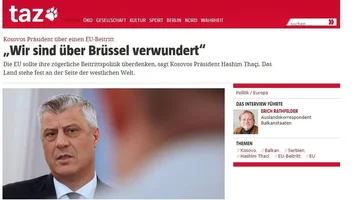
Thaçi to Tageszeitung: Anti-Western ideologies have no chance in Kosovo
Interview
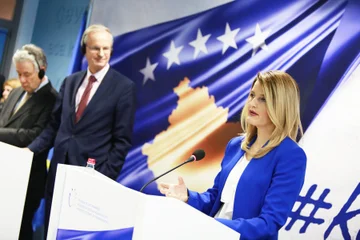
Hoxha: In 2018, we must shift into sixth gear
Interview
“Kosovo cannot progress with this political elite”
Interview
Haradinaj in Tagesspiegel: Kosovo Is Not Yet a Finished Product





