
Ancient Egypt has left us with images of towering pyramids, dusty mummies and walls covered in hieroglyphs, symbols depicting people, animals and unusual-looking objects. These ancient symbols—the ancient Egyptian alphabet—bear little resemblance to the Latin alphabet we know today. The meaning of hieroglyphs […]
The Ancient Egyptian Alphabet: What Are Hieroglyphs?
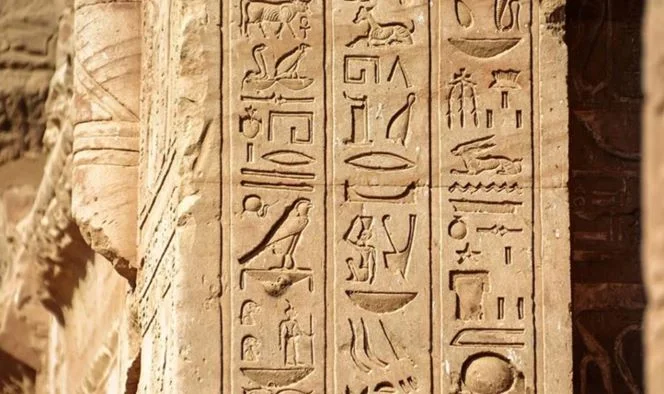
Ancient Egypt has left us with images of towering pyramids, dusty mummies and walls covered in hieroglyphs, symbols depicting people, animals and unusual-looking objects. These ancient symbols—the ancient Egyptian alphabet—bear little resemblance to the Latin alphabet we know today.
The meaning of Egyptian hieroglyphs remained somewhat mysterious until the discovery of the Rosetta Stone in 1798, after which the French scholar Jean-François Champollion was able to decipher the mysterious language. But where did one of the world’s most iconic and oldest forms of writing originate, and how do we understand it? And what is the origin of hieroglyphs?
Since 4000 BC, people have used drawn symbols to communicate. These symbols, engraved on vessels or clay tablets found along the banks of the Nile in tombs belonging to the elite, date from the time of a predynastic ruler called Nakada or “Scorpion I,” and were among the earliest forms of writing in Egypt.
However, Egypt was not the first place to communicate through writing. Mesopotamia already had a long history of using symbols, dating back to 8000 BC. While historians still debate whether or not the Egyptians got the idea of developing an alphabet from their Mesopotamian neighbors, hieroglyphs are distinctly Egyptian, reflecting the flora, fauna and images of Egyptian life.
By the beginning of Egypt’s Old and Middle Kingdoms, around 2500 BC, there were about 800 hieroglyphs. When the Greeks and Romans arrived in Egypt, more than 5,000 hieroglyphs were in use. But how do hieroglyphs work? There are 3 main types of glyphs in hieroglyphs.
First are phonetic glyphs, which include single characters that function like the letters of the English alphabet. Second are logographs, written symbols that represent a word, much like Chinese characters. And third were taxograms, which can change meaning when combined with other glyphs.
As more and more Egyptians began using hieroglyphs, 2 types of writing emerged: hieratic (priestly) and demotic (popular). Carving hieroglyphs into stone was a complex and expensive process. Thus, a need arose for a simpler, cursive form of writing.
Hieratic hieroglyphs were better suited to writing on papyrus made from reeds and ink. They were used mainly by Egyptian priests to write about religion, so much so that the Greek word that gave the alphabet its name—hieroglyphikos—means “carving of the sacred word.”
Demotic writing developed around 800 BC for use in other documents or in letter writing. It was used for 1,000 years, and was written and read from right to left, like Arabic, unlike earlier hieroglyphs, which had no spaces between them and could be read from top to bottom.
Therefore, understanding the context of hieroglyphs was very important. Hieroglyphs were still in use under Persian rule during the 6th–5th centuries BC, and after Alexander the Great conquered Egypt. Scholars think that during the Greek and Roman periods, Egyptians used hieroglyphs in an attempt to distinguish “real” Egyptians from their conquerors.
Although this may have been more a choice made by the Greek and Roman conquerors themselves, who did not learn the Egyptian language. In any case, many Greeks and Romans thought that hieroglyphs carried hidden, even magical, knowledge because of their continued use in Egyptian religious practice.
But by the 4th century AD, few Egyptians were able to read hieroglyphs. The Byzantine Emperor Theodosius I closed all non-Christian temples in 391, an act that also brought the use of hieroglyphs on monumental buildings to an end. The medieval Arab scholars Dhul-Nun al-Misri and Ibn Wahshiyya attempted to translate the symbols, which were then foreign.
But their progress was based on the mistaken belief that hieroglyphs represented ideas rather than spoken sounds. Progress in deciphering hieroglyphs came after another invasion of Egypt, this time by Napoleon Bonaparte. The Emperor’s forces, a large army accompanied by scientists and cultural experts, landed in Alexandria in July 1798.
A stone slab engraved with glyphs was discovered as part of the structure of Fort Julien, a French-occupied camp near the city of Rosetta. The surface of the stone is covered with 3 versions of a decree issued at Memphis by the Egyptian king Ptolemy V Epiphanes in 196 BC.
The texts at the top and in the middle are written in hieroglyphic and demotic forms of ancient Egyptian, while the bottom section is written in ancient Greek. Between 1822 and 1824, the French linguist Jean-François Champollion discovered that the 3 versions differed only slightly from one another. The Rosetta Stone (now in the British Museum) became the key to deciphering Egyptian writing. Despite this discovery, interpreting hieroglyphs remains a challenge even for experienced Egyptologists today.
Related

Interview
Sabedini: The Hague trial has lost credibility; I expect an acquittal for the accused

Interview
Ukrainian journalist staying in Kosovo: Serbia is helping Russia with fighters and propaganda

Interview
Kuçi after the cameraman’s arrest: They arrest the cameraman more harshly than the woman’s murderer

Interview
Vjosa as an Instrument

Interview
The mysterious murder of Festim Lato: the “Prime Minister of the Republic of Chameria” speaks

Interview
Sejdiu: The President has no mandate to discuss border correction

Interview
Çollaku: Dialogue should bring everyone together

Interview
Thaçi to Tageszeitung: Anti-Western ideologies have no chance in Kosovo

Interview
Hoxha: In 2018, we must shift into sixth gear

Interview
“Kosovo cannot progress with this political elite”

Interview
Haradinaj in Tagesspiegel: Kosovo Is Not Yet a Finished Product

Interview
A rare interview with Borges about loneliness and blindness…





